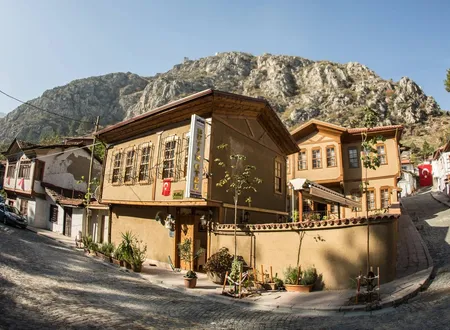
The historical identity of Amasya is bound to the narrow valley along the Yeşilırmak, the slopes below Harşena Castle and the mansions of the Ottoman era, and most of what has been written about the city's neighborhoods gathers around that core. Helvacı Neighborhood, by contrast, lies at the city's entrance from the direction of Tokat, at the mouth of the gorge between Ferhat Mountain and the Yeşilırmak, and as a residential area it belongs to recent times. Once registered as a village and later attached to the city center as a neighborhood, its streets, school, mosque and penal institution are all part of the present-day city. Yet the ground of the neighborhood carries a far older past than it first suggests: the protected open section of the Hellenistic-era Ferhat Water Canal, the Çağlayan (Çalan) Bridge attributed to the Danishmendid period, and the memory of the Helvacı Spring built in the seventeenth century all lie within these boundaries or just beside them. The neighborhood's name most probably derives from that spring and from the nickname of the family that built it, although no document makes the connection with certainty.
Location and Administrative History
Helvacı stretches along the Amasya-Tokat highway at the southwestern edge of the provincial center. According to the penal institution located in the neighborhood, the facility stands on the Tokat road, in Helvacı Neighborhood, about 7 kilometers from the city center as measured from the courthouse. Here the Yeşilırmak narrows between Ferhat Mountain (formerly Fon or Pont) and Karaman (Kelkis) Mountain opposite it; Hüsameddin calls this narrow passage the "cenûb boğazı", the city's southern gorge, gives its length as about four kilometers and writes that the stretch known as Ferhad Arası ends at Çalan Bridge. The architects who studied the Ferhat Water Canal, on the other hand, describe the same place as the western entrance to the town; because of the bend of the valley, the compass directions vary from source to source. Current map data show street names in the neighborhood such as Akça Sokak, Bülbül Sokak, Piri Reis Sokak and Turgut Reis Sokak. Streets named after seafarers suggest that the neighborhood was named in recent times, though no record has been found to confirm this.
The clearest information on Helvacı's administrative history comes from the study by Bekir Başalan on settlements in Amasya whose names were changed. Comparing the village and administrative-division lists published by the Ministry of the Interior from 1928 to 2024, Başalan counts, alongside the 100 villages attached to the Central District, the settlements later converted into neighborhoods: Boğazköy, Fındıklı, Helvacı, Karasenir, Orman Bağları, Saraycık, Yazı Bağları, Yeniköy and Yeşilyenice. The absence of Helvacı from his table of renamed places shows that the settlement has borne the same name since it was registered as a village. The year in which the village became a neighborhood is not stated in that study and could not be established from any other source. In Amasya Hâtıraları, Osman Fevzi Olcay's account of Amasya in the first half of the twentieth century, "Helvacı" appears as the name of a district: describing Yörgüç Paşa Neighborhood, the author speaks of the area that follows the city's "road to Helvacı and Hacılar Meydanı", and in the chapter on vineyards Helvacı Bağları (the Helvacı Vineyards) has a heading of its own. This suggests that the name was an established place name for the vineyard country on the Tokat side of the city long before it became a neighborhood.
The Origin of the Name and the Helvacı Spring
In Turkish, "helvacı" means a person who makes or sells helva (halva), and in Ottoman towns names of trades often turned into place names. The trade certainly existed in Amasya: Hüsameddin introduces Hâfız Âsım Mustafa Efendi, born in 1287 (1870-71), as "the son of Hasan Ağa, one of the helva makers of Amasya". Even so, there is no record linking the neighborhood's name directly to the helva makers' guild. What Hüsameddin's Amasya Tarihi does describe in detail is a fountain called the "Helvacı Spring" at the mouth of the gorge where the neighborhood lies. According to his account, the southern foot of Ferhad Rock is called Helvacı Pınarı and its northern foot Veng, both of them on the highway; the Helvacı Spring is at the eastern end of the gorge. The spring took its name from the fountain built there by Helvacı Mehmed Ağa, a former deputy governor (mütesellim) of Amasya who died in 1064 (1653-54). In the same stretch there was a second fountain, the "Bey Pınarı", built in 1164 (1750-51) by el-Hâc Osman Bey, a former sanjak governor in Egypt; Hüsameddin writes that both were in ruins in his own day.
The site of the spring and the location of the present neighborhood point to the same stretch, the mouth of the gorge on the Tokat side of the city. For that reason it is a strong possibility that the neighborhood's name comes from this fountain, and so from the nickname of Helvacı Mehmed Ağa. No source, however, states plainly whether the spring lies within today's neighborhood boundaries or whether it gave the neighborhood its name, and no reliable information could be found on whether the fountain still stands. The link between them therefore cannot be counted as a fact proven by documents and should be recorded as a possibility.
Helvacı Mehmed Ağa
Helvacı Mehmed Ağa, who built the spring, was among the notables of Amasya in the middle of the seventeenth century. Listing the notables (âyân) of Amasya in 1055 (1645-46), Hüsameddin names "Helvacı Mehmed Ağa and his brother Deli Yûsuf Ağa" together with Hoca Ahmed Paşa, Hacı Kerîm Paşazâde Hüseyin Bey and Kara Kadızâde Mehmed Ağa. As one of the renowned cavalrymen (sipahi) who distinguished themselves in the years of the Cretan War, he became trustee of the imperial endowments in Amasya in Shawwal 1058 (October-November 1648), and in Safar 1061 (January-February 1651), when the deputy governor Sefer Ağa was charged with forwarding military provisions, he served as the city's kethüdâyeri. Hüsameddin also records that in 1063 (1652-53) he had the wooden Mağdinus Bridge in the town repaired. Mehmed Ağa's descendants were known as the Helvacızâde: Hüsameddin presents Helvacızâde el-Hâc Ahmed Efendi bin Mehmed Ağa, evidently his son, as a scholar who taught in madrasas and often preached at the Gümüşlüzâde Mosque, and writes that he died in 1133 (1720-21). Helvacızâde Şükrü Ahmed Efendi, introduced in the same work as "the son of the sipahi Hasan Ağa, a descendant of Helvacı Mehmed Ağa, builder of the Helvacı Spring in Amasya", served as estate officer (kassâm) of Amasya and as judge in small towns, sat on the council of notables, and died around 1147 (1734-35) as a poet and scribe.
The Later History of the Spring
After Mehmed Ağa, the Helvacı Spring continued to attract the attention of the city's benefactors. Hüsameddin relates that Uncu el-Hâc İbrâhim Ağa, who had grown rich in the flour trade and, after returning from the pilgrimage, became a member of the pilgrims' council, endowed in 1203 (1788-89) seven shops in all, inside the Pabuççular market, beneath the Serdar Han and on the opposite side, together with a sum of money. One share of the endowment's income was assigned to the repair of "the Helvacı spring built by Helvacı Mehmed Ağa at the head of the southern gorge, and its roads", and another to the preacher and staff of the Fethiye Mosque in İbrâhim Ağa's own neighborhood. The administration of the endowment was left to his son-in-law Bakırcı es-Seyyid Sa'deddîn Efendi, and İbrâhim Ağa died in 1210 (1795-96). In the geographical part of his work, however, Hüsameddin writes that el-Hâc İbrâhim Ağa repaired the spring in 1210, made its water flow again and endowed several shops. This difference between the date of the endowment and the date of the repair comes from two separate places in the same work; the repair may well have been completed in the years after the endowment was founded.
Because the area in front of the spring was the point where the road from Tokat entered Amasya, it was at times the scene of violent events. According to Hüsameddin, Zaralızâde Mehmed Paşa, who as governor of Sivas had spent a large sum collected from Amasya on his own affairs, set about collecting the same tax a second time from the people when he became governor of the Amasya sanjak in 1166 (1752-53). The townspeople and the Janissaries, who had paid their taxes in full, resolved to close the gorges and keep the pasha out of the city. The Sublime Porte had found the complaints justified and dismissed Mehmed Paşa, but the pasha, unaware of this, had already come as far as the gorge. "A rather serious struggle" broke out in front of the Helvacı Spring between the armed townspeople and the pasha's men; several of the pasha's men were killed and some of the people of Amasya were wounded. When the notables intervened and the decree of dismissal arrived and was delivered, Mehmed Paşa turned back to Sivas.
Hüsameddin also uses the name of the Helvacı Spring in his accounts of the Turkish capture of Amasya. In his rendering, based on the Târîh-i Âl-i Dânişmend, when Melik Ahmed Dânişmend Gâzi besieged Amasya around 467 (1074-75), it was decided that the emir Ferhâd Gâzi should set out "from in front of the Helvâcı Spring", cross Fon Mountain and descend on the city from the south; Ferhâd Gâzi fell in this operation and was buried on the mountain. The author connects the name of Ferhat Mountain with this Danishmendid emir rather than with the legendary lover Ferhad. Elsewhere in the conquest narrative it is written that Emir Ahmed Gâzi held the right bank of the river from the south, "that is, the Helvâcı Spring side", while İltigin Gâzi held the western side of Çalan Bridge. In these accounts the name of the spring is borrowed from the geography of Hüsameddin's own day to describe events of the eleventh century; since the fountain was built in the seventeenth century, the name was of course not in use when the events took place. In a footnote, Hüsameddin also proposes that the expression "Derb-i Harşene", the Harşena pass, which appears in accounts of the Umayyad raids of the eighth century, must refer to the areas of "Derbend Önü" and the "Helvâcı Spring". This identification is the author's own interpretation.
Amasya Families Bearing the Name Helvacı
In Amasya the nickname "Helvacı" did not belong to a single family. Besides the Helvacızâde descended from Helvacı Mehmed Ağa, the Helvacıoğulları, one of the most powerful notable families of the city in the eighteenth century, bore the same name, and their nickname came from service in the palace. In Topkapı Palace, the helvahâne attached to the imperial kitchen (matbah-ı âmire) was a unit where, besides sherbets, jams, helva and pastes, medicines too were prepared; in the second half of the sixteenth century eighteen helva makers worked there, while in the first half of the seventeenth century the number of staff had risen to between eighty-five and ninety. Several young men from Amasya rose through this unit. According to Hüsameddin, İbrâhim Ağa, son of the sipahi Hasan Ağa, entered the Enderun as a child and was trained in the palace helvahâne, became steward of the helva makers in 1093 (1682) and chief helva maker in 1096 (1685), and in 1099 (1687), after the accession of Süleyman II, was dismissed and sent back to Amasya. His line was known in Amasya as the Serçeoğulları.
The great ancestor of the Helvacıoğulları, el-Hâc İsmâil Ağa, was the son of Mehmed bin Hasan of the Gökmedrese Neighborhood. As a young man he entered the Enderun and was taken on as an apprentice in the privy helvahâne, rose there to become steward of the helva makers, but, having offended the chief helva maker İbrâhim Ağa, was given a sipahi fief and sent to Amasya in 1115 (1703). Son-in-law of Müezzinbaşızâde el-Hâc Abdî Ağa, one of the notables of Amasya, İsmâil Ağa advanced through the valor he showed in the Battle of the Prut in 1711, and served several times as kethüdâyeri of Amasya, as deputy governor of Amasya in 1124 (1712), then as voivode of Zile and Tokat, voivode of Merzifon and superintendent of the treasury (beytülmal) of Amasya. In 1139 (1726-27) he took the administration of the sanjak into his own hands as chief notable, and in 1141 (1728) he took on the collection of the poll tax for the entire province of Sivas. When his rivalry with Gürcüzâde el-Hâc İbrâhim Bey turned into a bloody clash, the governor of Anatolia, Köprülüzâde Abdullah Paşa, came to Amasya to investigate, and the notables involved were sent into exile. İsmâil Ağa's place of exile is given in one place in Hüsameddin's work as Diyarbekir and in the annals section as Ankara. After he was pardoned, he joined the Persian campaign in 1145 (1732) with the volunteers he had gathered and died in that war; the year of his death, too, is given differently in two places in the work, as 1146 and 1147.
İsmâil Ağa's sons Mehmed, Abdüllatîf and Hasan Ağa and their descendants were called the Helvacıoğulları. His son Abdî Ağa entered the Janissary corps, rose to standard-bearer in the wars against Nadir Shah, became serdar of Amasya in 1152 (1739), held the post several times and was honored with the rank of turnacıbaşı for his service in the Russian wars; he died around 1191 (1777). His grandson Haseki el-Hâc İsmâil Ağa was trained in the Corps of Gardeners (Bostancı) in Istanbul and became a haseki, was sent to Amasya in 1188 (1774) and died around 1210. The family's twentieth-century representative, Helvacızâde Hasan Şevkî Efendi, was a close friend of Hüsameddin. Born in 1289 (1872-73) in the Hacı Hamza Neighborhood, Şevkî Efendi studied with Hüsameddin at the rüşdiye school, and at night the two worked together in the upper room of the fatwa office beside the Abdullatif Efendi Library. Şevkî Efendi became clerk of records and then chief clerk of the Islamic court, clerk of the estate office in 1341 (1922-23), retired when the Civil Code came into force, took up the grain trade and died at the beginning of 1352 (1933). Hüsameddin calls him "a loyal brother of mine" and writes that he saw some of the genealogies and endowment deeds used in his work in Şevkî Efendi's hands.
Hüsameddin's records also include a sheikh bearing the same name. Türkmenzâde Sheikh Abdullah Efendi, grandson of Türkmenoğlu Abdullah Ağa, the serdar of Amasya who was put to death after the abolition of the Janissary corps in 1241 (1826), was a Naqshbandi sheikh known in Amasya as the "Helvâcı Şeyh", and he died in Shawwal 1323 (December 1905). Olcay, describing the Mahkeme Çarşısı, likewise mentions a coffeehouse belonging to "Hakkı Efendi, the Helvacı Sheikh". There is no information that these persons had any connection with Helvacı Neighborhood; they are worth mentioning for showing how common a nickname the name was in the city.
The Ferhat Water Canal
The oldest structure within the neighborhood's boundaries is the Ferhat Water Canal, registered in the Ministry of Culture and Tourism's inventory under the address "Helvacı Neighborhood, Ferhat Arası locality". According to the inventory, the canal was made in the Late Hellenistic and Early Roman period by carving into the edge of the bedrock, to meet the water needs of the ancient settlement on the south bank of the Yeşilırmak; its date of construction is given as the first century BC. About 20-25 kilometers long, the canal begins at the spring in the Kırkgöz locality of Meşeli Çiftliği village in the Central District, runs underground in places in vaulted sections and ends in the Mehmet Paşa Neighborhood in the town. Hüsameddin had described the same waterway as an eighteen-kilometer canal that started in front of the "Şâhin Rock", passed Ferhad Arası and Memi Dede, wound through the Gökmedrese, Şâmîce, Receb, Çeribaşı and Mehmed Paşa neighborhoods and ended at the Kibrithane in the Bayezid Neighborhood. Popular belief holds that the canal was dug by Ferhad, the lover of Şirin; the Amasya historian Kara Müftüzâde Mustafa Vâzıh Efendi had also accepted this view. Hüsameddin, by contrast, argues that the canal was a very ancient waterway and that the name Ferhad came from the Danishmendid emir buried on the mountain.
Most of the roughly six-kilometer section running from the level of the penal institution in Helvacı to the Kibrithane, the old industrial quarter in the east of the town, now passes as a tunnel beneath the city. The section of about 675 meters that curves along the foot of Ferhat Mountain, parallel to the Amasya-Tokat highway, lies above ground and was registered as a monument on 25 September 1975. In 1997, on the initiative of the Amasya Governorate, the Amasya Municipality and the Amasya Museum, Gediz Urak and Işık Aksulu of Gazi University were commissioned to prepare a conservation and landscaping project for this section, and a team led by the museum director Ahmet Yüce carried out cleaning and excavation work lasting thirty working days. It was recorded that the canal then ran behind a lime kiln, a car service station and a sand-sieving plant. The work showed that the canal was 87-94 centimeters wide in its rock-cut sections, was covered with rubble-stone vaults where it crossed streambeds, and was plastered inside with Horasan mortar. Diagonal chisel marks two centimeters deep on the canal walls show that the rock was cut with metal chisels struck by hand.
The excavation yielded eleventh- and twelfth-century terracotta vessels from the fill inside the vault, an apse built of rubble stone on the outer face of the canal with remains of colored mosaic on its floor, and an arrowhead probably of the Early Roman period. Urak and Aksulu suggest that the canal's construction technique resembles that of the royal rock tombs of Amasya dated to the second century BC, that the canal was most probably built in the Hellenistic period, was repaired in the third century AD, and lost its function in the late Byzantine period, in the twelfth century, when settlements grew up around it. A survey of the vegetation also identified the yellow-flowered Sideritis amasiaca, a species native to the region, around the canal. In the article they published in 2006, the researchers noted that the project had not yet been implemented and proposed that the canal be laid out as a rest and recreation area at the entrance to the town from the Tokat direction. No information from after that date could be found on its present state of conservation.
Çağlayan (Çalan) Bridge
The neighborhood's other historic structure is the Çağlayan Bridge over the Yeşilırmak. According to current descriptions, the bridge stands 5-6 kilometers from the city center on the Tokat highway, at the turn-off for the 15th Infantry Training Brigade Command and at the Eryatağı junction of Helvacı Neighborhood. About 70 meters long, the bridge rests on six round arches; its piers are of cut stone, its arches of brick, and on the western side of the piers there are triangular cutwaters. Its date and builder are not known for certain. According to the general view it was built by the Danishmendid emir İltekin Gazi in 1075 or 1076, while some sources attribute it to İltekin's son Hüsâmüddevle Hasan and to the twelfth century.
Hüsameddin refers to the bridge as "Çalan Köprü", writes that it stands at the end of the southern gorge, that is, of Ferhad Arası, and notes that it is recorded in old documents as the "İltekin Bridge". According to him, its foundations, deck and sides are of stone and its arches and piers of red brick; because there is a small, square, room-like projection in the middle of its southern face, it took the name "Çalak" or "Çalan" from the word "çalak", meaning projecting. The prevailing view today, however, is that the name derives from a word meaning "cascade" (çağlayan). The mention in current descriptions of an angular projection on the western side of the central pier may refer to the same feature as the room-like projection Hüsameddin describes. In the conquest narrative he relates, İltigin Gâzi holds the western side of Çalan Bridge and Emir Ahmed Gâzi the Helvacı Spring side, which shows that these two place names were used together for centuries to describe the same mouth of the gorge. In Hüsameddin's time the vineyards around Çalan Bridge were likewise known as the continuation of the Ferhad Arası vineyards on the south bank of the river.
The Penal Institution
The institution that has most shaped Helvacı's recent history is the Amasya E-Type Closed Penal Institution, in service since 1969. According to the institution's official description, buildings occupy 8,420 square meters of a total plot of 82,040 square meters, and 73,620 square meters are set aside as a safety and security zone. Built of reinforced concrete to the standard E-type plan, the institution consists of five blocks, A to E, and has a capacity of 732 in 54 rooms. By a circular of the Ministry of Justice's General Directorate of Prisons and Detention Houses dated 27 June 2005, part of it was converted into a high-security penal institution. The institution has no perimeter wall; it houses tailoring, bookbinding and shoe-repair workshops, a canteen, a library, classrooms and a small mosque, three staff residences adjoin the administrative section in Block A, and part of that block is allocated to a gendarmerie post. In the study of the Ferhat Water Canal, too, the starting point of the canal's section beneath the city is given as the level of the prison in Helvacı.
Şehitler Mosque
Among the new buildings associated with the neighborhood is Şehitler Mosque (the Martyrs' Mosque); map data give its address as Babaküstü Sokak. According to the description by the firm that prepared its architectural design, the mosque has a footprint of 700 square meters, can hold about a thousand worshippers at once on its basement, ground and gallery floors, and took the Ortaköy (Büyük Mecidiye) Mosque in Istanbul as its model. The dome and flat surfaces are clad in lead, and Ünye stone was used on the façade, the door and window frames and the balustrades. The engineering firm that prepared the structural design describes the building as the largest mosque in Amasya, mentions two minarets 40 meters high, domes modeled as shells and a coffered floor system, and lists the project under the year 2017. Since the year of construction is left blank in the architectural firm's description, no exact opening date can be given.
There is a margin of contradiction here. In the Amasya Governorate's announcement, the foundation-laying ceremony of Şehitler Mosque is described as that of a building under construction in Bahçeleriçi Neighborhood in the Central District; the ceremony also stressed its resemblance to the Ortaköy Mosque. Since the architectural descriptions match, it is likely to be the same mosque, but because the neighborhood is named differently, it could not be determined whether the mosque stands on the boundary between Helvacı and Bahçeleriçi, whether the address changed, or whether two separate buildings are meant. In any case the building is a recently built mosque that belongs to the neighborhood's present-day fabric.
Population and Change
According to TÜİK's address-based population records, the population of Helvacı Neighborhood has developed as follows:
- 2012: 1,938
- 2013: 2,036
- 2014: 1,996
- 2015: 1,919
- 2016: 2,116
- 2017: 2,293
- 2018: 2,312
- 2019: 2,639
The figures separate two distinct periods. Having risen to 2,036 in 2013, the population declined slightly until 2015, falling to 1,919, and then grew every year to reach 2,639 in 2019. The increase between 2012 and 2019 is 701 people, or about 36 percent; the 720 people added in the four years after 2015 alone correspond to about 37.5 percent of that year's population. For comparison, in 2019 Beyazıtpaşa Neighborhood in the Central District had 2,796 residents and İhsaniye Neighborhood 2,364; Helvacı falls within the same size band as these neighborhoods. In the summary of another compilation, figures of 1,905 for 2008 and 2,921 for 2025 were seen; since they could not be verified directly, these two values are mentioned only as an indication. The presence within the neighborhood of a penal institution with a capacity of 732 may have affected the figures in the address-based records, but no data could be found showing how convicts and detainees are reflected in these counts. Nor is there any sourced explanation of whether the population growth stems from new housing or from migration from surrounding neighborhoods.
Daily Life and Current Issues
Mehmetçik Primary School and a flour products factory are recorded within the neighborhood's boundaries; the accuracy of this list, which is based on current map data, is not otherwise guaranteed. The fact that the Tokat highway cuts through the neighborhood from end to end is one of the most discussed issues of daily life. At the junction known in the neighborhood as Tugay Kavşağı (Brigade Junction), beside which there is a pedestrian overpass, a 62-year-old retired prison guard was struck and killed by a car in October 2025 while trying to cross the road. According to the local press report, the neighborhood headman (muhtar) Ahmet Köseoğlu said that there was only a warning light at the junction and that most people did not use the overpass, called for a signal system with red, amber and green lights, and recalled that a meeting on the matter had been held at the Amasya Governorate two days before the accident, attended by Governor Önder Bakan and Mayor Turgay Sevindi. Residents of the neighborhood also said they felt uneasy every time they crossed the junction.
The neighborhood has also entered the national news through a painful event. The family home of İdris Bolat, a 23-year-old special operations police officer killed in an operation in the Yüksekova district of Hakkâri in March 2016, was in Helvacı Neighborhood. According to the press report, when the police officers, the provincial mufti and a provincial director who came to break the news found no one at home, the neighborhood headman of the time, Salim Kelek, fetched the father from the city center in his own car, and the news was given in front of the house. The same report states that Bolat had been named after his uncle, who was killed in Diyarbakır in 1992.
Where the Records Fall Silent
A search through Hüsameddin's Amasya Tarihi has shown that the name Helvacı has been associated with the mouth of the gorge on the Tokat side of the city since at least the middle of the seventeenth century, carrying the name of a spring there and of the family that built it. On the other hand, when Helvacı was founded as a village, whether it appears as a separate settlement in the Ottoman tax registers, in what year it was converted from a village into a neighborhood, and where the Helvacı Spring lies today could not be determined from open sources. The chapter on the Helvacı Vineyards in Olcay's work could not be read for this study either. The material that could fill these gaps lies in the Islamic court registers of Amasya, the tax and endowment registers, the records of the Republican-era village law and the municipality's zoning archive.
Chronology
2nd-1st century BC: Date range proposed for the construction of the Ferhat Water Canal (Hellenistic-Early Roman period).
1074-1076: The area of the Helvacı Spring and Çalan Bridge in the Danishmendid conquest narrative related by Hüsameddin; the date of construction of the bridge attributed to İltekin Gazi.
1645-46: Helvacı Mehmed Ağa and his brother Deli Yûsuf Ağa are named among the notables of Amasya.
1648: Helvacı Mehmed Ağa becomes trustee of the imperial endowments.
1651: Helvacı Mehmed Ağa is kethüdâyeri of Amasya.
1653-54: Death of Helvacı Mehmed Ağa, builder of the Helvacı Spring.
1703: El-Hâc İsmâil Ağa, trained in the palace helvahâne, is sent to Amasya; beginning of the Helvacıoğulları family.
1750-51: The Bey Pınarı fountain is built in Ferhad Arası.
1752-53: Clash in front of the Helvacı Spring between the townspeople and the men of Zaralızâde Mehmed Paşa.
1788-89: Uncu el-Hâc İbrâhim Ağa founds an endowment for the repair of the Helvacı Spring and its roads.
1795-96: According to Hüsameddin, the spring is repaired; death of İbrâhim Ağa.
1969: The Amasya E-Type Closed Penal Institution opens in Helvacı.
25 September 1975: The open section of the Ferhat Water Canal is registered as a monument.
1997: Cleaning and excavation work on the Ferhat Water Canal and preparation of the conservation project.
27 June 2005: Part of the penal institution is converted into a high-security facility.
2012-2019: The neighborhood's population rises from 1,938 to 2,639.
2017: Year under which the structural design of Şehitler Mosque is listed.
October 2025: After the fatal accident at Tugay Kavşağı, residents call for traffic signals.
Bibliography
Primary sources
- Hüseyin Hüsâmeddîn Yasar, Amasya Tarihi (Amasya Municipality, 2022), vols. 1-4, pp. 76 (the gorges), 87 (Ferhad Rock and the Helvacı Spring), 104 (bridges), 294 and 314 (Derb-i Harşene, conquest narrative), 570-576 (Helvacı Mehmed Ağa), 631-647 (Helvacı İsmâil Ağa), 652-654 (events of 1166)
- Hüseyin Hüsâmeddîn Yasar, Amasya Tarihi, vols. 6-8, pp. 46 (Serçe İbrâhim Ağa), 66 (endowment of Uncu el-Hâc İbrâhim Ağa), 191 (Helvacızâde Ahmed Efendi), 313 (Helvacı el-Hâc İsmâil Ağa), 322
- Hüseyin Hüsâmeddîn Yasar, Amasya Tarihi, vols. 9-12, pp. 312 (Helvâcı Şeyh), 400 (Helvacızâde Şükrü Ahmed Efendi), 413 (Helvacızâde Şevkî Hasan Efendi), 479 (Helvâcızâde Âsım Mustafa Efendi), 575, 596 (Helvacıoğlu Abdî Ağa)
- Osman Fevzi Olcay, Amasya Hâtıraları: Bildiklerim, Gördüklerim, İşittiklerim ile Amasya, simplified by Turan Böcekçi and Mehmet H. Seçkiner, Amasya Municipality Cultural Publications, 2009 (passages on Yörgüç Paşa Neighborhood and the Mahkeme Çarşısı; table of contents of the vineyards chapter) amasya.bel.tr
Academic studies
- Bekir Başalan, "Amasya İlinde İsimleri Değiştirilen Yerleşim Yeri Adları Üzerine Bir İnceleme", Folklor Akademi Dergisi, 7/3 (2024), pp. 1382-1391
- Gediz Urak and Işık Aksulu, "Documentation for Preservation of the Ferhat Water Canal in Amasya", METU Journal of the Faculty of Architecture, 23/2 (2006), pp. 93-112
Official sources
Other sources
- Arif Bilgin, "Matbah-ı Âmire", TDV İslâm Ansiklopedisi, vol. 28, Ankara 2003, pp. 115-119
- Amasya E-Type Closed Penal Institution, "Kurum Tanıtımı" (institutional description)
- nufusu.com, "Merkez (Amasya) Mahalleleri Nüfusu" (TÜİK/ADNKS data, 2012-2019)
- Haritamap.com, "Helvacı Mahallesi Nerede Harita - Merkez Amasya"
- Kavis Yapı Architecture, "Amasya Şehitler Camii" project page
- Uska Engineering, "Amasya Şehitler Cami" project page
- Amasya Governorate, announcement of the Şehitler Mosque foundation-laying ceremony
- Yeni Birlik, "Amasya'da trajedi: Yardımsever adam feci şekilde can verdi", 18 October 2025
- Memurlar.net, "Yüksekova'daki operasyonda bir polis şehit düştü", 31 March 2016
Online sources