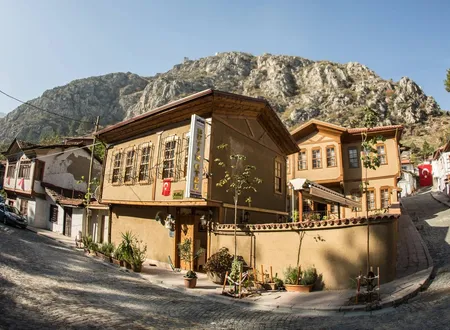
Akbilek, counted today among the most populous neighborhoods of Amasya's central district, lies outside the city's old core along the Yeşilırmak, in the former belt of vineyards that leans against the eastern foot of Karaman Dağı, on the newer residential axis. The neighborhood takes its name not from a tree, a gate or a bridge but from the nickname of a scholar who has been remembered for centuries as the "Akbilek Saint." This scholar was Molla Bahşî Halife, who taught in Amasya in the early sixteenth century, preached from the pulpit and was known for his memory of Qur'anic exegesis. His nickname passed first to the vineyard where his grave lay, and then to the neighborhood that grew up when that vineyard was divided into plots. Because open-access documentation on the administrative history of the neighborhood itself is limited, documented information and information resting on hagiographic tradition are kept apart below.
Origin of the Name
Akbilek was the nickname given to Bahşî Halife in Amasya. Some compiled sources also call the same figure "Dede Bahşi bin İbrahim" or "Akbilek Bahşi Halife bin İbrahim"; Hüsameddin Yasar, however, gives his father's name as Ya'kûb bin Ahmed and records that the scholar signed himself "Bahşî bin Ya'kûb el-Ahmerî." Two accounts circulate to explain the nickname. According to the first, recorded in Amasya Tarihi, the scholar was known as Akbilek because a band of whiteness encircled his wrist. This explanation rests on a plain bodily mark; a nickname arising from such a distinguishing feature is a common occurrence in Ottoman towns.
The second, widespread among the local people, is a hagiographic tale (menkıbe). In it, Bahşî Halife was speaking in a sermon about the virtue of ritual ablution and said that the limbs washed in ablution would shine like light in the hereafter. As some of his listeners silently wondered how this could be, the scholar opened his arms, and the places he had washed lit up with light. After this, the congregation called him Akbilek, "white wrist." The tale should be read not as a historical event but as the way local religious tradition explains the nickname. What the two accounts share is that the words "ak" and "bilek" became the name first of a person, then of the vineyard where he was buried, and finally of today's neighborhood.
Hüsameddin describes the passing of the name to the vineyard in two places, and the two descriptions differ slightly. In the geographical section of the work, he writes that the places on the eastern slopes of Karaman Dağı falling south of the Şeyh Cûî locality were called Akbilek, and that because Molla Bahşî Halife was buried south of the vineyards, the area became known by this name from the Hijri year 931 (1524-25). In the volume of biographies, however, he states that the same vineyards were formerly known as the "Hekim Bağları" (the Physician's Vineyards) and only later took the name Akbilek Vineyards. The name, in other words, was not given to empty land; it settled over a vineyard that already had an older name. No definitive document has been found showing when the neighborhood entered official records under the name Akbilek or by what administrative arrangement it was created; for this reason no date is given for the neighborhood's name.
From the Physician's Vineyards to the Akbilek Vineyards
The vineyard's older name leads back to the medical circle of fifteenth-century Amasya. According to the biography Hüsameddin wrote of the physician Hacı İlyas Çelebi, the vineyards known today as the Akbilek Vineyards were this physician's property and appear in the endowment deed of Yörgüç Paşa as the "Hekim Bahçesi" (the Physician's Garden). Hacı İlyas Çelebi, who bore the honorific Şücaeddin, learned medicine from Burhaneddin Ahmed Çelebi, physician to Hacı Şadgeldi Paşa, ruler of Amasya; he served as chief physician in Amasya to Sultan Mehmed I (Çelebi Mehmed) and to his son Prince Murad, and worked as a physician at the hospital (darüşşifa). The quarter west of the Sultan Bayezid Mosque is also recorded as having been named after him. Yörgüç Paşa bought this garden from the physician's son Alâeddin Ali Çelebi and endowed it as a pious endowment (waqf) in the Hijri year 840 (1436-37).
This record shows that the name Akbilek settled over a known property with an identifiable owner. Hüsameddin also writes, however, that Bahşî Halife made his living from the produce of his field around what became his grave and of his vineyards in the locality called the Akbilek Vineyards. A garden endowed in 1436-37 on one side, and on the other a scholar owning vineyards in the same locality about a century later, may at first sight seem contradictory. Hüsameddin's remark in the geographical section that this area is thought to have been a large walled vineyard that was later divided suggests that the two pieces of information may concern different parts of the same broad estate; but this is an inference, and no document showing a change of ownership has been found.
The same geographical section also describes Akbilek's neighbors. The Akbilek Vineyards are a rectangular area stretching from north to south, south of the Şeyh Cûî Vineyards. The vineyards and slopes above the Akbilek quarter, on the eastern skirts of Karaman Dağı, are called "İltekin." Hüsameddin connects this name to İltekin Gazi, whom he describes as one of the Danishmendid emirs and a Khwarazmian Turkmen: because the emir entered Amasya from this side during the conquest, destroyed Kelkis Castle and was later buried here, these slopes, he says, have appeared in official records under the name İltekin since the Hijri year 567 (1171-72). In Osman Fevzi Olcay's memoirs, too, the Akbilek Vineyards, the Şeyh Cui Vineyards and the "Alp Tekin Vineyards" are names of Amasya vineyards listed side by side. The fact that one of the neighborhood's main roads today bears the name Alptekin Caddesi may be related to this old vineyard name; but since no official record showing the origin of the street name has been found, this connection can be offered only as an inference.
A stanza from a poem in Hüsameddin's work describing the western mountains and vineyards of Amasya also captures this landscape:
Mağrib tarafı kûh-ı refî'-i Karamânî
Olmuş eteği Akbilek'e cây-ı emânî
Tefsîr ile takvâda alem pîr-i zamânî
These lines, which say that the skirts of the lofty Karaman Dağı to the west have become a safe dwelling for Akbilek, where there lies a master of the age renowned for exegesis and piety, show that even at the beginning of the twentieth century the name evoked both a quarter and a grave at the same time.
Molla Bahşî Halife
What is known of Bahşî Halife's life rests on several compilations and studies, which differ in minor details. His birthplace heads the list. Compiled sources show him as born in Uluköy, attached to Taşova, while an academic article on the Halvetî lodges states that he was born in the village of Kızılca in Amasya. Hüsameddin also points to Kızılca and derives his reasoning from the scholar's own signature: the nisba "Ahmerî" means "of Kızılca" (literally "the red one"). The Turkish translation of the Şakâ'ik by Mecdî Mehmed Efendi of Edirne states that Bahşî Halife was born in a village belonging to Amasya; Hüsameddin says this village was Kızılca, two hours' distance from the city.
The same source also corrects a confusion. Kâtib Çelebi, in his biographical work Süllemü'l-vüsûl, refers to him as "Bahşî Halîfe es-Sonisavî," that is, as a native of Sonisa. According to Hüsameddin, the Bahşî Halife from Sonisa was not this man but another Bahşî Halife, the father of Kemaleddin İbrahim Dede Cönkî Efendi. The confusion of two contemporary scholars bearing the same name helps in understanding why differences over the birthplace, such as Uluköy and Kızılca, may have arisen; this last point, however, is an inference not explicitly stated in the sources.
The course of study Hüsameddin gives is quite detailed. After memorizing the Qur'an in Amasya, Bahşî Halife studied the Arabic sciences, legal methodology and theology under Mevlânâ Şemseddin Ahmed Cündî and the madrasa teacher Abdî Efendi, and then went to Istanbul. There he completed his education under leading scholars of the day such as Molla Muslihuddin Kestellî, Hatibzâde Muhyiddin and Efdalzâde Hamidüddin Efendi, then moved on to Aleppo, where he studied hadith with Ebû Zer el-Buhârî. In Egypt he studied with Judge Zakariyyâ al-Ansârî and Jalâl al-Dîn al-Suyûtî, and in the Hejaz, at Mecca, he received the Six Books of hadith by audition from Shams al-Dîn Muhammad al-Sakhâwî, reading many works of exegesis before returning home. The compiled sources and the article on the Halvetî lodges also name Suyûtî, Ansârî and Sakhâwî; only the article links this period of study to the Hejaz.
Returning to Amasya, Bahşî Halife taught exegesis, hadith and jurisprudence there, according to the compiled sources, for nearly forty years. Hüsameddin writes that, content with little, he devoted himself to preaching, teaching and conversation, and for a time served as the pulpit preacher (kürsü şeyhi) of the Sultan Bayezid Mosque. It is reported that he knew most of the legal texts, the Qur'an commentary of Baydâwî and the greater part of the hadith collections by heart, and that he delivered his lessons from memory, without a book, in the manner of the Arab scholars. Both the compiled sources and Hüsameddin state that he was the teacher of Ibn Kemal, the Şeyhülislam Kemalpaşazâde, known as "Müftü's-sekaleyn" and one of the leading names of Ottoman learning, who received the sciences of exegesis and hadith from him.
His works are said to include the "Mi'râcü'l-Ulâ" and the "Tenbîhü'l-Gabî." Hüsameddin gives the full title of the first as "Mi'râcü'l-ulâ fî tefsîr-i sûreti'l-İsrâ" and says it is a commentary on the Sura of the Night Journey (al-Isrâ); he adds that he also wrote a work on seeing the Prophet in dreams. The passage Hüsameddin quotes from Mecdî's translation of the Şakâ'ik sheds a little more light on this work: it writes that Bahşî Halife met the Prophet many times in the world of dreams and composed an unparalleled treatise describing these encounters. According to the same text, in scholarly conversation he would relate statements on the merits of certain verses by saying, "It is written thus on the Preserved Tablet; I have seen it," and what he said was held to prove true. These accounts show the reputation for miracles his contemporaries ascribed to him and should be read as the language of reverence for a scholar; they cannot be treated as historical fact.
On his Sufi lineage the sources diverge. The article on the Halvetî lodges connects him to Muhyiddin bin Muhammed, a deputy (halife) of Cemâl-i Halvetî, and counts him as a Hanafi scholar belonging to the Halvetî order. Hüsameddin's account agrees with this: Bahşî Halife became a disciple of Cemalîzâde Şeyh Muhyiddin Mehmed Efendi, sheikh of the Hâce Sultan Lodge, and lived as his deputy in asceticism and remembrance of God. Another summary, by contrast, refers to him as a deputy of Şeyh Zekeriyya Efendi. Hüsameddin describes him as "Halvetî in disposition, Hanafi in legal school" and counts him the unique man of his age in exegesis and hadith.
The compiled sources portray him as a man who cared little for worldly affairs, constantly performed supererogatory prayers and was content with little. A detail supplied by Hüsameddin makes this portrait concrete. Bahşî Halife would accept the votive offerings and alms brought to him, never wasting a single grain of them; with these savings he had a graceful masjid built within the arasta (market arcade), endowed the properties he bought to its upkeep, and distributed the remainder to the poor and to madrasa students. The masjid was long known as the "Molla Bahşî Mescidi" and was kept in good repair. According to a footnote in the work, a fairly large farm in the village of Eslemez in the district of Gümüş was endowed for the masjid's expenses, and the trusteeship and the office of imam remained in the scholar's line for a long time. No information has been found as to whether this masjid still stands today.
His Death
The date of his death is given in several closely related forms. The compiled sources cite the years 1523-24, the article on the Halvetî lodges the Hijri year 930 (1524). Hüsameddin also specifies the day: Bahşî Halife died on the second Friday of the month of Dhu al-Hijja in the year 930, that is, around October 1524. In the volume of the work that narrates the events of the Ottoman period year by year, too, the entries for 930 include the sentence: "The famous exegete Bahşî Halîfe of Amasya died this year; he was well known as Akbilek." These dates are very close and are easily explained by the Hijri year spanning two Gregorian years. The year 931 that Amasya Tarihi gives for the nickname and the vineyard name refers not to his death but to the establishment of the name; considering that the year 931 began immediately after Dhu al-Hijja 930, the two records complement each other.
The same volume also records that these years were turbulent for Amasya and its surroundings. In 930 the Celâlî bands known as the followers of Sultan Murad had overrun the province of Sivas, and in the following year the followers of Zünnûn Baba turned to violence all around Amasya. The last year of Bahşî Halife's life thus coincided with a period when the region was shaken by these uprisings. There is, however, no record of how this turmoil affected his circle.
His Family and Descendants
Hüsameddin writes that Bahşî Halife's scholarly line continued in Amasya for many years and lists four sons. Şerefeddin Ya'kûb Efendi was among the well-known Halvetî sheikhs; his son Abdullah Efendi is also counted among the great sheikhs, and this branch was called the "Şeyh Ya'kûbzâdeler." From this branch came the mufti of Amasya Hacı Mustafa Efendi and the well-known preacher Sinâneddin Yusuf Efendi. Kemaleddin İbrahim Efendi was one of the senior scholars, and his sons Sa'deddin Mehmed and Necmeddin Yahya Efendi, known as "Fâzıl Dede," are also remembered as scholars. Muhyiddin Mehmed Efendi served as a judge, and his descendants were called the "Kadızâdeler."
Muhyiddin Mehmed Efendi, son of the fourth son, Şemseddin Ahmed Efendi, went to Aleppo and died there after the Hijri year 968 (1560-61). Hüsameddin follows the descendants of this Aleppo branch as well: Muhyiddin Mehmed Efendi, one of the judges, died in Mecca in 1102 (1690-91); his brother Kemaleddin Ebü'l-Vefâ Abdullah el-Halebî el-Bahşî wrote a book on the transmitters of hadith; and the sons of Muhyiddin Mehmed Efendi died in Damascus and Aleppo. Hüsameddin notes that the lives of these "Bahşîzâdeler" are written in detail in Muhibbî's Khulâsat al-athar. The TDV Encyclopedia of Islam entry on Muhammed b. Muhammed el-Bahşî (d. 1687), regarded as the founder of the Bahşiyye branch of the Halvetiyye, likewise records that his great-grandfather Ahmed el-Bahşî was a well-known Sufi and scholar of exegesis and jurisprudence who migrated from Amasya to Syria. It is possible to think that this Aleppo family descended from Akbilek Bahşî Halife; the encyclopedia entry does not, however, explicitly establish this link, and the idea that the two pieces of information concern the same family remains an inference here.
A well-known scholar also came from the female line. According to Hüsameddin, Ferferîzâde Şehabeddin Ahmed Efendi was the son of Seyyid Muhyiddin Mehmed Ferferî and the grandson, through his daughter, of Molla Bahşî Halife, famous as "Akbilek." Having studied with his father and with Fâzıl Cum'a Efendi, Şehabeddin Ahmed taught for a long time at the Kâsım Bey Madrasa in Hakala, then moved into the judiciary and served in many important cities, retiring in 981 (1573-74) with the professorship of the Torumtay Madrasa. The work also states that the well-known scholar Ürgüplü Hacı Ahmed Efendi traced his descent to Bahşî Halife through the line of İydîzâde Hacı Mustafa Âkif Efendi.
The Tomb and Its Location
The structure, recorded in the inventory of the Ministry of Culture and Tourism as the "Ak Bilek Mezarı (Evliyası)" (Grave of the Ak Bilek Saint), is dated to the Ottoman period. It stands within a retaining wall of rubble stone measuring 6.80 x 5.10 m and 0.70 m high. The concrete-covered grave inside the wall has the form of a rectangular prism and measures 2.50 x 0.80 x 0.65 m. The head and foot stones are of plain stone; the inscription on the headstone has worn away and is illegible. A reinforced-concrete structure with a timber hipped roof was later added over the grave, and most recently a timber masjid. According to the record, Amasya Municipality carried out landscaping in 1938 and rebuilt the retaining walls. The structure is in the third-degree monumental protection group.
The former state of the grave is best described by two accounts of Hüsameddin. In the list in which he enumerates the city's tombs in alphabetical order, the "Akbilek Türbesi," first on the list, lies at the foot of Karaman Dağı, above the vineyards, at the edge of a field, and is described as "a place of visitation for scholars." In the biographical volume, it is written that the grave stands where the Akbilek Vineyards end, at the edge of a high field, at a spot overlooking the road, and that scholars visited it from time to time until recently. Osman Fevzi Olcay, too, listing the great Sufis of Amasya, places "Pir Akbilek Bahşî Halife" on the road through the Akbilek Vineyards. All three accounts speak of an open grave beside a road; the present enclosed tomb and the adjoining mosque are the work of a later period.
The sources diverge on which neighborhood the tomb lies in. The inventory information places it in the "Akbilek Mevkii" (Akbilek locality) in Şeyhcui Neighborhood, beside the mosque. One of the compiled sources writes that it stands on a hill in Şeyhcui Neighborhood near the Akbilek Vineyards. The article on the Halvetî lodges, however, describes the structure as a covered tomb at the foot of Karaman Dağı, above the vineyards to which it gave its name, today in Akbilek Neighborhood, beside the railway line; according to the article, the site was formerly an open grave, and in recent times a tomb was built over it and a mosque bearing his name beside it. A change in neighborhood boundaries over the years may be a reasonable explanation for this discrepancy, but no administrative document confirming it has been found. In any case, the tomb lies within the vineyard that gave the neighborhood its name, around today's boundary between Akbilek and Şeyhcui.
According to the compiled sources, the tomb is well kept, resembles a house, has a tiled roof and has a small mosque beside it. The sarcophagus is inside. The article on the Halvetî lodges also notes that the tomb is visited for blessing particularly by scholars; this matches Hüsameddin's description of it as "a place of visitation for scholars."
Pilgrimage Tradition and Tales
The tomb remains a living place of devotion today, visited with vows and wishes. According to the compiled sources, people come for every kind of request; those suffering spiritual distress in particular perform two cycles of prayer here, vow a sacrifice at the sarcophagus and fulfill their vows once they recover. It is also said that in the past, students beginning madrasa education in Amasya held their first lessons at his tomb and resolved questions they could not solve by visiting the tomb on Fridays. That a scholar who in his lifetime accepted votive offerings and distributed them to students should, after his death, become the focus of both vows and student visits shows a notable continuity.
One of the tales attached to Bahşî Halife is the account given above, connected with the sermon on ablution, which explains the origin of the nickname. Another concerns a drunkard who drank every night and fell asleep at the tomb. According to the tale, this man found himself outside the tomb every morning; one night he again fell asleep there, this time saw visions of hell and repented. None of these stories rests on documents. Even so, they matter for showing how a scholar's grave became, over time, a place of wishes and moral lessons, and how the spiritual map of the city, woven with Halvetî lodges and zaviyes, took shape.
In the twentieth century the name Akbilek was also used as a symbol for recalling Amasya's old circle of learning. In his memoirs, Osman Fevzi Olcay expressed his sorrow at seeing the city's old families scattered in a poem he wrote to Talat Öncel, a former governor, asking: "Hani Akbilek Bahşiler? Nerde Zembilli Ali'ler?" (Where are the Akbilek Bahşîs? Where are the Zembilli Alis?). In this line, Bahşî Halife's name stands beside that of another of the city's old scholars as the emblem of a vanished tradition of learning.
Halvetîism in Amasya and Bahşî Halife's Place in It
Amasya is one of the cities in Anatolia where the Halvetiyye was most widespread. According to Kadir Özköse, who has studied the subject, the order made positive contributions in the Ottomans' favor in Ottoman-Safavid relations and functioned as a civilian element of balance in securing the empire's eastern borders. The fact that most Halvetî sheikhs were important representatives of lodge literature also enriched the life of art, literature, poetry and music in Amasya. Examples such as the Mehmet Paşa Madrasa being built together with the lodge of Habib-i Karamânî, and the Yakup Paşa Madrasa together with the lodge of Abdurrahman Çelebi, show that madrasa and dervish lodge developed hand in hand in Amasya.
Bahşî Halife is one of the names of this milieu linked to its Cemâliyye branch. In Özköse's list of the Halvetî sheikhs of Amasya, he appears as "the Cemâliyye sheikh Akbilek Bahşî Halife of Amasya (d. 930/1524)." Being both a madrasa teacher and a Halvetî deputy, he embodied in his own person the interweaving of madrasa and lodge that Özköse points to. That his son Şerefeddin Ya'kûb was also a Halvetî sheikh shows that this bond continued within the family.
In Özköse's assessment, the Halvetî lodges contributed for four centuries not only to cultural richness in Amasya but also to the building of social solidarity. Bahşî Halife's memory is therefore not confined to religious devotion around a grave; it also merges into the shared memory of students reading in the madrasas, sheikhs trained in the lodges and the people living in the vineyard belt. His being remembered as the teacher of a scholar such as Ibn Kemal, and the branches of his line reaching as far as Aleppo, Damascus and Mecca, also show the ties that linked Amasya's early sixteenth-century circle of learning to the Ottoman center and to the Arab cities.
From Vineyards to Neighborhood
The Akbilek Vineyards were part of a broad belt of vineyards and gardens lying outside Amasya's old core. Hüsameddin names the Şeyh Cûî Vineyards as the first and foremost of the excursion spots of the outing season, which lasted from spring to the end of May; the Akbilek Vineyards lay just south of this excursion ground. Olcay, too, writes that the broad area west of today's railway station, beginning at the foot of Harşena and stretching on one side to Şeyh Cui and on the other to the Akbilek Vineyards, was called "Karaağaç Meydanı." These accounts show that until recently Akbilek was a transitional belt of vineyards at the western edge of the city, between the station area and the slopes of Karaman Dağı.
On maps, Akbilek Neighborhood appears in the city center, adjoining the Hacılar Meydanı and Şeyhcui areas. Addresses such as Alptekin Caddesi, Kemal Nehrozoğlu Caddesi and Çamlıbel Sokak are recorded within the neighborhood's boundaries; its postal code is 05000. Some map and postal-code records also count Akbilek among the group of neighborhoods known as the Gökmedrese area.
The city's growth in the Republican period and afterward gradually turned the vineyard areas outside the old fabric along the riverbank into residential land. Akbilek too took its present form as a neighborhood established in this belt of expansion. Because no document has been found showing when the vineyard was divided into plots or when the neighborhood acquired its present boundaries, this transition can be conveyed only as a general trend, without a date.
Mosques and Religious Buildings
Map and directory records list the Akbilek Evliya Mosque and the Akbilek Bağları Mosque at Akbilek Neighborhood addresses. The article on the Halvetî lodges also states that a mosque bearing Bahşî Halife's name was built beside the tomb in recent times. Since no reliable information has been found on the construction date, patron or architecture of these buildings, no date is given. That their names refer to the neighborhood's memory of its saint and to its vineyard culture is to be expected; this, however, is an inference rather than documented information. These newer mosques should not be confused with the Molla Bahşî Mescidi, which Bahşî Halife himself had built in the arasta within the city.
Population and Change
A demographics website that compiles population records, while noting that it is an amateur compilation and does not guarantee its accuracy, gives the population of Akbilek Neighborhood by year as follows:
- 2012: 6,120
- 2013: 6,018
- 2014: 6,624
- 2015: 7,516
- 2016: 8,079
- 2017: 8,609
- 2018: 8,729
- 2019: 9,112
Another compilation shows, for the following years, 9,194 in 2020, 9,559 in 2021, 10,642 in 2022 and 9,607 in 2023. In a list published in the local press on 14 February 2024, based on the Population Registration System, Akbilek is Amasya's fifth most populous neighborhood with 9,607 residents. Şeyhcui heads the list with 27,428, followed by Hacılar with 14,998, Bahçeleriçi with 10,840 and Ellibeşevler with 9,610. The difference between Akbilek and Ellibeşevler is just three people. The same compilation shows a current figure of 9,724 (4,961 men, 4,763 women), though the year of this figure is not clearly stated in the source.
Between 2012 and 2019 the population rose from 6,120 to 9,112, an increase of about 49 percent; between 2012 and 2023 the increase was about 57 percent. In the same compilation, Ellibeşevler had 8,611 residents in 2012 and 9,503 in 2019. Akbilek thus narrowed the gap with one of its most populous neighbors from about 2,500 people to around 400. Growth accelerated between 2014 and 2016. The small drop in 2013 and the decline in 2023 may stem from the nature of the counts and address registrations; since no source explaining the reason has been found, no comment is made on this. That neighboring Şeyhcui and Hacılar also stand at the top of the list shows that the city's old western vineyard belt as a whole has become Amasya's principal residential area.
Akbilek Today
Today Akbilek is one of the most populous neighborhoods of Amasya's central district. Shops and homes line Alptekin Caddesi. This commercial density along the street shows that the neighborhood's once vineyard-covered land now serves the everyday life of the city. The neighborhood's name, meanwhile, is still tied to a scholar's wrist, and through it to a vineyard named first after a physician and then after an exegete. The tomb on the Şeyhcui boundary is the most tangible structure surviving from the neighborhood's old vineyard identity, and it still draws visitors.
Chronology
1171-72: The Hijri year 567, from which, according to Hüsameddin, the slopes above Akbilek began to appear in official records under the name "İltekin."
1436-37: The Hijri year 840, in which Yörgüç Paşa bought the "Hekim Bahçesi," on the site of today's Akbilek Vineyards, from the son of the physician Hacı İlyas Çelebi and endowed it.
1523-24: The year in which, according to compiled sources, Bahşî Halife (the Akbilek Saint) died in Amasya. The article on the Halvetî lodges gives the date of death as Hijri 930 (1524).
1524 (around October): According to Hüsameddin, the death of Bahşî Halife on the second Friday of Dhu al-Hijja in the year 930.
1524-25: The Hijri year 931, from which, according to Amasya Tarihi, the vineyard area began to be called the Akbilek Vineyards.
1573-74: Retirement of Bahşî Halife's grandson through his daughter, Ferferîzâde Şehabeddin Ahmed Efendi, with the professorship of the Torumtay Madrasa.
1690-91: Death in Mecca of Judge Muhyiddin Mehmed Efendi, a descendant of the scholar from the branch that settled in Aleppo.
1938: Landscaping and repair of the retaining wall of the Ak Bilek Grave by Amasya Municipality.
2012: Neighborhood population 6,120.
2019: Neighborhood population 9,112.
2023: Neighborhood population 9,607; Amasya's fifth most populous neighborhood.
Bibliography
Primary sources
- Ministry of Culture and Tourism, Kültür Portalı, "Ak Bilek Mezarı (Evliyası)" cultural inventory record.
- Sosyo Denemeler blog, "Bahşi Halife Türbesi / Amasya - Merkez - Şeyhcui Mahallesi", 2013 (based on Abdülhalim Durma, Evliyalar Şehri Amasya, 2003 and Rahime Özdoğan, Amasya'da Adak Yerleri ile İlgili Halk Anlatıları, 2006).
- Hüsameddin, Amasya Tarihi, vol. 7, pp. 485-491 (biography of Bahşî Halîfe-Akbilek and his descendants; e-book pp. 409-411).
- Hüsameddin, Amasya Tarihi, vol. 7, pp. 258-259 (the physician Hacı İlyas Çelebi; the "Hekim Bahçesi" and Yörgüç Paşa's endowment; e-book p. 343). amasya.bel.tr
- Hüsameddin, Amasya Tarihi, vol. 1, pp. 83-86 (the Şeyh Cûî, Akbilek and İltekin vineyards; e-book pp. 101-102) and p. 135 (list of tombs); vol. 3, p. 292 (events of the year 930; e-book p. 502).
- Hüsameddin, Amasya Tarihi, vol. 11, p. 196 (Ferferîzâde Şehabeddin Ahmed Efendi; e-book p. 415).
- Olcay, Osman Fevzi. Amasya Hâtıraları: Bildiklerim-Gördüklerim-İşittiklerim ile Amasya. Amasya Municipality Cultural Publications (sections on the Bağ-ı Helkıs and Yukarı Meydan neighborhoods; list of "The Great Sufis of Amasya").
Academic studies
- Kadir Özköse, "Amasya'da Bulunan Halvetiyye Tekkeleri", Akademiar Dergisi, no. 5, Ankara, December 2018, pp. 91-118.
Other sources
- Nihat Azamat, "Bahşî", TDV İslâm Ansiklopedisi, vol. 4, Istanbul 1991, p. 521.
- Nufusu.com, "Merkez Mahalleleri Nüfusu Amasya" (2012-2019 series).
- 05.com.tr, "Amasya'nın en Kalabalık 5 Mahallesi", 14 February 2024.
Online sources
- https://www.kulturportali.gov.tr/turkiye/amasya/kulturenvanteri/ak-bilek-mezari-evliyasi
- http://sosyodenemeler.blogspot.com/2013/08/bahsi-halife-turbesi-amasya-merkez.html
- https://www.nufusu.com/merkez-amasya-mahalleleri-nufusu
- https://www.05.com.tr/haber/8496/amasyanin-en-kalabalik-5-mahallesi.html
- https://islamansiklopedisi.org.tr/bahsi--bahsiyye