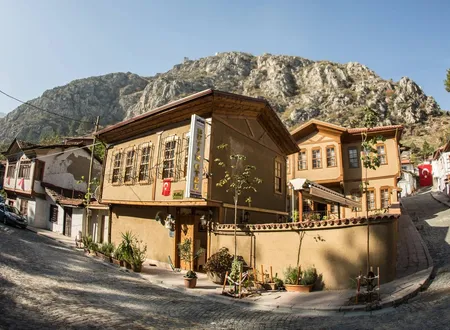
Aşağı Neighborhood is one of the 40 neighborhoods of Amasya's Central District, but it is not a neighborhood to be looked for within the fabric of the city itself. It is one of the two main neighborhoods of the town of Ziyaret. Ziyaret lies northeast of Amasya, on the slope of a small mountain that descends from Akdağ toward the Yeşilırmak, on the east bank of the stream that runs in front of it, and it is an old settlement. Today its name may seem to indicate nothing more than a direction, yet behind it lie a settlement history of more than seven hundred years, a mosque and bathhouse complex from the Seljuk period, Ottoman pious endowments (waqfs), and the dervish lodge of a Naqshbandi sheikh who was well known in Amasya in the early nineteenth century. To write the history of the neighborhood is therefore to separate out the share of Ziyaret's history that falls to Aşağı.
In population compilations the neighborhood appears only as "Aşağı Mah." and is not explicitly tied to Ziyaret. The identification rests on the town's neighborhood structure. The academic study of Ziyaret states, on the basis of Ministry of the Interior data, that the town consists of the neighborhoods of Aşağı, Yukarı and Saraycık, and in the Central District's list of neighborhoods, of these names, Aşağı and Yukarı are not confused with any other settlement. In 2019 the three neighborhoods had populations of 2,109, 1,455 and 183, a total of 3,747; the same study gives the town's population as 3,901. The figures are close and support the identification, but no document was found that states it directly.
Hüseyin Hüsameddin Yasar's Amasya Tarihi counts Ziyare among the neighborhoods of the city and mentions it as two neighborhoods under the names "Aşağı Mahalle" and "Yukarı Mahalle." In Yasar's account the distinguishing feature of Aşağı is that it holds the oldest buildings of Ziyare: the Keçioğlu Mosque, the old bathhouse beside it, the lodge (zaviye) and the primary school belong to this neighborhood, and to the north stands a small mosque (mescit) built by İbrahim Çelebi of Ziyare. For this reason Aşağı can be read as the religious and institutional core of Ziyaret.
The Name and the Early Settlement
The oldest known name of the settlement in which the neighborhood lies is Zemendu, or Semendu. From lines he takes from Bedreddin Aynî's Ikdü'l-Cümân and from İbn Bibi's history of the Seljuks, Yasar writes that the name was given to a strong fortress and a pleasant town, and that the form Ziyare is its rendering in the speech of the people. Among the people it is still called Ziyere. The settlement was once surrounded by a wall; the foundation stones and wall remains seen at the edge of the vineyards and on the mountain slope are the basis for Yasar's conclusion. The fortress is one of the seven fortresses Yasar lists around Amasya; its remains cannot be made out today.
Yasar says that the water of the place is very cold and its air sound, but that, because the old fortress stood north of the city in a basin-like hollow, the air there was heavy. The Seljuk government exiled to this fortress the emir of Sivas, Kır Han of Khwarazm, who died there soon afterward; this report, which rests on İbn Bibi, had an effect on the rebellion of Berke Han, the governor of Amasya. On the origin of the name Yasar states plainly that no certain document exists. He does not trust Vâzıh Efendi's tying of Ziyere to the name of a monastery, because he has seen that this author counted old names he could not explain as monastery names. His own suggestion consists of two possibilities: the Sanitli Turks living in Amasya calling the place "Sanit" may have turned into Semendu in time, or, since the Seljuk Sultan Mesud, when he made Amasya his capital, renewed the place, had a pavilion built there and spent the spring days in it, the name Ziyare, in the sense of a place that is visited, may have taken the place of Zemendu.
After the Republic the name of the settlement was officially changed to Ziyaret. According to Kurt, the reason for the change was the intense attention shown to the Tomb of Hicabi Baba. When the names Aşağı and Yukarı were given is uncertain. That Yasar, in describing the mescit that İbrahim Çelebi of Ziyare had built in 1075 (1664-1665), gives its position as "the northern side of Aşağı Mahalle" suggests that the name was in use by the seventeenth century at the latest; since the text may also reflect the naming of Yasar's own time, this is an inference. In the survey of 1844-1845 the village appears with three neighborhoods, and the third is Soğukpınar. Today Soğukpınar no longer exists as a separate neighborhood; it survives as a street name within the boundaries of Aşağı Mahalle. The town's third neighborhood today is Saraycık. No document has been seen on the date at which Soğukpınar was joined to Aşağı.
From the Mevdud Mosque to the Keçioğlu Mosque
According to Yasar, the oldest building of the neighborhood is the mosque that Hoca Muhibbeddin Mevdud-ı Ziyari, one of the Seljuk emirs, had built around 1281-1282 (about 680). With a stone foundation, walls and minaret of red brick and a wooden upper part, this mosque is mentioned together with two bathhouses and a lake enclosed by a high wall on the bank of the stream. In the same source Muhibbeddin Mevdud appears around 1291 as the müstevfî of the land of Rum, that is, its chief accountant. The line of scholars bearing the nisba Ziyari also descends from him: Saîdeddin Mevhûb, whom Yasar calls his grandson in volumes 1-4, died in 1385 and was buried before the Tomb of Şadgeldi Paşa; it is noted that his fame is inscribed on his gravestone. In the biographical volumes Yasar also shows the same man, by his chain of descent, as the son of Mevdud's grandson, so that the number of generations is inconsistent within the source itself.
In later centuries earthquakes and other disasters brought the mosque to ruin. Yasar writes that around 970 (1562-1563) Keçioğlu el-Hac Ali Çelebi had it rebuilt and put its endowments in order, and that the name in popular use and in official records became "Keçioğlu Mosque" from then on. Beside the building stand an old bathhouse, a lodge and a primary school; Yasar places the mosque, the bathhouse and the other dependencies expressly in Aşağı Mahalle. How much of the older fabric remains in the structure that is today also called the Hicabi Baba Mosque is not explained in the sources that could be consulted.
The trace of the family that renewed the mosque continues in Yasar's biographical volumes. Keçizâde el-Hac İbrahim Kemâleddin Efendi was a hâfız from Ziyare and is introduced as the son of Hac Ali Çelebi, one of the notables of the place. After his father he served as imam in the mescit of his forefather, became administrator (mütevelli) of the "mosque endowment," served for a few years as city superintendent (emin) of Amasya, was present as administrator of the endowment during a brigand attack in 1011, and died in 1026 (1617). The names of his son Hac İsa Çelebi and of his grandson Hac Mehmed Çelebi are also given. The text does not name the mosque, but when the name Keçizâde, his origin in Ziyare and the tradition of administration at the Keçioğlu Mosque are considered together, it is very likely that this is the building meant.
The Lake, the Bathhouse and the Mescits
The water structures of the neighborhood also stand out in Yasar's account. For the lake built by Mevdud, Yasar says "to the garb-ı şimâlî of the stream," that is, to its northwest; in the summary of the study on Ziyere the same information appears as northeast. Since the lake can no longer be traced, it cannot be checked which of the two directions is right; the same study adds that the lake in question was artificial. Separately from Mevdud's lake, Prince Bayezid, while governor of Amasya, had the "lower lake" built around 870 (1465-1466) and turned all the vineyards below it into a private garden. These gardens remained under the administration of the chief of the gardeners (bostancılar kethüdası) until 1143 (1730-1731). Yasar does not say in which neighborhood the lake lay; since its name is "lower," associating it with Aşağı Mahalle is plausible, but this does not rest on a document.
The mescit to the north of Aşağı is the second building named in Yasar's section on Ziyare. El-Hac İbrahim Çelebi of Ziyare had a mescit built "on the northern side of Aşağı Mahalle" in 1075 (1664-1665), placed a fountain in front of it, and put its endowments in order. The building of the school and fountain beside the mosque, and the endowment of a shop and a piece of vineyard, are likewise found in Yasar's biographical volumes, in the entry for Hüseyin Ağa-Kazancıoğlu, one of the notables of Ziyare. The entry presents him as a charitable man of wealth and influence, administrator of the Keçioğlu Mosque endowment, and says that he died around 1210 (1795-1796). In the e-book the text of the entry is interleaved with sentences from another entry by the two-column print layout; the details above have been separated out from the order of the sentences.
The buildings of Yukarı Mahalle belong to a different chronology. According to Yasar, the Amasya kethüda el-Hac Mehmed Çelebi had a mosque built there around 1080 (1669-1670), the notable Çilingiroğlu el-Hac Ali Efendi enlarged it in stone and added a minaret in 1198 (1783-1784), and the building was repaired once more in 1243 (1827-1828); beside it are a bathhouse and a school. The roots of the building group in Aşağı, by contrast, go back to the Seljuk period. This difference in age between the mosques of the two neighborhoods suggests that the first nucleus of Ziyare formed on the Aşağı side, but it is an inference limited to the buildings that Yasar describes.
People Around the Mosque
The positions of chair sheikh (kürsü şeyhi) and preacher at the Keçioğlu Mosque were the posts that shaped the intellectual life of Ziyare, and Yasar mentions a few of those who held them. Sa'deddin Mehmed Efendi, son of the mosque's preacher Şeyh Mustafa Efendi, became preacher in his place on his father's death in 1140 (1727-1728), but he withdrew from the post in the month of Shawwal 1141, and Yahya Efendi took his place. This line is one of the few details showing that the preachership of the mosque could pass from father to son in the eighteenth century and that the succession was not always lasting.
Ziyârelizâde el-Hac Hüseyin Efendi, after completing his studies in Amasya and beginning to teach, became chair sheikh of the Keçioğlu Mosque in Ziyare and died in 1205 (1790-1791). Yasar describes him as a scholar, jurist, master of Arabic and the rational sciences, truthful, measured and versed in matters of administration; his sons were Abdullah, Mehmed and Ahmed Efendi. In the next generation, Süleyman Efendi is the son of Seyyid Osman Efendi of Ziyare Mahallesi and is known as Müftüzâde. After completing his studies with Hâfız Ali Efendi he withdrew to Ziyare as chair sheikh of the Keçioğlu Mosque, kept to the circle of remembrance (zikir) of Abdülbâki Hicâbî Efendi, and died in 1243 (1827-1828). Süleyman Efendi's life shows how the relationship between mosque and lodge worked in the neighborhood: a chair sheikh trained in the madrasa could at the same time be a disciple in the circle of a Sufi order.
The highest-ranking figure buried near the mosque is Deli Zülfikâr Paşa. According to Yasar, Zülfikâr Paşa was the son of Baloğlu Sipahi Mehmed Ağa, of the people of Ziyare Mahallesi; his grandfather Abadlı Behlül Bey had settled in Ziyare. Zülfikâr Paşa became governor of Diyarbekir in 1020 (1611), was appointed governor of Erzurum a second time in 1022, was dismissed after the grand vizierate of Öküz Mehmed Paşa in 1023 and ordered to reside in Amasya, and died in 1024 (1615). Yasar describes him as a brave, prudent and intelligent vizier and writes that he is buried near the Keçioğlu Mosque in Ziyare, which he had repaired. His sons Mehmed and Ali Bey, his steward (kethüda) Ahmed Ağa and his treasurer Yahya Ağa are also mentioned. From this it can be understood that the Keçioğlu Mosque was a building that a vizier repaired again about half a century after its renewal of 1562-1563.
Hicabi Baba and the Dervish Lodge
The best-known person of the neighborhood in the nineteenth century is Abdülbâki Hicâbî Efendi, called among the people Gül Baba and Hicabi Baba. He was born in the city of Bahçesaray in the Crimea and, according to the sources, migrated to Anatolia in 1774 when the Crimea was occupied by Russia, and settled in Amasya. There he received a license (icazet) from the lessons of Ürgüplü Ahmed Efendi and then attached himself to Turhallı Şeyh Mustafa, who belonged to the Mujaddidi branch of the Naqshbandi order. After becoming a sheikh he settled in Ziyaret and began his guidance in the Keçioğlu Mosque and its lodge. According to Yasar's entry on the Hicâbî Lodge, the lodge was founded beside the mosque in 1212 (1797-1798); that is, Hicabi added a Sufi hearth to the old mosque-and-lodge nucleus of Aşağı Mahalle.
Just as he had the lodge built, he also repaired the mosque, and from then on the Keçioğlu Mosque has also been called the Hicabi Baba Mosque. It is also known that he had a madrasa in which he gave his lessons and which is not mentioned in the sources. Yasar writes that, during the Russian war, about a thousand students gathered under Abdullah Efendi of Taşköprü and went to Rumelia, and that "the sheikh of Ziyare, Hicâbî Abdülbâki Efendi" was among this battalion; the campaign falls in 1224-1225 (1809-1810) and lasted about a year. Hicabi died in Ziyaret in 1238 (1822) and was buried in the tomb adjoining the mosque. On one of the sarcophagi in the tomb is read the name of his son, the madrasa teacher Hâfız Mehmed Efendi, and on another that of his grandson, İsmail İzzettin. His son-in-law, İbrahim Zühdî Efendi, married to his daughter, and Yasin Efendi of Dagestan are his two deputies (khalifa).
Yasar writes that after the death of İbrahim Zühdî Efendi the lodge began to be used as a school; the lodge became a thing of the past, but the visiting around the tomb continued. Four treatises of Hicabi are known: Zübdetü'l-İslam, Risâle-i Hicâbî, the Arabic Risâle fi't-Takvâ and el-Ebkiretü'l-Mu'telife fî Şerh-i Emsileti'l-Muhtelife. Bursalı Mehmed Tahir attributes to him eight further works besides these. Zübdetü'l-İslam was published by the Ziyaret Municipality in 2013, transliterated into today's alphabet. One of his deputies, Şehir Kethüdâsızâde Mehmed Ârifî Efendi, turned the reception room of his house in the Acem Ali neighborhood of the city of Amasya into a lodge and served as sheikh for about thirty years; thus the line of the hearth in Aşağı Mahalle reached the city as well.
Aşağı in the Surveys of 1840 and 1844-1845
The most detailed document on the neighborhood is the property-and-income (temettuat) registers of 1844-1845. In the heading of the three registers examined by Songül Keçeci Kurt, Ziyere is named as a village of the Akdağ district within the Amasya sub-governorship of the province of Sivas, and the property, land and incomes of the Muslim population living in the neighborhoods of Soğukpınar, Aşağı and Yukarı are entered. According to this survey, Aşağı Mahalle has 59 households; Soğukpınar has 43 and Yukarı 151, and 254 households are entered for the village as a whole. Calculated at five persons per household, the population of the village is 1,270 and that of Aşağı about 295. In the population register of 1840 the household count is 70 for Aşağı, 54 for Soğukpınar and 129 for Yukarı. Kurt attributes this difference between the two surveys to the neighborhood boundaries not being drawn sharply and to some households having been entered under different neighborhoods.
Non-Muslim households appear in 1844-1845 only in Yukarı Mahalle; Aşağı is entirely a Muslim neighborhood. The situation is the same in the survey of 1914: Aşağı has 292 Muslims, Soğukpınar 285 Muslims and 27 Greeks, Yukarı 796 Muslims and 23 Greeks, and the town total is 1,423 persons. The population of Aşağı remained almost unchanged between the estimate for 1845 and 1914. It can also be understood from the documents Kurt cites that Ziya Paşa had the road to Ziyere built during his term as sub-governor of Amasya in 1863, and that the village then had about 200 households.
The names of the household heads show the social fabric of the neighborhood. In the register of Aşağı the first household belongs to "Davulcu Oğlu Mehmed"; then come names with occupational nicknames such as "Çanakçı Oğlu Hacı Hasan," "Dümbelekçi Oğlu Ömer," "Etlikçi Oğlu Abdullah" and "Berber Oğlu Mustafa." The Kabakçı and Kirlioğlu families, with three households each, are the most numerous lines of the neighborhood. People such as "Canikli Mehmed," "Yenicelili Mehmed" and "Yozgatlı Süleyman" are known by the names of their home towns. Of the 59 household heads, eight, or 13.5 percent, bear the title hajji. In the 31st household is Hatip Şerif, in the 42nd Derviş Mehmed, in the 53rd Hacı Osman Ağa. In two households of the neighborhood women are entered as property owners: Emine Hatun, as daughter of Çercili Mehmed Efendi, in the 55th household, and Azime in the 46th. Residents of Ziyaret whom Kurt interviewed said that many of these nicknames are still used today to tell families apart; for example the nickname "Kabzeli Ahmed" of the 50th household survives today as "Kamzeli."
Mulberry, Vineyard and Livestock
The livelihood of the neighborhood rests on gardening. In Aşağı, 48 of the 59 household heads, or 81.3 percent, are gardeners; this is the highest share among the three neighborhoods of Ziyere (67.4 percent in Soğukpınar, 66.8 percent in Yukarı). The rest are two laborers, two silk-weighing masters, two sellers, one dervish and one imam. The cultivated and planted land of the neighborhood consists of 108 dönüm of mulberry garden, 23 dönüm of vineyard and 6 dönüm of field. Of the mulberry gardens, 28 dönüm, about a quarter, are gardens divided in halves, that is, worked in partnership. The mulberry points to silkworm raising, an old occupation of Amasya; Kurt notes that from about 1865 a silkworm disease greatly reduced production, and that today other fruits such as cherries have taken the place of the mulberry.
Livestock raising in Aşağı is feeble compared with Yukarı. The neighborhood is recorded with 40 cows and heifers, 12 calves, 64 goats, 38 kids, 16 donkeys, 8 mules and 12 beehives, a total of 178 animals. In Yukarı this number is 1,511, and all the herder households live there. The only property income visible in Aşağı is from mills: 750 kuruş of revenue is calculated from the mill belonging to three households. In Olcay's Amasya Hâtıraları "the highland herders of Ziyere" are named as regular customers of the greengrocer's shop of Madenüzcü Hacı Mustafa Ağa in the city, and it is said that the best cream, milk and yogurt came there; this line is said of Ziyere as a whole, but it shows that the town's tradition of livestock raising continued in the early twentieth century as well.
In the tax tally Aşağı stands in the middle among the three neighborhoods. In 1844-1845, 6,222 kuruş of annual tax, 2,050 kuruş of silk tithe, about 510 kuruş of grape tithe, 23 kuruş of beehive tithe and 5 kuruş of sheep-and-goat tax were collected from Aşağı; the neighborhood's total tax is 6,310 kuruş. The annual temettuat income is 29,296 kuruş and the trade income 21,449 kuruş. Trade income per household is 363.5 kuruş, the highest of the three neighborhoods; 260.8 kuruş is entered for Soğukpınar and 336.7 for Yukarı. Income per household is 885 kuruş and tax per household 106 kuruş, and the ratio of tax to income, at 11.9 percent, is the highest in Ziyere. Kurt also notes inconsistencies in the register totals; even so, the households' incomes are close to one another and no marked difference in wealth is seen in the village.
Population
The numerical history of the neighborhood in the recent period can be followed through the series compiled from the Address-Based Population Registration System data of the Turkish Statistical Institute (TÜİK). The population of Aşağı Mahallesi is recorded as 2,094 in 2012, 2,151 in 2013, 2,249 in 2014, 2,203 in 2015, 2,235 in 2016, 2,258 in 2017, 2,213 in 2018 and 2,109 in 2019. Throughout the seven-year period the population stayed between 2,100 and 2,260, reached its highest value in 2017, and between 2012 and 2019 showed an increase of only fifteen people, less than one percent. The two-year decline after 2017 totals 149 people. This series shows that the Muslim population of 292 in 1914, if the boundaries have not changed, rose about sevenfold in a hundred years.
The meaning of these figures becomes clear when they are compared with the district as a whole. According to the 2013 table of 40 neighborhoods in the same compilation, the total population of the Central District was 99,965, and by 2019 it had risen to 120,850; this is an increase of more than 20 percent in six years. Most of the increase took place in the newly developing neighborhoods of the city: in 2019 Şeyhcui, with 23,145, Hacılar Meydanı, with 14,837, and Bahçeleriçi, with 11,821, headed the list. The share of Aşağı Mahallesi fell from about 2.2 percent in 2013 to 1.7 percent in 2019. In 2013 the neighborhood was the tenth largest of the Central District by population, and in 2019 the fourteenth. The neighborhood has not shrunk, but because the rest of the city has grown it has lost its relative weight.
The series of the neighboring neighborhood Yukarı is 1,418 in 2012, 1,529 in 2017 and 1,455 in 2019. The two neighborhoods peaked around 2017 in the same years and then declined slightly in the same way. Aşağı is every year about 45 to 52 percent more populous than Yukarı. Yet in 1844-1845 Yukarı was two and a half times the size of Aşağı by household count, and in 1914 about 2.7 times by population. The reversal of the picture took place after 1914, and no document showing its cause exists in the sources that could be consulted; the joining of Soğukpınar to Aşağı, changes in neighborhood boundaries and new housing construction are the possibilities that come to mind.
According to the Ministry of the Interior data that Kurt cites, the town has 481 buildings in Aşağı, 512 in Yukarı and 67 in Saraycık. If the building count of 2016 and the population of 2019 are read together, the number of persons per building is about 4.4 in Aşağı and about 2.8 in Yukarı; this is only an observation and should be read with care because it rests on data from different years. The address of the Ziyaret Municipality is in Yukarı Mahalle. On the headman, school and public buildings of Aşağı there is no detail in the sources that could be consulted; for these the municipality and the neighborhood headman's office are the right places to apply.
Chronology
About 1281-1282 (680): Hoca Muhibbeddin Mevdud-ı Ziyari has a mosque, two bathhouses and a lake built in Ziyare.
About 1291 (690): Muhibbeddin Mevdud is mentioned as müstevfî of the land of Rum.
1385 (787): Death of Saîdeddin Mevhûb.
About 1465-1466 (870): Prince Bayezid, during his governorship of Amasya, has the lower lake built.
About 1562-1563 (970): Keçioğlu el-Hac Ali Çelebi renews the mosque and puts its endowments in order.
1611-1615 (1020-1024): Governorships of Deli Zülfikâr Paşa and his death in 1615; his burial near the Keçioğlu Mosque.
1617 (1026): Death of Keçizâde el-Hac İbrahim Kemâleddin Efendi.
1664-1665 (1075): El-Hac İbrahim Çelebi of Ziyare has a mescit and a fountain built north of Aşağı Mahalle.
1727-1728 (1140): Death of the mosque's preacher Şeyh Mustafa Efendi and his son Sa'deddin Mehmed Efendi becoming preacher.
1774: Hicabi Baba comes to Anatolia on the occupation of the Crimea.
1797-1798 (1212): Founding of the Hicâbî Lodge beside the Keçioğlu Mosque.
1809-1810 (1224-1225): Hicabi's taking part in the Russian war with the student battalion.
1822 (1238): Death of Hicabi Baba and his burial in the tomb adjoining the mosque.
1840: Aşağı Mahalle entered in the population register with 70 households.
1844-1845: Aşağı Mahalle has 59 households in the temettuat survey; the village has 254 households, an estimated 1,270 people.
1914: Muslim population of 292 in Aşağı Mahalle.
2012-2019: The population of Aşağı Mahallesi stays between 2,094 and 2,258; 2,109 in 2019.
Sources
Primary sources
- Hüseyin Hüsameddin Yasar, Amasya Tarihi, vols. 1-4, Amasya Municipality, 2022, p. 122 (entry "Ziyâre Mahallesi").
- Hüseyin Hüsameddin Yasar, Amasya Tarihi, vols. 9-12, p. 173 (entry on Zülfikâr Paşa).
- Hüseyin Hüsameddin Yasar, Amasya Tarihi, vols. 9-12, p. 49 (entries on Ziyârelizâde Hüseyin Efendi and Hüseyin Ağa-Kazancıoğlu).
- Osman Fevzi Olcay, Amasya Hâtıraları (recollections on the highland herders of Ziyere). amasya.bel.tr
Academic studies
Other sources
- "Hicâbî, Abdülbâki Gül Baba", Türk Edebiyatı İsimler Sözlüğü (teis.yesevi.edu.tr).
- nufusu.com, "Merkez Mahalleleri Nüfusu, Amasya" (compilation of TÜİK/ADNKS data, 2012-2019).
Online sources
- https://www.historystudies.net/dergi/1844-1845-temettuat-defterlerine-gore-ziyere-koyunun-sosyal-ve-ekonomik-durumu201610.pdf
- https://teis.yesevi.edu.tr/madde-detay/hicabi-abdulbaki-gul-baba
- https://amasya.bel.tr/uploads/e-kitap/kitap/9-12/files/basic-html/page173.html
- https://amasya.bel.tr/uploads/e-kitap/kitap/9-12/files/basic-html/page49.html
- https://www.nufusu.com/merkez-amasya-mahalleleri-nufusu