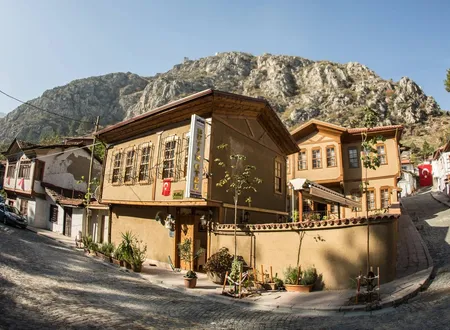
Koza Neighbourhood (Koza Mahallesi), part of the central district of Amasya, is one of those quarters that rarely figure in the city's tourist narratives. In a city known for its citadel, the timber mansions along the Yeşilırmak, its rock-cut tombs and its history as a princely sanjak, the story of the settlements reaching out from the narrow core of the valley toward the higher ground has often never reached the written record. Koza is one of them. It is not a place remembered for a historic building or an inscription, nor did it exist for long as a separate administrative unit: the area now known as the neighbourhood lay within the boundaries of neighbouring İpekköy until 2006. Koza takes its identity from the schools, streets, student dormitory and fast-growing population that have defined it since that separation. What follows is limited to what the available documents allow, and where no document exists this is stated plainly.
Location and Geography
According to compiled map and place-name records, Koza belongs to the central district of Amasya and lies roughly 6 kilometres from both the district centre and the city centre. The Ministry of National Education's school records, however, give the distance from the neighbourhood's middle school to the provincial centre as 8.5 kilometres; the difference may come from one figure being measured as the crow flies and the other by road. Its elevation is given as about 421 metres. The neighbourhood sits on the higher ground beyond the dense core of the city in the Yeşilırmak valley. Between it and the old city, squeezed along both banks of the river on the valley floor, the difference is one of landform as well as of kilometres; Koza lies outside that narrow urban fabric in the shadow of the Harşena and Ferhat mountains, in a more open and quieter belt. The crowds of the centre do not reach it, and the rhythm of daily life is shared with the surrounding villages and quarters. It is linked to the centre by city buses.
Its nearest neighbours are İpekköy (about 1.2 km), a facility belonging to an infantry training brigade (about 2.2 km), Kapıkaya (about 2.5 km) and Karasenir (about 2.8 km). Further off come the Amasya Small Industrial Estate (4.5 km), Ezinepazarözü (4.8 km), Bulduklu and İlyas (5 km each), Dadıköy (5.4 km), Kayabaşı (5.9 km) and Sevincer (6.2 km). These distances show that Koza is less a centre in its own right than part of a belt of scattered village and neighbourhood settlements around the city. The gaps between the settlements give this belt a sparse and open appearance. Kırklardağı Hill (7.1 km) is its most prominent height and, seen from the neighbourhood, it defines the horizon.
The neighbourhood's primary and middle school stands on the highway linking Amasya to Samsun. The strategic plan the school drew up for 2024-2028 records its position on this road as a threat to pupils' safety; the same document notes that distance from the city centre reduces pupils' participation in social activities, while being outside the city gives the school a clean environment and room to expand.
Postal and administrative classifications list the neighbourhood under the "Gökmedrese" district heading. This is purely an administrative grouping; since there is no information suggesting any direct connection between Koza and the historic Gök Medrese in the city centre, no such link is drawn here.
Separation from İpekköy and the Founding of the Neighbourhood
The only direct account of Koza's founding that could be found appears in the institutional history of the neighbourhood's Şehitler Primary and Middle School. According to it, the site of the school lay within the boundaries of İpekköy until a local referendum held in 2006. After the vote, this area remained in the newly established neighbourhood named Koza and was attached to the centre. The school history does not say on what date the vote took place, how many voters took part or why the rest of İpekköy remained a village. No Official Gazette notice or municipal council decision on the matter could be found.
This also explains the neighbourhood's absence from older records. Bekir Başalan's study of renamed settlements in Amasya lists 100 villages in the central district and nine villages later converted into neighbourhoods (Boğazköy, Fındıklı, Helvacı, Karasenir, Orman Bağları, Saraycık, Yazı Bağları, Yeniköy, Yeşilyenice). Koza appears neither among the villages nor among those turned into neighbourhoods, and it is absent from the table of renamed settlements too. Neighbouring İpekköy and Kapıkaya, by contrast, are on the village list. That Koza was never registered as an independent village and came into being through the division of a village fits this picture; unlike the villages that became neighbourhoods, Koza arose from the separation of one part of İpekköy.
The name, however, was in use long before 2006. According to the same school history, the school opened in the 1987-1988 academic year as "Koza Primary School". Koza had therefore become established as the name of an area or locality within İpekköy at least twenty years before the neighbourhood was created. Whether this locality had an older history is unknown. No neighbourhood, village or locality called Koza appears in the volumes of Hüseyin Hüsameddin Yasar's Amasya Tarihi or in Osman Fevzi Olcay's Amasya Hâtıraları. The absence of the name from these two works does not prove that the place is an entirely new settlement; it shows only that the available documents allow no firm statement about the period before 1987.
Amasya has a long past stretching from the Pontic kingdom through Rome and Byzantium to the Danishmendid, Seljuk and Ottoman periods, and as a princely sanjak it counted among the most important provincial centres of the Ottoman Empire. Yet it is not known in which layer of this past the land on which Koza stands was first settled. The accessible sources mention no historic mosque, fountain, cemetery or inscription belonging to the neighbourhood. Its known buildings are recently established educational and residential institutions, and it is they that shape its present face.
Origin of the Name
In Turkish the word koza means the cocoon spun by the silkworm, and also the husked fruit of certain plants. No reliable document has been found explaining why the name was given to the neighbourhood or to the earlier locality. The fact that the village it belonged to is called İpekköy ("Silk Village") and that the neighbourhood's main street is named İpek ("Silk") Street brings sericulture to mind; given that Koza is a part split off from İpekköy, it seems all the more likely that the names were chosen from the same field of association. Since no source confirms this, however, it remains an association.
Behind this association lies a real history of silk production in Amasya. In the first volume of Amasya Tarihi, Hüsameddin, listing the city's exports, says that "its silkworm houses, its mulberries and its cocoons are very famous" and writes that in recent years annual cocoon production had reached one million kilograms. In the same passage, describing the succession of seasons in Amasya, he records that the cocoon season followed the cherry season and gave occasion to many festivities. The author's figure of one million kilograms is not confirmed by any other document; but it is clear that silkworm rearing held an important place in the daily life of the villages around the city. Whether the names İpekköy and Koza preserve a memory of this tradition cannot be said on the basis of the available sources.
Streets and Layout
Daily life in the neighbourhood revolves around these streets rather than the city's busy market. The main artery is İpek Street. Twelve named streets are counted within the neighbourhood: Ceylan, Cihangir, Elmacı, Karagöz, Kordon, Maarif, Müjde, Mukaddes, Nur, Osmanlı, Tavşanlı and Vatan. To these are added Şehit Ali Bilgiç Avenue and Tarlabaşı Street; Vatan Avenue also appears as the address of the schools. Names such as Maarif ("Education"), Vatan ("Homeland"), Osmanlı ("Ottoman") and Mukaddes ("Sacred") look more like names assigned later in a planned fashion than place names arising spontaneously in an old village. This suggests a settlement shaped by a particular zoning plan rather than a narrow, organic village fabric; its separation from a village and attachment to the centre in 2006 is consistent with this impression. No document has been found, however, showing when the plan was made or by which body. Nor do the records reveal by what criteria the street names were chosen one by one.
The Martyrs in the Names of Schools and Streets
A common thread runs through the names of Koza's institutions and streets: two of the neighbourhood's schools and one of its avenues bear the names of martyrs. The first of these is the primary and middle school. According to its history, the school, opened in 1987 as Koza Primary School, was renamed Şehitler İlköğretim Okulu ("Martyrs' Primary School") in 2003 in memory of soldiers from the neighbourhood who fell fighting the PKK. The history gives neither the names nor the number of these soldiers, and no other accessible source has been found to supply them.
The vocational high school takes its name from the Special Operations police officer Gültekin Tırpan. According to announcements by the Amasya Provincial Directorate of Family and Social Services, Tırpan was killed on 18 January 2016 in the İdil district of Şırnak. His mother is Nermin and his father Hüseyin Tırpan. On the fourth anniversary of his death, 18 January 2020, a mevlid was recited at the Sultan Bayezid II Mosque in Amasya in memory of him and of all the martyrs, attended by his family, the families of other martyrs and Special Operations police officers. On the anniversary of his death in January 2023, directorate staff also prayed with the family at his grave. It could not be established in which year the school was given this name or what it had been called before.
No naming decision could be found for the person after whom Şehit Ali Bilgiç Avenue is named. A martyr remembered by this name in Amasya is Gendarmerie Specialist Sergeant Ali Bilgiç; the provincial directorate visited his mother and father in 2022, and in May 2026 attended the funeral of his wife, Leyla Bilgiç. According to a report in the local press in February 2024, the reading room at Şehitler Primary School was named after Şehit Ali Bilgiç; students of the neighbourhood's vocational high school took on the painting of the room, and the martyr's mother served the working students stuffed vine leaves. The head teacher said they would open the room together with the martyr's mother. That both the reading room and the avenue in the same neighbourhood bear this name suggests that the martyr commemorated by the avenue is also Specialist Sergeant Ali Bilgiç; no document directly showing this has been seen. The date and place of Bilgiç's death are not given in the sources consulted either.
Educational Institutions
Koza's most distinctive feature is the large number of educational and residential institutions it hosts relative to its small population. This is why, seen from outside, the neighbourhood looks like a zone of schools and dormitories.
Şehitler Primary and Middle School
Şehitler Primary School and Şehitler Middle School share the same school site, and their address is Vatan Avenue. Opened as Koza Primary School in the 1987-1988 academic year, the school took the name Şehitler İlköğretim Okulu in 2003. Because the old building was poorly suited to teaching, a new five-storey building with 23 classrooms was constructed and came into service in March 2019. The new building has a multipurpose hall, a library, a guidance service, and computer and science laboratories; in the school's own assessment, however, the lack of a sports hall is listed as a problem. Smart boards are used in every classroom.
In the 2023-2024 academic year the school had 234 pupils in total: there were two kindergarten classes, five primary classes and five middle-school classes. As of March 2024, of the middle school's 100 pupils, 47 were girls and 53 boys. Thirty-eight of them were brought in from surrounding villages under the bussed schooling scheme, which is why the school describes itself as a bussed-education centre. The middle school's own profile, meanwhile, lists 95 pupils, 10 teachers and five classrooms. These figures show that the school serves a small community on a neighbourhood scale. The school's strategic plan lists the low socio-economic level of parents and weak reading habits among its weaknesses, while it counts the small number of pupils per classroom and per teacher as an opportunity. The plan also contains a target of holding meetings with dormitory managers about pupils who stay in dormitories and miss school; this shows that some of the middle-school pupils are boarders.
Şehit Gültekin Tırpan Vocational and Technical Anatolian High School
The neighbourhood's other large school is the Şehit Gültekin Tırpan Vocational and Technical Anatolian High School on Tarlabaşı Street. It has project-school status; its student body is given as about 400, its teaching staff as about 60 and its classrooms as 39. It admits students in fields such as electrical-electronic technology and construction technology and has a boarding house. One news report places the school in the Hızırpaşa district; since its official address is Koza Neighbourhood, it is treated here as part of the neighbourhood. The reason for the discrepancy cannot be determined from the documents.
The vocational high school is one of the places where the name Koza appears most often in the local news. During the 2020 pandemic, 12,000 masks a day were produced at the school under the "1,000 Schools Improvement Project"; according to the Provincial Directorate of National Education, by 2 November 2020 the number of masks produced had reached 560,000. In spring 2023 the school also made natural soap from waste oil collected in the dormitory kitchen, an effort described in an announcement dated 8 May 2023. Early the following year the school's students took part in renovating the neighbouring primary school's reading room named after Şehit Ali Bilgiç, painting the room mentioned above.
Sultan Bayezid Male Student Dormitory
The institution likely to have had the greatest effect on Koza's population structure is the Sultan Bayezid Male Student Dormitory, run by the Credit and Dormitories Agency (KYK). Its address is Cihangir Street, Şehit Ali Bilgiç Avenue, Koza Neighbourhood, and its capacity is given as 1,048. The dormitory serves male students at Amasya University. The year it opened could not be established. In autumn 2021, in a report on the shortage of student housing in Amasya, the governor of the day said that a dormitory for a thousand students in the provincial centre would come into service by the end of the year; but since the report gives neither the location nor the name of that dormitory, it is not known whether it is the same as the Sultan Bayezid Dormitory.
The university's İpekköy Campus also lies close to the neighbourhood. Although some address and map records show the campus together with the name "Koza", the university's own contact details give the address of the Faculty of Health Sciences and other units as "İpekköy Campus, İpekköy". For this reason the campus is not counted here as part of the neighbourhood.
Population and Change
According to a series compiled from TÜİK's address-based population records, the population of Koza Neighbourhood has developed as follows:
- 2012: 1,352
- 2013: 1,353
- 2014: 1,330
- 2015: 1,326
- 2016: 1,354
- 2017: 1,310
- 2018: 2,002
- 2019: 2,162
A population that stood at around 1,300, almost unchanged for years, rose by about 700 between 2017 and 2018 to exceed 2,000. The jump is also visible in the ranking of the central district's neighbourhoods. Koza stood at roughly twenty-second place by population in 2017, rising to fourteenth in 2018 and thirteenth in 2019. The top three neighbourhoods in the ranking did not change in the same period; the rise therefore points to a change specific to Koza rather than to a general movement in the city.
A population record given for 2026 shows 2,451 people in Koza, of whom 1,867 are men and 584 women. A neighbourhood comparison published by a real estate platform gives the population as 2,386; the two figures very probably refer to different years. The same comparison also outlines the neighbourhood's demographic profile: in Koza the largest age group is 15-29, the never-married form the largest group by marital status, and the average household size is 6.43. Since the average for the central district is 3.26, this is about twice the district figure. High-school graduates predominate in terms of education, while the income indicator is among the lowest of the central district's larger neighbourhoods. Within the central district, a similar profile, that is a young and largely single population with an unusually high household size, is found among the larger neighbourhoods only in Yazı Bağları.
Taken together, the male population exceeding the female by more than three to one, the weight of young and unmarried people and the size of households indicate that a significant share of the population is registered in communal residences rather than ordinary family households. The male student dormitory with a capacity of more than a thousand and the vocational high school with its boarding house are institutions that could account for this picture. The sources, however, do not state explicitly the reason for this distribution or for the sudden rise in 2018; and since the dormitory's opening date is unknown, any link between the 2018 jump and the dormitory remains an assumption.
Natural Disasters and Ground Movements
According to an announcement dated 10 July 2020 by the Provincial Disaster and Emergency Directorate of the Amasya Governorate, the directorate's technical staff carried out an on-site inspection after a landslide "in the locality of Koza Neighbourhood, Central District". The announcement states only that the inspection took place. The scale of the landslide and the number of buildings damaged or households affected were not disclosed, and no local press report dealing separately with the event could be found. The school's strategic plan likewise mentions location in an earthquake zone and natural disasters in general among environmental threats, but gives no record of a disaster specific to the neighbourhood.
Koza Today
Today Koza is one of the neighbourhoods of Amasya's central district that extend out of the city toward the higher ground, and it has its own muhtar (elected neighbourhood head), Hüseyin Keşoğlu. On 18 June 2025 the neighbourhood's children's park burned down in a fire, and the flames came close to spreading to an abandoned school building nearby. Given that the school moved to its new building in 2019, the empty building mentioned in the report may be the old school building; the report does not say so. In remarks quoted in the report, the muhtar said that the neighbourhood had only one park and that it was now gone, and asked for it to be rebuilt. The report gives the neighbourhood's population as about 2,000. The cause of the fire could not be determined; the municipality filed a criminal complaint and the investigation was pursued by the security forces.
These details show Koza to be a neighbourhood with limited public amenities despite its fast-growing population and large student presence. The period before its separation from İpekköy, how the name Koza first came into use, the details of the 2006 vote and the lives of the first residents await a local history that could be written by compiling the muhtar's office records and the recollections of older residents.
Chronology
1987-1988: Koza Primary School begins teaching on a site then within the boundaries of İpekköy.
2003: The school is renamed Şehitler İlköğretim Okulu in memory of soldiers from the neighbourhood who fell as martyrs.
2006: After a local referendum, part of İpekköy is attached to the centre under the name Koza Neighbourhood.
2012-2017: The neighbourhood's population runs between 1,310 and 1,354.
18 January 2016: Special Operations police officer Gültekin Tırpan, whose name the neighbourhood's vocational high school would later bear, is killed in the İdil district of Şırnak.
2018: The population rises to 2,002.
March 2019: The new five-storey, 23-classroom building of Şehitler Primary and Middle School comes into service.
2019: The population is recorded as 2,162.
10 July 2020: Technical staff of the Amasya Provincial Disaster and Emergency Directorate carry out an on-site inspection after a landslide in the locality of Koza Neighbourhood.
2 November 2020: The number of masks produced at the Şehit Gültekin Tırpan Vocational and Technical Anatolian High School reaches 560,000.
8 May 2023: Soap production from waste oil at the vocational high school is announced.
February 2024: The reading room at Şehitler Primary School is named after Şehit Ali Bilgiç; vocational high school students paint the room.
18 June 2025: The neighbourhood's children's park is put out of use by a fire.
Sources
Primary sources
Academic studies
Official sources
Other sources
- Amasya Merkez Şehitler Ortaokulu, 2024-2028 Stratejik Planı (March 2024; institutional history, pupil numbers, SWOT analysis).
- nufusu.com, "Merkez Mahalleleri Nüfusu Amasya" (population series 2012-2019).
- nufusune.com, "Koza Mahallesi Nüfusu, Merkez Amasya" (2026 population data). nufusu.com
- Emlakjet, "Amasya Merkez Demografi Analizi" (neighbourhood population, age group, marital status, household size).
- haritatr.com, "Koza Mahallesi Haritası Amasya Merkez" (location, distances).
- haritamap.com, "Koza Mahallesi Nerede Harita - Merkez Amasya" (streets, school).
- Republic of Türkiye Amasya Governorate Provincial Disaster and Emergency Directorate, "İlimiz Merkez İlçesi Koza Mahallesi mevkiinde yaşanan heyelan afetine yönelik incelemeler yapıldı" (10 July 2020).
- Amasya Provincial Directorate of Family and Social Services, "Özel Harekât Polisi Şehit Gültekin Tırpan için mevlid programı düzenlendi" (18 January 2020) and "Şehit Özel Harekat Polisi Gültekin Tırpan'ın sene-i devriyesinde kabri başında ailesi ile birlikte dualar ettik" (25 January 2023).
- Amasya Provincial Directorate of Family and Social Services, "Şehidimiz Uzman Çavuş Ali Bilgiç'in anne ve babasını evinde ziyaret ettik" (8 November 2022) and "Aziz Şehidimiz Jandarma Uzman Çavuş Ali Bilgiç'in Kıymetli Eşi Leyla Bilgiç'in cenaze törenine katıldık" (7 May 2026).
- sondakika.com, "Amasya'da Şehitler İlkokulu'nda Okuma Salonuna Şehit Ali Bilgiç'in İsmi Verildi" (21 February 2024; news summary).
- Türkiye Eğitim Kampüsü (bilimsenligi.com), "Amasya Devlet (KYK) Öğrenci Yurtları Adres ve Telefonları" (address of the Sultan Bayezid Male Student Dormitory); Kampüsüm, "Sultan Bayezid KYK Erkek Öğrenci Yurdu" (capacity).
- Sözcü, "Nehir manzaralı otel öğrencilere yurt oldu" (DHA, October 2021).
- Amasya University, contact details (İpekköy Campus addresses); Faculty of Health Sciences, "Hemşirelik Bölümü Akademik Personel Oryantasyon Eğitimi" (campuses).
- Amasya Provincial Directorate of National Education, announcements of the Şehit Gültekin Tırpan Vocational and Technical Anatolian High School (mask production, 2021; soap from waste oil, 8 May 2023).
- İşçi Haber, "Amasya'da korku dolu anlar: Çocuk parkı cayır cayır yandı" (June 2025).
Online sources
- https://amasyasehitlerortaokulu.meb.k12.tr/meb_iys_dosyalar/05/01/724870/dosyalar/2024_12/16130236_ortaokulstratejikplansehitler1.pdf
- https://www.emlakjet.com/emlak-piyasasi/demografi/amasya-merkez
- https://amasya.afad.gov.tr/ilimiz-merkez-ilcesi-koza-mahallesi-mevkiinde-yasanan-heyelan-afetine-yonelik-incelemeler-yapildi
- https://dergipark.org.tr/tr/download/article-file/4249891
- https://aile.gov.tr/amasya/haberler/ozel-harekât-polisi-sehit-gultekin-tirpan-icin-mevlit-programi-duzenlendi/