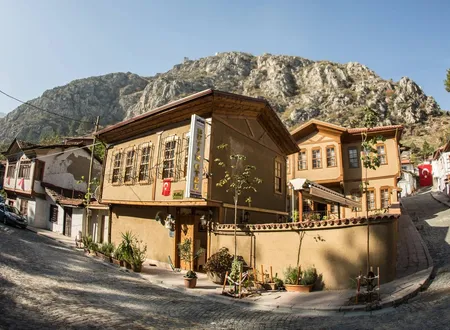
Ormanbağları Neighbourhood in Amasya's Central district appears in official records mostly as "Orman Bağları" and is one of the least populated of the forty neighbourhoods of the city centre. Its present administrative identity is fairly recent; the neighbourhood is one of the former villages drawn within the municipal boundary as the town grew. The name itself is far older than that status. Hüseyin Hüsameddin Yasar's Amasya Tarihi records that an eighteenth-century native of Amasya built a small mosque "in Orman Bağları", and in the same work the town's endowment records show vineyards lying "in the forest" being given to charitable foundations. Beside the grand monuments of the historic centre, squeezed into the narrow valley of the Yeşilırmak, this small settlement holds a quiet place; what is known of its past is kept in a few lines of biography, a footnote and the population registers. For that reason the known and the unknown are kept apart throughout.
Orman Bağları in Ottoman Records
In the first to fourth volumes of Hüsameddin's work, which list the town's quarters, mosques, madrasas and baths one by one, no quarter named Orman Bağları appears, and no settlement of that name is found in the ninth to twelfth volumes either. Osman Fevzi Olcay's Amasya Hâtıraları does not mention the place. The name surfaces in the sixth volume, which introduces notable Amasyans in alphabetical order, in the footnote to a biography, and there it is used as the name of a vineyard area: "Orman Bağlarında bir mescid-i şerîf bina etmişdir" (he built a mosque in Orman Bağları). This sentence is the only known written record showing that the name is at least two hundred and fifty years old.
Because these sources record the old quarters in such detail, the absence of the name as a quarter suggests that the settlement was not an old town quarter, and that inference holds as far as quarter status is concerned; Orman Bağları does not appear in the lists of the quarters of Ottoman Amasya. As a place name, however, Orman Bağları was known in the eighteenth century, and there was a mosque there. The present neighbourhood therefore looks less like a settlement founded from nothing than like the continuation of a vineyard area whose name has been in use since Ottoman times. There is, however, no document showing that the Orman Bağları of the footnote coincides exactly with the boundaries of today's neighbourhood.
Bâlioğlu Ahmed Ağa and the Orman Bağları Mosque
The man who built the mosque is mentioned briefly among the biographies Hüsameddin groups under the heading "Ahmed Ağa", directly after another Ahmed Ağa. The son of Ali Ağa, this Amasyan was enrolled in the eighty-seventh company of the silahdar corps in 1168 [1754-55] and rose step by step to become the corps' kethüda (steward). The silahdar corps was one of the mounted household cavalry divisions attached to the Ottoman palace, and its stewardship was among the senior posts in its administration; for a man from the provinces it was a respected position reached at the centre. Hüsameddin does not give his date of death explicitly, saying only "bu târîhlerde vefât etdi" (he died around this time). Since Hacı Velizâde Ahmed Ağa, described just before him, died in 1190 [1776-77], Ahmed Ağa son of Ali Ağa evidently died at roughly the same time.
The last sentence of the biography gives his nickname: Ahmed Ağa was known as "Bâlioğlu". The footnote states that the nickname was also pronounced "Bâlîzâde", and it is in this note that the mosque in Orman Bağları is mentioned. Ahmed Ağa's sons, Hâfız Ahmed Efendi and Mehmed Efendi, became imams of the mosque their father had built. For a time the two brothers shared the office; when Mehmed Efendi died in 1204 [1789-90], Ahmed Efendi remained sole imam. This detail shows that the mosque was built no later than 1789-90 and was functioning with a regular congregation at the end of the eighteenth century. That the imamate of a mosque passed from father to sons, and on the death of one son to the survivor, also shows how often offices in Amasya's small mosques were handed down within a family.
Hüsameddin's text mentions the two Ahmed Ağas one after the other but establishes no kinship between them; the footnote belongs to the second man, the steward of the silahdar corps. There were other families in Amasya bearing the name "Bâlîzâde". The work also mentions scholars such as Bâlîzâde Abdurrahman Efendi, who died at the beginning of the sixteenth century, and Molla Bâlîzâde Hacı Hasan Efendi, who served as deputy to the marshal of the descendants of the Prophet (nakîbüleşraf) at the end of the eighteenth century. Whether any of them were related to Bâlioğlu Ahmed Ağa, who built the Orman Bağları mosque, is unknown; no family link has been drawn on the strength of a similar name. Beyond this footnote, no information has been found about the mosque's name, structure, endowment or present condition.
Vineyards Endowed "in the Forest"
Two other records in Hüsameddin offer a clue to how the name Orman Bağları should be read. In them, "orman" (forest) is used almost as the name of a particular area of Amasya where vineyards lay. The first is in the section on the Sultan Bayezid Mosque. To the north-east of the mosque, on the riverbank, Türedîzâde Hacı Ali Ağa built in 1197 [1782-83] a row of taps so that the congregation could perform their ablutions with warm water in winter, with a room behind them for heating the water, and to meet the costs he endowed "ormanda kâ'in bir bâğını", that is, his vineyard lying in the forest. People called the place "Sıcak Su" (Warm Water). According to Hüsameddin, this vineyard, together with a shop endowed for a small ablution fountain nearby, later passed out of the endowment into private ownership, and the room and fountain, deprived of their income, fell close to ruin.
The second record concerns Hacı Ahmed Ağa, son of Usûlzâde Ömer Bey of the notables of the Karatay quarter, who was known as "Damgacı Ağa" because he made his fortune as tax-farmer of the stamp duty. Damgacı Ahmed Ağa, who also served as town steward, founded in 1174 [1760-61] an endowment for lessons at the Sultan Bayezid Mosque, so that hadith and Qur'anic exegesis would be taught every Friday and the collections of al-Bukhari and Muslim known as the Sahih read, and he gave to this endowment two plots of vineyard lying "in the outer forest". He entrusted the lessons to his son-in-law, the noted hadith scholar Sekü köylüzâde Hacı Hâfız Osman Efendi. The same man also rebuilt the Şeyh Mosque in İçerişehir.
These two records suggest that in eighteenth-century Amasya the word "orman" described, besides wooded land, a known area outside the town where vineyards lay; the phrase "outer forest" also hints that this area was divided into parts. In that light the name Orman Bağları can be read as "the vineyards of Orman". There is, however, no document showing that the vineyards given to the Sıcak Su and to Damgacı Ahmed Ağa's lesson endowment lay within the present boundaries of Ormanbağları. Hüsameddin describes their location no more closely, and the connection remains an interpretation.
Origin of the Name
The name of the neighbourhood is made of two words: "orman" (forest) and "bağ" (vineyard, orchard). At first sight it evokes woodland and vineyards or orchards. Given Amasya's tradition of vine-growing and fruit-growing, the association is not surprising. The town, set in the Yeşilırmak valley at the foot of Mount Harşena, is a garden town known for its misket apples, cherries and peaches; the water of the valley and the shelter of its slopes created conditions well suited to vines and fruit trees. Hüsameddin's records give this general association a concrete footing: in the eighteenth century Orman Bağları was in use as a place name, and in the area called "orman" there were vineyards valuable enough to be endowed. No document has been found showing when the name was first given, which forest it refers to or what crop the vineyards were devoted to; no unsourced guess has been made.
The same district also has villages named Ormanözü and Bağlarüstü. The former name of Ormanözü was Mörek and that of Bağlarüstü was Moramıl; these, in other words, are new names given in the Republican period. Ormanbağları is a different case: since its name appears in an Ottoman record, it is evidently not a name imposed later. No connection can therefore be drawn between the naming of the three settlements beyond the similarity of the words.
From Village to Neighbourhood
The most useful clue to the neighbourhood's recent history is its administrative status. According to Bekir Başalan's study of changed place names in Amasya, the Central district had one hundred villages in 2024, to which the villages later converted into neighbourhoods must be added. Başalan lists these nine settlements one by one: Boğazköy, Fındıklı, Helvacı, Karasenir, Orman Bağları, Saraycık, Yazıbağları, Yeniköy and Yeşilyenice. Ormanbağları thus belongs among the former villages that gained neighbourhood status as the town expanded. That a place known in the eighteenth century as a vineyard area outside the town became in time a village and then a neighbourhood can be read as one course in the relationship between Amasya's belt of vineyards and gardens and the town itself; when its village status began, however, is not known. As the surface-area and population figures below also show, the settlement is akin less to the town centre than to the rural fringe, the belt of farmland, vineyards and gardens that thins out around the centre.
The same study notes that the names of thirty-five settlements in the Central district were changed, a proportion of twenty-four per cent. Ormanbağları is not in the table of changed names; according to the study, then, there is no record of the settlement ever having been known by another name. This agrees with Hüsameddin's record showing the name in use since Ottoman times. The sources used do not give the year in which the village became a neighbourhood, so no date has been written.
Location and Settlement Pattern
Ormanbağları is one of the forty neighbourhoods of the Central district of Amasya Province, with the postcode 05100. In the postal service's district arrangement it is listed as one of the nineteen neighbourhoods attached to the Gökmedrese area; the same group includes historic town quarters such as Hatuniye, Şeyhcui, Üçler, Hızırpaşa and Gökmedrese together with settlements such as Helvacı and Karasenir that were villages before becoming neighbourhoods. This grouping serves only postal delivery and does not show the neighbourhood's exact location.
According to compilations based on TÜİK (Turkish Statistical Institute) data, its surface area is about 1.103 square kilometres. The figure stands out when compared with the small quarters of the historic core of the Central district: Hatuniye covers about 0.544 and Nergiz about 0.093 square kilometres. With a population of around 160, Ormanbağları has roughly 145 people per square kilometre; rather than a tight, dense historic fabric, the neighbourhood covers a relatively wide and thinly settled area. This picture fits what one would expect of a former village named after its vineyards and sets it apart from the narrow quarters of the historic core.
The sources used do not describe which roads and valleys the neighbourhood borders; rather than draw inferences from a map, this detail has been left out. The known general framework is that Amasya was built in the narrow valley cut by the Yeşilırmak, between Harşena and the opposite slopes, and that the settlement spread largely along both banks of the river. Buildings that found no room on the valley floor climbed the slopes, and the fabric loosened where the valley widened; this description holds for the town as a whole and does not show Ormanbağları's exact place within it.
Historic and Religious Buildings
No verified record has been found of a registered tomb, bathhouse, fountain or bridge within the boundaries of Ormanbağları. Amasya's well-known monuments (Harşena Castle, the Mirror Cave, the Alçak Bridge, the Tomb and Madrasa of Halifet Gazi) stand in other neighbourhoods and in the town centre; attributing them to this neighbourhood would be wrong.
The neighbourhood's known religious building today is the Ormanbağları Neighbourhood Mosque on Orman Bağları Street. It is registered under the neighbourhood's name in the list of mosques of the Central district; no details have been found about its date of construction, founder or architecture. Whether there is any continuity between the mosque that Bâlioğlu Ahmed Ağa built in Orman Bağları in the eighteenth century and the present mosque, that is, whether the present building stands on the site of the old one or is a renewed form of it, is not known. Since no inscription, endowment record or repair document showing this has been found, the two buildings have not been linked. Still, the fact that a place of worship is recorded in an area bearing the same name two and a half centuries apart suggests that the settlement kept a congregation, however small, throughout that time.
Population and Change
The most concrete information known about the neighbourhood is its population. According to a population table (based on ADNKS, the address-based population registration system) compiled by amateurs who state that they do not guarantee its accuracy, the population of Orman Bağları Neighbourhood was as follows:
- 2012: 182
- 2013: 174
- 2014: 165
- 2015: 162
- 2016: 155
- 2017: 160
- 2018: 150
- 2019: 145
Between 2012 and 2019 the neighbourhood shrank by about 20 per cent, from 182 people to 145, the only exception being the slight rise in 2017. In a separate compilation based on the 2023 TÜİK population reports, the neighbourhood's population appears as 160. This equals the 2017 figure and suggests some recovery after 2019; but because the two compilations do not use the same method, comparisons between years should be made with care.
In the ranking of the Central district, Ormanbağları is second from the bottom in both the 2019 and the 2023 figures. In the 2019 table only Hatuniye (126) is smaller; Gümüşlü (167), Nergiz (174) and Saraycık (183) follow it. In the 2023 compilation, too, Hatuniye is the smallest neighbourhood with 127 people, with Orman Bağları at 160, Gümüşlü at 173 and Saraycık at 178. At the other end of the tables stands Şeyhcui, with 23,145 people in 2019; in the 2023 compilation it is again the most populous neighbourhood, with 20,971. In the Central district the gap between the largest neighbourhood and the smallest exceeds a hundred and fifty times; two different scales of life appear side by side in these figures, within the same administrative unit of the same town.
The sources offer no explanation for the fluctuation in population. None of the possible factors, such as migration, ageing, house building or boundary changes, is documented, so none has been put forward.
Ormanbağları Today
Today Ormanbağları appears in the official records as one of the least populated neighbourhoods of Amasya Central. Because it lies outside the town's well-known sightseeing routes, the rock tombs, the castle and the riverside Yalıboyu houses, it seldom appears in tourist sources, which is why so little has been written about it until now. No written source has been found on the history of its muhtar's office (the elected neighbourhood headman), its customs or its local stories; this gap is best filled by the oral memory of its residents. The records of Bâlioğlu Ahmed Ağa's mosque and of the vineyards "in the forest" also show where research could continue: searching tax registers, endowment deeds and the Islamic court registers for the name Orman Bağları and for the phrases "orman" and "dış orman" (outer forest) could shed light on the mosque's endowment, the owners of the vineyards and the process by which the settlement became a village.
Chronology
1754-55 (1168): Ahmed Ağa son of Ali Ağa, "Bâlioğlu", who would later build a mosque in Orman Bağları, is enrolled in the eighty-seventh company of the silahdar corps.
1760-61 (1174): Damgacı Hacı Ahmed Ağa gives two plots of vineyard lying "in the outer forest" to his lesson endowment at the Sultan Bayezid Mosque.
c. 1776-77 (1190): Bâlioğlu Ahmed Ağa, steward of the silahdar corps, dies.
1782-83 (1197): Türedîzâde Hacı Ali Ağa endows his vineyard lying "in the forest" to the Sıcak Su ablution place beside the Sultan Bayezid Mosque.
1789-90 (1204): Mehmed Efendi, one of the imams of the Orman Bağları mosque, dies; the office passes to his brother Hâfız Ahmed Efendi.
2012: The neighbourhood's population is recorded as 182.
2019: The population falls to 145; the neighbourhood is the second smallest in the Central district.
2023: The population is reported as 160.
2024: Başalan's study names Ormanbağları as one of the nine villages later converted into neighbourhoods.
Bibliography
Primary sources
- Hüseyin Hüsâmeddîn Yasar, Amasya Tarihi, vol. 6 (e-book pp. 209-210; biography of Ahmed Ağa son of Ali Ağa, "Bâlioğlu", and footnote 83 on the Orman Bağları mosque).
- Hüseyin Hüsâmeddîn Yasar, Amasya Tarihi, vol. 6 (e-book p. 207; biography of Damgacı Hacı Ahmed Ağa, vineyards endowed "in the outer forest").
- Hüseyin Hüsâmeddîn Yasar, Amasya Tarihi, vol. 1 (e-book p. 118; the Sultan Bayezid Mosque, Türedîzâde Hacı Ali Ağa's Sıcak Su endowment and the vineyard "in the forest").
- Osman Fevzi Olcay, Amasya Hâtıraları (searched to establish that it contains no record of the neighbourhood). amasya.bel.tr
Academic studies
Official sources
Other sources
- nufusu.com, "Merkez Mahalleleri Nüfusu, Amasya" (neighbourhood population tables 2012-2019; amateur compilation).
- AtlasBig, "Amasya Amasya Merkez'in Mahalleleri, Nüfus Bilgileri, Haritalar ve İstatistikler" (compilation based on the 2023 TÜİK population reports; population and surface area).
- List of mosques in Amasya Central (entry for the Ormanbağları Neighbourhood Mosque).
- posta-kodlari.com, "Amasya Amasya Merkez Gökmedrese Posta Kodu 05100" (neighbourhoods attached to the Gökmedrese area).
Online sources
- https://amasya.bel.tr/uploads/e-kitap/kitap/6-8/files/basic-html/page207.html
- https://amasya.bel.tr/uploads/e-kitap/kitap/1-4/files/basic-html/page118.html
- https://dergipark.org.tr/tr/download/article-file/4249891
- https://www.nufusu.com/merkez-amasya-mahalleleri-nufusu
- https://atlasbig.com.tr/amasya-amasya-merkezin-mahalleleri