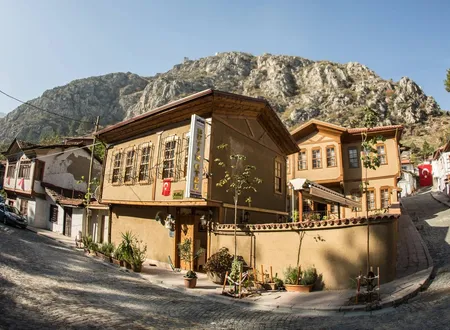
Saraycık Neighbourhood is one of the neighbourhoods of Ziyaret, a town (belde) attached to Amasya Central District. The name recurs often across the province: there are separate settlements called Saraycık in Merzifon, in Gümüşhacıköy and in the Central District itself, so it has to be stated at the outset which one is meant. What is described here is the neighbourhood inside the boundaries of Ziyaret, in the Yeşilırmak valley, some three kilometres from the centre of Amasya. No book or article-length study of the neighbourhood exists; what is known rests on administrative records, population series and local news of recent years; where there is no document, as with the origin of the name, that has to be said plainly. Over the last few years the neighbourhood's name has come up again and again in connection with a series of works, from irrigation lines to the DSİ reservoir and the Yeşilırmak flood embankment, from natural gas to road building; the visible face of Saraycık today is largely the sum of these works.
Location
Saraycık lies in the north-east of Amasya, where the narrow valley through which the Yeşilırmak divides the city widens towards Ziyaret. The road that leaves the city centre and follows the river passes, in this stretch where the mountains draw apart, between orchards and small settlements. The old core of Ziyaret leans against a hillside descending from Akdağ; Saraycık, as far as the news of recent years allows one to judge, lies below that slope, on the valley floor, close to the river. The report that the State Hydraulic Works (DSİ) carried out its improvement work on the Yeşilırmak embankment directly "in Saraycık Neighbourhood" is the clearest sign that the neighbourhood reaches down to the riverbank. The neighbourhood is therefore at once near the city and on the scale of a village: the built-up area of Amasya does not extend this far, yet the centre is only some three kilometres away.
Which Saraycık
Two separate Saraycıks circulate in Amasya Central District, and the sources frequently confuse them. A place-name study based on Ministry of the Interior data lists Saraycık among the hundred villages of the Central District; the same study, when counting the villages later turned into neighbourhoods, names another Saraycık alongside Boğazköy, Fındıklı, Helvacı, Karasenir, Yeniköy and Yeşilyenice. In other words, the Central District has both a Saraycık that has kept its village status and a Saraycık that has become a neighbourhood. That the neighbourhood belongs to Ziyaret is clear from the phrase "Ziyaret Town, Saraycık Neighbourhood" used by the municipality and by local news agencies. The village, for its part, is the settlement that a map service places at about 40.62 north, 35.95 east; set against the coordinates of central Ziyaret (roughly 40.69 north, 35.87 east), it lies some ten kilometres away.
The distinction looks minor, but it changes how the records are read. The entry given in encyclopaedias under "Saraycık, Amasya", with 142 inhabitants in the 2021 address-based census, belongs to the village; the neighbourhood's population series is a separate one, ranging between 160 and 190. The reports of April 2026 that the Provincial Special Administration was renewing water and sewer lines were also written about "Saraycık village". The Provincial Special Administration's remit is the villages, so that work very probably concerns the village and has not been used as information about the neighbourhood. The same confusion might arise over the DSİ reservoir; but every report on the reservoir describes it explicitly as a facility built "in the town of Ziyaret" and notes that the mayor of Ziyaret has been following its construction, so it is treated below together with the Saraycık inside the town.
The Saraycık that appears in Hüseyin Hüsâmeddîn Yasar's Amasya Tarihi, however, is neither this neighbourhood nor the village in the Central District. Yasar relates that the sixty or so villages of the district of Hacıköyü were formerly divided into four nahiyes (sub-districts), and that the Kabakoz Nahiye was later joined to the "Saraycık Nahiye". This sub-district took its name from the village of Saraycık and covered the northern and partly the western parts of the district; the village where Şeyh Saltuk Baba and his descendants lived, known as "Şeyhler" or "Şeyhoğulları", and Segü, the village of Següköylü Hacı Mehmed Efendi, ancestor of a family of religious scholars in Amasya, also lay within it. This information concerns the Saraycık within today's Gümüşhacıköy; it has nothing to do with the neighbourhood in Ziyaret and should not be used for the neighbourhood's past.
The Name
The word "Saraycık" can be read as a form made by adding the diminutive suffix "-cık" to the Turkish word "saray" (palace); the meaning "little palace" follows naturally from the grammar. Yet there is no accessible document showing from which building, person or event the Saraycık in Ziyaret took its name. Bekir Başalan's study, which lists the settlements of the Central District whose names were changed, does not include Saraycık; it describes how names such as Ziyaret, Karakese, Ümük and Yeşilyenice were altered in ways that still recall their older forms (Ziyere, Karakise, İmük, Yenice), while Saraycık stays outside that list. On this evidence the name has not undergone an official renaming, at least in recent times. The tradition of Sultan Mesud's pavilion that Hüsâmeddîn Yasar records for Ziyâre might suggest a connection, but Yasar ties that pavilion to Ziyâre itself, does not mention Saraycık, and offers the pavilion story only as a conjecture. Linking the neighbourhood's name to a palace or a mansion would therefore be groundless, and it has not been done.
Within the Town of Ziyaret
Ziyaret, to which Saraycık belongs, is an old settlement in the north-east of Amasya, founded on the skirts of a mountain that descends from Akdağ towards the Yeşilırmak. Hüsâmeddîn Yasar describes it among the quarters of Amasya under the heading "Ziyâre Quarter", writing that the older form of its name was "Zemendû" or "Semendû" and that the common people called it "Ziyere". According to Yasar the settlement was once enclosed by a wall; the foundation stones and ruined walls visible at the edge of the vineyards and on the mountainside show this. There is no firm document on the origin of the name. Yasar rejects Vâzıh Efendi's view that Ziyere was the name of a monastery, on the grounds that it rests on no document; he reports, purely as a conjecture, that the name "ziyâre" may have arisen from Sultan Mesud's frequent visits to his pavilion here.
The same source relates that the Seljuk emir Hoca Muhibbeddîn Mevdûd built here, around AH 680, a mosque with stone foundations, a red-brick minaret and a timber superstructure, together with two baths, and created a walled pool to the west and north-west of the stream. The account also records that during the governorship of Bayezid II in Amasya (around AH 870) the lower pool was built and the vineyards below it were made into a crown garden. Water-storing works are thus nothing new in the town; the fact that the State Hydraulic Works is building a reservoir within the same town boundaries today may be seen as a kind of continuation of those pools of centuries ago. The mosque was later ruined, repaired around AH 970 by Keçioğlu Hacı Ali Çelebi and known thereafter as the "Keçioğlu Mosque". Yasar says that Ziyâre at that time consisted of two quarters, the Lower Quarter and the Upper Quarter, each with a mosque, a bath and a school; he makes no mention of Saraycık. The neighbourhood may therefore be a later settlement lying outside this old core, or a part added to it; no written information on this has been found.
Ziyaret's present administrative status is more recent. Its municipality was established in 1958, and the town is attached to Amasya Central District. Its population was recorded as 3,745 in 2013, 3,901 in 2014, 3,965 in 2020 and 4,084 in 2021. That the town is known for its fruit growing is an emphasis repeated constantly, from Yasar's mention of its vineyards and apples to the municipality's statements today; the local press calls the town Amasya's "fruit production centre". Saraycık's place in this shared life is also seen above all through farm water.
From Village to Neighbourhood
That Saraycık was formerly a village is clear from Başalan's list of "villages later turned into neighbourhoods". It is not clear, however, by what decision and on what date the change from village to neighbourhood took place. The fact that population compilations contain a series for it as a neighbourhood beginning in 2012 suggests that the change may have been made around that time. Since Amasya is not one of the metropolitan provinces covered by Law No. 6360, it would be wrong to explain the conversion by that law; villages joined to a town municipality such as Ziyaret becoming neighbourhoods is, rather, the ordinary result of municipal legislation. This explanation is an interpretation; no decision or date concerning the change has been found. Its practical consequence, though, is plain in the news of recent years: works such as roads, irrigation lines, natural gas and the culture house are now carried out and announced by Ziyaret Municipality; the Provincial Special Administration, which serves the villages, does not appear in these reports.
Population
The population of Saraycık Neighbourhood does not reach even a few hundred. The series compiled from the results of the address-based population registration system is as follows:
- 2012: 163
- 2013: 160
- 2014: 171
- 2015: 167
- 2016: 166
- 2017: 178
- 2018: 186
- 2019: 183
A compilation based on 2023 data gives the neighbourhood's population as 178. Over ten years the series has stayed between 160 and 190; no large-scale emigration or depopulation is visible. In a settlement of this size the departure of a few households or the arrival of a new family is enough to move the figure; the rise from 166 in 2016 to 186 in 2018 should be read on that scale. Over the same period the total population of the town of Ziyaret is around four thousand; Saraycık forms a small part of it, and within the town this thinly settled place on the valley floor differs clearly in scale from the old quarters on the mountainside. The figure of 142 given for the village of Saraycık is a separate record and should not be compared with this series.
Farming and Irrigation
There is no detailed record of what livelihoods in Saraycık rest on; no information specific to the neighbourhood on crops, orchards or holdings has been published. What is available is the attention the town administration has paid to the irrigation lines in the neighbourhood. In the work announced on 3 May 2026 it was reported that Ahmet Kemal Dayıoğlu, Mayor of the town of Ziyaret, inspected the work in Saraycık Neighbourhood on site and was briefed by the crews, and that ahead of the summer worn sections of the agricultural irrigation lines were being renewed and faulty points repaired. Dayıoğlu explained the work with the words "Agriculture is one of our town's most important sources of livelihood", and said the aim was for producers to be able to water their fields without trouble. The report gives neither the scale of farming in the neighbourhood nor the kinds of crops; but the fact that the irrigation line in Saraycık was taken in hand is enough to show that the neighbourhood is among the town's irrigated orchards and fields.
The Saraycık Reservoir
The largest water investment in the town in recent years is the State Hydraulic Works' reservoir bearing the name Saraycık. According to information shared by the DSİ 7th Regional Directorate at the end of May 2025, the embankment fill of the Saraycık Reservoir under construction in the town of Ziyaret had been completed. The reservoir is being built as a clay-core rockfill dam, rising 47.5 metres above its foundation. It was announced that on completion it would bring water to 970 decares of farmland. The reservoir's exact location, that is, whether it lies within the neighbourhood's boundaries or in another part of the town's lands, is not stated in the reports; it may be supposed that it takes its name from the neighbourhood, but no statement confirming this has been found.
The reservoir has also been a project the town administration has followed closely. It was announced that on 9 September 2025 Ziyaret's mayor, Dayıoğlu, inspected the work being carried out at the Saraycık Reservoir and on its transmission line, was briefed by the site manager on the work done and planned, and that the findings were passed on to the DSİ Provincial Directorate. Dayıoğlu said they would follow the process closely and persistently until "the project is completed and impounding of water begins". This wording shows that even several months after the embankment fill was finished, the reservoir had not yet begun to hold water. The mention of a transmission line also shows that the reservoir was designed as part of an irrigation system that will carry its water to the fields.
That construction continued into 2026 is clear from a statement on investments in Amasya made in April 2026 by Mehmet Akif Balta, Director General of DSİ. While noting that over the past twenty-three years DSİ had given Amasya eight dams and two reservoirs, Balta also listed the works still under construction, saying that they consisted of one dam and one reservoir, namely the Aydınca Dam and the "Ziyaret Saraycık Reservoir". The Saraycık Reservoir was thus recorded at that date as the only reservoir under construction in the province. The date on which it began to hold water or was opened for irrigation does not appear in the sources on which this article rests.
The Yeşilırmak and Flooding
Saraycık's nearness to the river makes it easier for the neighbourhood to use the water, but it also leaves it exposed to flooding. In mid-May 2026 the Yeşilırmak, swollen by the rains that hit Amasya, overflowed and left farmland and greenhouses under water in the town of Ziyaret, attached to the city centre, in the villages of Aksalur, Büyük Kızılca, İpekköy, Karaköprü, Kayrak, Ovasaray, Sarıkız and Yeşildere, and in Yeşilyenice neighbourhood. The affected area is given as 5,850 decares in the Anadolu Agency report of 17 May; the İhlas News Agency, in its report of the day before, speaks of more than 4,500 decares of farmland for the same flood. The governor's office announced that damage assessment was under way. The reports name the town as a whole and do not mention Saraycık separately; which fields in the neighbourhood were flooded is therefore not known.
Four months after the flood, on 9 September 2026, it was reported that State Hydraulic Works crews were carrying out improvement work on the Yeşilırmak embankment in Saraycık Neighbourhood. The report says the work was being done so that the situation would not recur on the river, "where floods occurred at many points because of the heavy rains of recent months"; the town's mayor, Dayıoğlu, also inspected the work on site and was briefed by the crews. The section and the length of embankment being improved were not stated. Even so, the report makes it clear that the neighbourhood lies on the valley floor, along a stretch of bank protected by an embankment. The renewal of irrigation lines on one side and the strengthening of the flood embankment on the other, in the same neighbourhood, show that the Yeşilırmak is for Saraycık a source both of livelihood and of unease.
Building and Infrastructure Work in Recent Years
For a small neighbourhood, written records are scarce; the fullest information comes from the investments Ziyaret Municipality has made here over the past decade, and it is these investments that shape the neighbourhood's present appearance. On 25 January 2017 the municipality began building a culture house in Saraycık; this date, announced as the day the first sod was turned, marks the start of work undertaken at the initiative of the then mayor, Mehmet Uyanık. The municipality refers to it in its own announcement as the "3rd Culture House". It is thus the third of Ziyaret's culture houses, which shows that the neighbourhood was planned as a separate social centre within the town. There is no accessible record of the building's later progress; the presence in the municipality's news archive of another announcement from the same year, headed "Our Saraycık Culture House Construction", shows that the work continued.
The neighbourhood long went without natural gas. On 13 August 2025 Ahmet Kemal Dayıoğlu, Mayor of the town, announced that the gas line had reached Saraycık and that connections within the neighbourhood were complete, saying the gas would be turned on once subscription formalities were finished. The report stresses that the neighbourhood had "waited for years" for this service, and adds that the trenches opened along the pipe routes would be repaired once the fill had settled. That promise appears to have been kept on 20 September 2026. On that date the municipality reported that asphalting was under way on Saraycık roads dug up for pipe replacements carried out as part of the infrastructure work, and Dayıoğlu inspected the work on site. The municipality's statement announced the work with the words "We are renewing our infrastructure and making our roads more beautiful". The report's phrase "pipe replacements" suggests that other lines besides natural gas were also renewed, but it does not say which.
Historic Buildings
No verified information has been found that there is any registered building, mosque, fountain or monument within the boundaries of Saraycık Neighbourhood. The historic buildings of the town of Ziyaret (the Keçioğlu Mosque and the old quarters around it) are concentrated in the Lower and Upper Quarters; no old endowment, mosque or inscription bearing Saraycık's name is known. In this respect the neighbourhood stands beside Ziyaret's long past without carrying its written traces; what is visible today is mostly the culture house, the gas line, the irrigation lines and the renewed roads of recent years. Osman Fevzi Olcay's Amasya Hâtıraları mentions the road to Ziyaret and names İhsaniye Quarter, which ended at the fork of Kulis Tepesi and the Ziyaret road; but the name Saraycık does not appear. Nor does the name occur in volumes 6 to 12 of Hüsâmeddîn Yasar's Amasya Tarihi. For the neighbourhood's founding, its first inhabitants and the origin of its name, the Amasya Islamic court registers, the Ottoman tax surveys and Ziyaret Municipality's own archive are the sources that could be searched.
Chronology
1958: A municipality is established in the village of Ziyaret.
2012: First population record for Saraycık as a neighbourhood (163).
25 January 2017: The first sod is turned for the Saraycık Culture House.
May 2025: The embankment fill of the Saraycık Reservoir in the town of Ziyaret is completed.
13 August 2025: The natural gas line reaches Saraycık Neighbourhood.
9 September 2025: The town's mayor inspects work on the Saraycık Reservoir and its transmission line; the reservoir is not yet holding water.
20 April 2026: DSİ announces that the Ziyaret Saraycık Reservoir is the only reservoir under construction in Amasya.
3 May 2026: Report on the renewal of irrigation lines in Ziyaret; the work is also inspected in Saraycık.
16-17 May 2026: The overflowing Yeşilırmak floods farmland and greenhouses in the town of Ziyaret and the surrounding villages.
9 September 2026: DSİ crews carry out improvement work on the Yeşilırmak embankment in Saraycık.
20 September 2026: Asphalting continues on Saraycık roads after the infrastructure work.
Bibliography
Primary sources
- Hüseyin Hüsâmeddîn Yasar, Amasya Tarihi, vols. 1-4, pp. 121-122 (Ziyâre Quarter); pp. 191-192 (district of Hacıköyü, Saraycık Nahiye): https://amasya.bel.tr/uploads/e-kitap/kitap/1-4/files/basic-html/page121.html
Academic studies
- Bekir Başalan, "Amasya'da Adı Değiştirilen Yerleşimler", DergiPark (village/neighbourhood lists for the Central District and Gümüşhacıköy): https://dergipark.org.tr/tr/download/article-file/4249891
Other sources
- nufusu.com, "Merkez Mahalleleri Nüfusu Amasya" (TÜİK/ADNKS series, 2012-2019): https://www.nufusu.com/merkez-amasya-mahalleleri-nufusu
- Atlasbig, "Amasya Merkez'in Mahalleleri, Nüfus Bilgileri" (TÜİK 2023): https://atlasbig.com.tr/amasya-amasya-merkezin-mahalleleri
- Objektif Amasya (İhlas News Agency), "Amasya'ya Yeni Gölet: Gövde Dolgusu Tamamlandı", 31 May 2025: https://www.objektifamasya.com/haber/25140088/amasyaya-yeni-golet-govde-dolgusu-tamamlandi
- Objektif Amasya, "Ziyaret'in Saraycık Mahallesi Doğalgaza Kavuştu", 13 August 2025: https://www.objektifamasya.com/haber/25947082/ziyaretin-saraycik-mahallesi-dogalgaza-kavustu
- Objektif Amasya, "Saraycık Göleti ve İletim Hattındaki Çalışmalar Yerinde İncelendi", 9 September 2025: https://www.objektifamasya.com/haber/26230116/saraycik-goleti-ve-iletim-hattindaki-calismalar-yerinde-incelendi
- Objektif Amasya, "DSİ'den Amasya'ya 23 Yılda 26 Milyar Liralık 149 Eser", 20 April 2026: https://www.objektifamasya.com/haber/27846333/dsiden-amasyaya-23-yilda-26-milyar-liralik-149-eser
- Objektif Amasya, "Amasya'nın meyve üretim merkezinde sulama hatlarında çalışmalar sürüyor", 3 May 2026. amasya.bel.tr
- Haberler.com (AA), "Amasya'da seralar ve tarım arazileri sular altında kaldı", 17 May 2026: https://www.haberler.com/guncel/amasya-da-yesilirmak-tasti-5-bin-850-dekar-tarim-arazisi-sular-altinda-19855145-haberi/
- İhlas News Agency, "Amasya'da Yeşilırmak Nehri taştı, tarım arazileri sular altında kaldı", 16 May 2026: https://www.iha.com.tr/amasya-haberleri/amasyada-yesilirmak-nehri-tasti-tarim-arazileri-sular-altinda-kaldi-424183107
- Objektif Amasya, "Amasya Yeşilırmak'ta Islah Çalışmaları Sürüyor", 9 September 2026: https://www.objektifamasya.com/haber/28665504/amasya-yesilirmakta-islah-calismalari-suruyor
- Objektif Amasya, "Ziyaret'te Saraycık Mahallesi'ndeki Yollarda Asfalt Çalışması", 20 September 2026: https://www.objektifamasya.com/haber/28840478/ziyarette-saraycik-mahallesindeki-yollarda-asfalt-calismasi
Online sources
- https://dergipark.org.tr/tr/download/article-file/4249891
- https://www.objektifamasya.com/haber/25140088/amasyaya-yeni-golet-govde-dolgusu-tamamlandi
- https://www.objektifamasya.com/haber/27846333/dsiden-amasyaya-23-yilda-26-milyar-liralik-149-eser
- https://www.haberler.com/guncel/amasya-da-yesilirmak-tasti-5-bin-850-dekar-tarim-arazisi-sular-altinda-19855145-haberi/
- https://www.objektifamasya.com/haber/28665504/amasya-yesilirmakta-islah-calismalari-suruyor