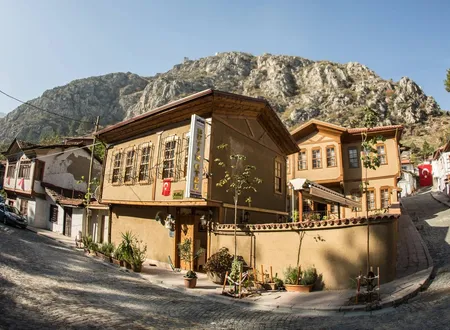
Sofular is a small neighbourhood in the central district of Amasya. Its population runs to a few hundred and its area is under half a square kilometre. Yet in the narrow ground around Pirler Park stand, close together, a hadith school founded by a beylerbey, a Halveti lodge from the time of Çelebi Mehmed, the tomb of the pirs and the tomb of a Bektashi postnişin. The history of the neighbourhood is largely the history of these buildings and of the scholar, sheikh and trustee families who lived around them; the streets, the houses and everyday life have left fewer traces in accessible sources. Hüseyin Hüsâmeddîn Yasar's Amasya Tarihi and Osman Fevzi Olcay's memoirs fill this gap in part, and the account below leans on them heavily.
Origin of the Name
A sofu is someone who lives in devotion and asceticism without attachment to worldly affairs; Sofular is its plural. Derivation from this word is the nearest explanation for the name, and the density of lodges, retreat cells and tombs in the neighbourhood supports the reading. No document has been found, however, that shows when or why the name was given, so the explanation remains a possibility. Hüsameddin also regards the name of the Sofular neighbourhood in Merzifon as a designation arising from figures of the ninth Hijri century; that the same name occurs in two districts shows that the word is not tied to one place. Some publications say the neighbourhood was also known as Molla; the origin of this name and the period of its use are uncertain.
Location and Boundaries
Sofular Neighbourhood lies in the city centre, around Pirler Park. The Sofular Mosque stands to the right at the exit to the park, and the Çilehane Mosque faces the park. Compilations based on TÜİK data give the area as roughly 0.394 square kilometres. The terrain is sloping, and this has directly shaped the buildings: because the Dârülhadis Mosque stands higher than the street to its north, it rests on two terraces at different levels.
Osman Fevzi Olcay describes the neighbourhood this way: the area running from the Saraydüzü locality and the rear, southern side of the Tomb of Pir İlyas, starting at the hill where the hospital now stands and reaching to the Sofular Mosque, is Sofular Neighbourhood. The slope is steep and tiring, but the air is good. According to Olcay, although the neighbourhood sits at the entrance to the city it has seen no development; still, people such as Ali Bey, a samovar repairer among the Oltu refugees, and Lütfü Bey, who retired from the Istanbul police and served as Finance Accountant in Amasya in the armistice years, were well-known residents of the quarter. Olcay's biography records that he was born in Sofular in 1887; he himself names Sofuzâde Neighbourhood as the place where he was born and raised. The sources do not make clear whether the two names denote the same place or two adjoining neighbourhoods.
Boundaries with neighbouring districts are unclear in the sources. Hüsameddin defines Çilehane Neighbourhood as the area around Aşağı Pirler and gives its limits: Savakça to the east, Gümüşlüzâde to the west, Mehmed Paşa to the north and the Pir İlyas cemetery to the south. In this older division the Çilehane Mosque would be expected to lie in a separate neighbourhood next to Mehmed Paşa. Accordingly, one official address record places the Çilehane Mosque in Mehmet Paşa Neighbourhood while other sources attach it to Sofular; the address of the Tomb of Hamdullah Efendi likewise carries both neighbourhood names. Olcay also mentions Çilehane as a small neighbour: a neighbourhood of five or ten houses with mulberry trees in its middle, a ruined mosque and, in its courtyard, the grave of Pir Abdurrahman Çelebi. The limits were evidently redrawn later, but the date is unknown.
Saray Düzü and the Gümüşlüzâde Garden
Pirler Park, on the northern edge of the neighbourhood, was a garden before it took its name from the tombs. According to Hüsameddin, the stream between Mount Lokman and the Balus Rock divides into two branches above the Beyler Palace; one runs west to Sofular Neighbourhood, the other north to Bayezid Paşa Neighbourhood. That this place, known among the people as "Beyler Sarayı", "Saray Düzü" and "Pir İlyas", appears in a sharia document dated 614 (1217-18) as "Mülk-i Gıyâseddîn Şah" may be taken as a sign that princes had lived here since Seljuk times. In later centuries the property passed to the Gümüşlüzâde family; Gümüşlüzâde Tâceddîn Mahmud Çelebi had a pavilion built here, and the eastern part was called "Gümüşlüzâde Köşkü" and the western part "Gümüşlüzâde Bahçesi". When Çelebi Sultan Mehmed came to Amasya he bought the pavilion and had a palace built in its place, while the garden stayed in the family's hands.
Hüsameddin relates that in a small, sturdy tomb at the head of the garden lie Dündi Hatun, wife of Tâceddîn Mahmud Çelebi, and his daughter Ayşe Hatun. Pir Hayreddin Hızır, of the line of Pir İlyas, was buried in a separate tomb near the Mahmud Çelebi Tomb, and so the Gümüşlüzâde Garden gradually became a cemetery. The high ground on its eastern side served for some three hundred and fifty years as the Amasya palace of the Ottoman dynasty. Hüsameddin writes that Çelebi Sultan Mehmed stayed there sixteen years, Murad II twenty and Bayezid II twenty-six, and from the ruins he infers a walled complex with a large harem and selamlık, two baths, two kitchens and two gardens with marble pools. The palace was damaged in the earthquake of 1147 (1734-35), could not be repaired because of the Iranian wars, and was destroyed completely in the earthquake of 1241 (1825-26). When the Amasya Idadi school burned in the fire of 1311 (1893-94), a new school was built on the western side of the palace garden, and between 1316 and 1318 a barracks was built in the middle of the old palace. The name of Saraydüzü Avenue recalls this past.
The Sofular Mosque and Dârülhadis
The building that gave the neighbourhood its name is the Sofular Mosque, also called the Abdullah Paşa Mosque and the Dârülhadis Mosque. According to the TDV Encyclopaedia of Islam, it was built by Beylerbey Hacısinanbeyzâde Abdullah Paşa, one of the statesmen of Bayezid II's time, to serve as a mosque and dârülhadis. The Pasha's death is recorded as 896 (1490-91); the endowment deed was drawn up by his son, the Chief Treasurer Abdülkerim Bey, in 907 (1501-1502). Hüsameddin writes that the complex was finished in 890 (1485) and names the son who drew up the deed as Abdî Bey; some records give the year of construction as 1502. This discrepancy suggests that the complex was begun in the Pasha's lifetime and completed by his son, but the sources give no clear detail on the matter. In 1505 Abdülkerim Bey also added a dârülkurrâ, a school where the Qur'an was taught, to the east of the building; this part has not survived.
The walls are of rubble stone, reinforced in places with three courses of brick bonding, with large cut stones at the corners. On the axis of the north façade is a portal with a depressed arch, reached by a two-sided flight of steps from a landing in front. Above the door are an Arabic inscription in thuluth script giving the founder's name and the date of construction, and a crown window. That the door sits high above the street, and that this section is deliberately tall, makes the façade look more imposing than it is. Beyond the door one enters a roughly square, rectangular-plan sofa that serves as a closed courtyard. A simple star vault covers it, and at the centre of the vault is an octagonal-prism light lantern. East and west of the sofa are two square-plan dârülhadis cells each, with depressed groin vaults; the cells have hearths with brick-built chimneys and cupboard niches. The prayer hall to the south also served as a classroom. A skew passage between the eastern cell and the prayer hall opens onto the grave of Abdullah Paşa and the courtyard where the dârülkurrâ once stood.
The prayer hall is reached by steps. This square space is covered by a pendentive dome carried on a twelve-sided, four-windowed drum; the weight of the dome is transferred by four pointed arches to cut-stone corner piers. Today the hall shows no marked decoration; only the vertically fluted conch of the mihrab draws attention. The wooden leaves of the portal and of the prayer-hall door are original; the inscriptions on their upper panels and the peony and rumi carving on the middle panels reflect the style of Bayezid II's period. At the northeast corner rises a minaret on a square base projecting outward. The cylindrical shaft is decorated with brick bonding and hexagonal brick cassettes, the balcony is worked with vertical fluting, and the minaret is finished with a conical wooden cap covered in lead.
In M. Baha Tanman's assessment the building has a design without parallel in Ottoman architecture. It embodies the link between closed-courtyard madrasas, represented by only two examples in the early Ottoman period, and mosques with tabhane, that is, zaviye mosques. Hüsameddin's description gives the same arrangement: in front of the inner door of the mosque are two small rooms on each side of a void under a large dome; the rooms are small and the real classroom is the mosque itself. According to the same author, the front of the mosque was the dârülhadis, the right side a madrasa, the left side formerly the dârülkurrâ, and the opposite side a classroom reserved for the learned. Some compiled publications mention a hexagonal rubble-stone Abdullah Paşa Tomb in the courtyard; since this information appears only in web sources, it should be treated with caution.
Hadith Teachers, Professors and Trustees
Under the heading Abdullah Paşa Medresesi, Hüsameddin lists the succession of professors and hadith teachers of the dârülhadis year by year. Scholars such as Şermîzâde Takiyyeddîn Osman Efendi and the professor Abdî Efendi served here as muhaddis and were held in esteem at the fifty-akçe grade in the ranking of madrasas. In 1098 (1687) Mahmud Efendi, in 1101 Hâfız Ömer Efendi, in 1124, on his father's death, his son Hâfız Abdullah Efendi, in 1136 İsmâil Efendi of Diyarbekir and in 1142 Seyyid Abdülvehhab Efendi of Ortaköy took up the lectures. Between 1145 and 1204 names such as Osman, Ahmed, Şeyh Mustafa and Şeyhülkurrâ Hâfız Osman appear; in 1228 Seyyid Mehmed Efendi, in 1246 Yenicelizâde Seyyid Mehmed Efendi, in 1248 Seyyid Mustafa Efendi and in 1257 Hoca Hâfız Mehmed Efendi became professors. In 1275 Hoca Hâfız Mehmed Efendi's sons Ömer Vehbî and Hasan Sıdkî ran the lessons together; by then the endowment revenues had been lost and the madrasa had fallen into ruin. In 1313 (1895-96) the public lecturer Gürcî Mehmed Efendi, with great effort and by raising contributions, had the madrasa rebuilt and became its honorary professor.
The administration of the endowment lay in the hands of a family of notables descended from the founder. In Hüsameddin's pages, Hacı Paşazâde Hüseyin Bey, of the line of Abdullah Paşa, settled in Amasya as trustee of the endowment on the death of his cousin Hacı Mustafa Bey in 1052 (1642-43). Evliya Çelebi, who came to Amasya in 1058 (1648), was a guest in this bey's mansion. Hüseyin Bey managed the endowment well for about nine years, enlarged it by adding some cash and income-producing properties, and died in 1061 (1651); his son was the mîr-i mîrân Abdülkerim Paşa. Another Hüseyin Bey of the line of Abdullah Paşa, son of Abdî Bey, followed him as trustee and died in 1066. Hüsameddin counts both among the notables. The same book also mentions, in the last quarter of the eighteenth century, el-Hâc Abdullah Bey son of Mehmed Bey and his sons from the family of trustees of the endowment.
Administrators are also among the people who came from the neighbourhood. One of the biographies Hüsameddin gives belongs to Koca Kethüdâ Hüseyin Ağa, son of the sipahi Mehmed Ağa of Sofular Neighbourhood. From 968 (1560-61) Hüseyin Ağa served several times as Amasya kethüdâyeri and mütesellim, in 1003 acted as deputy to the governor of Sivas, retired for old age in 1007, and died around 1011. In the 1620s another native of Amasya, the chief treasurer Vizier Abdülkerim Paşa, was put to death in Zilhicce 1034 (1625) through the jealousy of Grand Vizier Hâfız Ahmed Paşa, and his property was confiscated. When the treasurer of Sivas came to Amasya the following Muharram to take over the estate, the Pasha's sister Ayşe and his wife Ümmühânî Hanım came from Istanbul and settled in the inherited family house in Sofular Neighbourhood; when the house was put up for sale, Ayşe Hanım went to court and proved that the Pasha had given his share to her during his lifetime, and she barely saved the house from confiscation. A daily allowance of thirty akçe was fixed for them.
The Sofular Madrasa and the Scholars of the Neighbourhood
The second educational building tied to the mosque is the Sofular Madrasa. According to Hüsameddin, this madrasa lies west of the Abdullah Paşa Mosque, behind the dârülhadis, and the classroom opposite it was built in 1310 (1892-93) by Cünûnzâde Hacı Mustafa Ağa, one of the notables and an admirer of Tevfik Efendi, as a place of study for the students of Köprülü Hacı Hâfız Mustafa Tevfik Efendi, a well-known scholar of the day. The building was of timber and was run by Mustafa Ağa; its first professor was Hacı Hâfız Efendi. As Olcay describes it, the madrasa consisted of five or six rooms in the inner yard of the mosque, and, on the right side of the street, a building with a few rooms and a classroom. Köprülü Hacı Hâfız Tevfik Efendi taught in this classroom and received guests in his free time.
Olcay names the occupants of the rooms. The Provincial Stamp Duty Clerk Abdülaziz Efendi lived in the corner room facing the street; Olcay remembers him as good company, generous, hospitable and familiar with music, and writes that he would sometimes take a saz on his lap and make it speak. In the other rooms lived Şeyh Ağazâde Hâfız Ahmed and his brothers Hâfız Emin and Hâfız Muhyiddin. Olcay also mentions Abdülaziz Efendi's table: his cupboard held everything from olive-oil stuffed vegetables to water börek, and out-of-season fruit was never missing.
According to Olcay, at the very highest point of the neighbourhood lies Siraceddin İsmail Şirvânî, a Naqshbandi-Khalidi sheikh, father of Grand Vizier Mehmed Rüştü Paşa and teacher of Mir Hamza Nigârî. The imam and muezzin of the mosque and tomb that Şirvânîzâde Mehmed Rüştü Paşa had built was Türbeli Hâfız Sebâtî Mehmed Efendi, born in Erzurum; Hüsameddin presents him as a poet who came from Shirvan to Erzurum and from there to Amasya. Olcay writes that "our renowned poet Sebâtî Hoca" and his son Ali Hâver Bey lived around the Tomb of Mevlânâ Siraceddin. The Ministry of Culture and Tourism records state that the tomb was built by Rüştü Paşa in 1283 (1867) and stands on the high hill above Şamlar Neighbourhood; Olcay regards the same hill as the highest point of Sofular. The two descriptions show once more that neighbourhood boundaries overlap.
Lodges were also part of this area. Hüsameddin records the Şeyh Abdul Lodge in Sofular Neighbourhood at the western end of the Pir İlyas cemetery; the Naqshbandi sheikh Şeyh Abdullah Efendi built it in 961 (1553-54) and arranged its endowments. After being ruined and repaired several times, the lodge stood until 1271 (1854-55) and then disappeared. In the same year the Halveti sheikh Yâkub Efendi founded the Kuşbaz Lodge, on a spot facing the square east of the Çilehane Mosque, and arranged its endowments. After Yâkub Efendi, Şeyh Abdurrahman Efendi, a second Yâkub Efendi and Şeyh Hasan Efendi continued the guidance; after the lodge collapsed, its endowments passed to the Ministry of Education in 1897.
The Çilehane Mosque
The neighbourhood's second major building is the Çilehane Mosque, facing Pirler Park. Built in 1413 by Yakup Paşa, one of Çelebi Mehmed's emirs, it is in fact a Halveti lodge and is used as a mosque today. Hüsameddin writes that Yakub Paşa built, inside a masonry enclosure, a mosque, a minaret, a Halveti çilehane, that is a zaviye, on either side, a classroom in front and a separate sheikh's room, and drew up its endowment deed in 815 (1412-13). The deed mentions the death of Pir İlyas and his successor Pir Celâleddîn Abdurrahman; it records that Çelebi Sultan Mehmed had it built for this Abdurrahman Çelebi. Trusteeship was assigned to Mevlânâ Şemseddîn Mehmed el-Buhârî, one of the successors, and his children, and when their line ended to Mü'eyyed Çelebi and his children. Hüsameddin also lists the sheikhs of the lodge: after Pir İlyas, his son-in-law Gümüşlüzâde Pir Abdurrahman Çelebi, then Şemseddîn Mehmed Buhârî, his son Celâleddîn Abdurrahman Çelebi and, in 843, Pir Sun'ullah-ı Halvetî, sheikh of Saraçlar.
The building, made up of lodge, mescit and retreat cells, is entered through a cut-stone door with a flattened arch and a large iwan. The body walls are of rubble stone with spaces filled with red mortar, and the stonework is supported horizontally by double courses of brick bonding. The windows are marble-framed and brick-arched. On entering from the west door one finds on the right the mescit and the halvet rooms reached by small passages, and on the left the tomb and lodge section. A large dome covers each of the mosque and the lodge. West of the western entrance stands a separate structure, presumed to be a tomb. The halvet rooms are small cells in which a disciple, for a fixed period, withdrew from the world and spent his time in worship, and the çile that gives the building its name comes from this.
A special room inside Çilehane is the Tomb of Aşağı Pirler. According to Hüsameddin, beside the qibla there is a fatiha window, opened after the cell was built, with a black marble inscription above it; inside lies Pir Celâleddîn Abdurrahman-ı Sânî, son of Pir Hüsameddin and grandson of Pir İlyas. According to another view, Abdurrahman Çelebi, son-in-law and cousin of Pir İlyas, is buried here; the two accounts are interwoven and the sources do not agree on a single person. Hüsameddin also records that in 1031 (1621-22) a succession dispute lasting ten years took place in the lodge: to end the quarrel between Şeyh Hüsâmeddîn Efendi, preacher of the Yakub Paşa Mosque, and the scholar Şeyh Abdî Efendi, the sheikh's room, the lodge and the retreat were treated as a madrasa, the lodge's sheikhdom going to Hüsâmeddîn Efendi and the professorship to Abdî Efendi. When Hüsâmeddîn Efendi died in Şaban 1034 (1625), trusteeship and sheikhdom passed to his nephew Şeyh İzzeddîn Hasan Efendi. Olcay writes that in his boyhood a Sufi named Hasan Efendi lived in one of the cells and prayed for the students; according to him, the Akdağ Hoca used to retire into seclusion in one of them.
The building was badly damaged in the 1939 earthquake and repaired by the General Directorate of Foundations in 1964. West of Çilehane, near the Pirler Tomb in Mehmet Paşa Neighbourhood, there was also the Çevikçe Lodge. Şemseddin Mehmed Kırtâsî, known as Çevikçe and renowned for his skill in paper making, built the lodge in 831 (1427-28), reserved the sheikhdom for the Halvetis and left its administration to his own sons. The lodge fell into ruin and was repaired many times; in 1677 Şeyh Süleyman Efendi repaired it, was removed from the sheikhdom in 1688 on the ground of involvement in the events of that year, and Ömer Efendi was brought in his place. After the deaths of Şeyh Osman Efendi (d. 1832) and Akşehirli İsmail Efendi (d. 1843), the lodge was converted into a madrasa in 1843.
The Tombs of Pir İlyas and Hamdullah Efendi
The Pir Sücaeddin İlyas Tomb inside Pirler Park is also known as the Upper Pirler Tomb. According to official records it was built in 1486 by Gümüşlüzâde Ahmet Bey. Buried in the tomb are Pir Sücaeddin İlyas, his son-in-law Pir Celaleddin Abdurrahman, his grandson Pir Hayreddin Hızır Çelebi and other members of the family. The park's name comes from the three pirs who lie here. The building was renewed in 1688 by Gümüşlüzâde İbrahim Paşa, damaged in the earthquake of 1895 and then took its present form; above its door are the original foundation inscription and a repair inscription from the reign of Abdülhamid II. The interior is divided into three sections by two pointed arches resting on buttresses in the north and south walls, each section domed; the western section is used as a mescit with a mihrab in the qibla wall. The date of Pir İlyas's death varies in the sources as 1410, 1411 and 1433.
According to Hüsameddin, Bayezid II arranged the endowment of the Tomb of Pir İlyas in 890 (1485) and gave the trusteeship to the pir's grandson Pir Hayreddin Hızır Çelebi and his children. Hızır Çelebi died on the eleventh of Zilhicce 891 and was buried in his ancestor's tomb; Kadızâde Pir Celâleddîn Abdurrahman Hüsâmî Çelebi succeeded him. Hüsameddin mentions the mosque and dârülhadis, completed the same year, in the same breath and writes that Amasya was enlivened by these buildings. The surroundings were for a long time a cemetery; Hüsameddin also speaks of the Kemal Paşa Tomb in front of Aşağı Pirler and writes that around 1625 Süleyman Ağa, steward of the Beyler Palace, had the lead on the dome of this tomb stripped off by gardeners and sold it, and that when his guilt was proved in court he was dismissed and sentenced to compensation and prison. Tarikat sources record that in 1938 the cemetery was cleared by the then governor Talat Öncel and the area turned into a park.
Everyday life at Aşağı Pirler also appears in Olcay's memoirs. The trustee of the well-known simit shop near the tomb was a man called Kayyum-zâde; every year on the eve of the Feast of the Sacrifice, Karcı İmam Tevfik had flour halva made, the halva was wrapped in flatbread and carried to the Tomb of Aşağı Pirler in large laundry baskets, and after the hafizes there had recited the hatim and prayed, it was distributed. Olcay says this custom was kept without fail once a year on the appointed day.
The Tomb of Hamdullah Efendi, at the southwest end of the park, dates from 1847. It is square-planned and single-domed; the transition to the dome is made with squinches, the door and window frames are of regular cut stone, and the walls are of rubble masonry. Official descriptive texts link the tomb to Hamdullah Efendi, founder of the calligraphy school, but this identification is disputed. According to Hüsameddin, the Amasya-born Şeyhülhattâtîn Hamdullah Efendi went to Istanbul in 926 at the invitation of Sultan Süleyman. According to other sources, the Hamdullah Efendi in the tomb is the postnişin of the Hacıbektaş Lodge: during the abolition of the Janissary Corps and the closing of the Bektashi lodges a death sentence was passed on him, the sentence was commuted to exile by imperial decree, and he was sent to Amasya in 1827. His death date appears as 1836 in the traditional account and as 1846 in studies using archival documents; in 1847 this tomb was built over his grave. After his exile he is said to have used the pen name "Hasretî". The tomb has been restored and a cemevi added beside it, and both Alevi and Sunni visitors come.
Population and Urban Improvements
According to compilations based on TÜİK data, the population of Sofular Neighbourhood was 425 at the end of 2023; in the 2024 ADNKS data it appears as 347 (171 men, 176 women). This fall of about eighteen per cent within a year resembles the population loss seen in historic city centres, but a long-term conclusion cannot properly be drawn from a single year's difference. The figures of the Sofular neighbourhood in Merzifon, which bears the same name, are not included in these data.
Under the "New Cultural Route of the Ancient City: Sofular" project, carried out by the Amasya Governorate and Special Provincial Administration together with the Middle Black Sea Development Agency, the asphalt and concrete roadway and pavements on Saraydüzü Avenue and Pirler Street were removed and replaced with basalt stone paving in keeping with the traditional urban fabric. The project budget is about 1.63 million liras, of which 737 thousand liras is development-agency support. The same work envisaged restoring two registered timber houses held by the Special Provincial Administration and converting them into a "Living Cultures Museum"; as of June 2019 about forty per cent of the museum works had been completed. The project aimed to link the neighbourhood to the city's tourism route.
Chronology
815 (1412-13): Yakup Paşa drew up the endowment deed of the Çilehane (Halveti lodge) building; the year of construction is usually given as 1413.
831 (1427-28): Şemseddin Mehmed Kırtâsî built the Çevikçe Lodge.
890 (1485): The Abdullah Paşa Mosque and Dârülhadis were completed, and Bayezid II arranged the endowment of the Tomb of Pir İlyas, giving the trusteeship to Pir Hayreddin Hızır Çelebi.
1486: The Pir Sücaeddin İlyas Tomb was built by Gümüşlüzâde Ahmet Bey.
896 (1490-91): Recorded in the TDV Encyclopaedia of Islam as the date of death of Beylerbey Hacısinanbeyzâde Abdullah Paşa.
907 (1501-1502): The endowment deed of the Abdullah Paşa Dârülhadis was drawn up by his son.
1502: Given as the date of construction of the Sofular (Abdullah Paşa) Mosque.
1505: Chief Treasurer Abdülkerim Bey added a dârülkurrâ to the building (it has not survived).
961 (1553-54): The Şeyh Abdul (Naqshbandi) Lodge and the Kuşbaz Lodge were founded.
1031 (1621-22): The succession dispute at the Çilehane Lodge was settled by treating the sheikh's room and the lodge as a madrasa.
1034 (1625): Vizier Abdülkerim Paşa was put to death and his property confiscated; his house in Sofular was later left to his family.
1058 (1648): Evliya Çelebi came to Amasya and was a guest in the mansion of Hacı Paşazâde Hüseyin Bey, trustee of the Abdullah Paşa endowment.
1688: The Tomb of Pir İlyas was renewed by Gümüşlüzâde İbrahim Paşa.
1827: Hamdullah Efendi was exiled to Amasya.
1847: Recorded as the date of construction of the Tomb of Hamdullah Efendi.
1310 (1892-93): The classroom of the Sofular Madrasa was built by Cünûnzâde Hacı Mustafa Ağa.
1895: The Tomb of Pir İlyas was damaged in an earthquake and later rebuilt.
1897: The endowments of the Kuşbaz Lodge passed to the Ministry of Education.
1938: The cemetery around Pirler was cleared and made into a park.
1939: The Çilehane Mosque was badly damaged in an earthquake.
1964: The Çilehane Mosque was repaired by the General Directorate of Foundations.
Bibliography
Primary sources
- Hüseyin Hüsâmeddîn Yasar, Amasya Tarihi, vols. 1-4, pp. 90-91, 133, 138, 150, 152, 172-173, 177, 482, 554-555; vols. 9-12, pp. 21, 26, 47 (Amasya Municipality, 2022)
- Osman Fevzi Olcay, Amasya Hâtıraları, ed. Turan Böcekçi and Mehmet H. Seçkiner, Amasya 2009 (sections on Sofular Neighbourhood, Çilehane Neighbourhood, Sofular Madrasa, Çilehane Madrasa) amasya.bel.tr
Academic studies
- M. Baha Tanman, "Dârülhadis Camii", TDV İslâm Ansiklopedisi, vol. 8, Istanbul 1993 (islamansiklopedisi.org.tr)
- Kadir Özköse, "Amasya'da Bulunan Halvetiyye Tekkeleri", DergiPark, 2018, issue 5 (dergipark.org.tr)
- Metin Hakverdioğlu, "Anadolu'yu Aydınlatan Şirvânîler ve Amasya'daki ...", ASOBİD, Amasya Special Issue, September 2022 (DergiPark) amasya.gov.tr
Official sources
- Republic of Türkiye Ministry of Culture and Tourism, Culture Portal, entry "Çilehane Camii" (kulturportali.gov.tr)
- Republic of Türkiye Ministry of Culture and Tourism, Culture Portal, entry "Pir Sücaeddin İlyas Türbesi" (kulturportali.gov.tr)
- Amasya Governorate, "Türbeler" page (amasya.gov.tr)
Other sources
- Amasya Special Provincial Administration and Amasya Governorate, announcements on the "Kadim Kentin Yeni Kültür Rotası: Sofular" project; Atlasbig, "Amasya Merkez Mahalleleri" (compilation of TÜİK 2023 data) and ADNKS 2024 compilation
Online sources