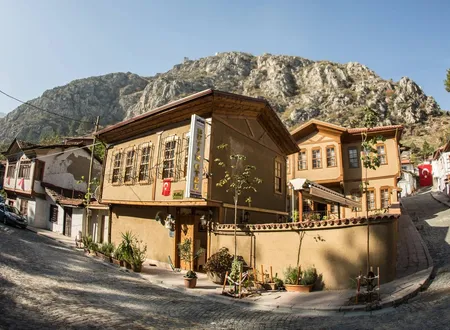
Üçler Neighbourhood is an old residential quarter in the centre of Amasya, close to the Yeşilırmak, south of the Sultan Bayezid Complex and behind Ziyapaşa Boulevard. When people speak of historic Amasya today, the Yalıboyu houses and the rock tombs come to mind first; Üçler stands behind that picture as a quieter fabric of streets. Yet Hüseyin Hüsameddin Yasar's Amasya Tarihi presents the neighbourhood as one of the best documented districts of the city. The origin of its name rests on a story, the dates of its mosque's construction and renewal are known, its tombs, cemetery, lodge and schools are listed one by one, and the scholars, notables and Janissary commanders who came from it are named.
In spite of this richness, little has been written about the neighbourhood. Official promotional texts mention only the nearby bridge, population compilations give figures, and for the mosque nothing circulates beyond the address that map records supply. The Hijri dates in this text are followed by their approximate Gregorian equivalents in parentheses.
Origin of the Name
The name "Üçler" ("the Threes") comes from a nickname attached in Amasya to two different trios of men, and Hüsameddin places both at the head of the neighbourhood's history. The first trio consists of Niğdelizâde Sofî Bayezid Çelebi, who served as tutor to Çelebi Sultan Mehmed, and his uncles Feyzullah and Yakub Çelebi. In common speech they were called "the Threes"; all three were buried inside a house in this neighbourhood, and the neighbourhood took the name Üçler for that reason. According to Hüsameddin, the family lived there until about 815 (1412-13). Sofî Bayezid died in Dhu al-Qa'da 814 (early 1412) and Feyzullah Çelebi in Ramadan 815.
The second trio belongs to a much later period. Three Iranians who attached themselves to Prince Ahmed during his governorship of Amasya, Kutbeddin Ahmed, Kutbeddin İsa and Kutbeddin Mahmud, were also called "the Poles" and "the Threes", and Hüsameddin says they lived in the same neighbourhood until 921 (1515-16). Elsewhere the third man's name appears as that of the physician Kutb-ı Şirvânî. Hüsameddin ties the wide fame of the name "Üçler" throughout the city to this second usage. The first Üçler is mentioned in the endowment deed of Kadi Abdurrahman Muslihî dated 850 (1446-47), the second in Feridun Bey's Münşeât, and Hüsameddin bases his argument on these two documents. The relevant texts of the deed and of the Münşeât have not been examined separately here, so the explanation rests on Hüsameddin's reading and has not been tested against another source.
Map records show that some of the neighbourhood's streets still bear the names Feyzullah Çelebi and Handan. Handan Ağa was the first trustee of the mosque endowment described in the next section, and Feyzullah Çelebi is the uncle in the first trio mentioned above.
Location and Boundaries
Hüsameddin describes the neighbourhood's position as follows: on the qibla side of the Sultan Bayezid Mosque, on the site of the former Alişir Neighbourhood, bounded on the east by Devehane and on the west by Receb, on the south partly by a cemetery and partly by Küpceğiz, and on the north by the chaussée. The chaussée in question, as Hüsameddin explains elsewhere, is the road that the governor of Amasya, Ziya Paşa, had laid out around 1281 (1864-65), and it must coincide with today's Ziyapaşa Boulevard. The name Alişir comes from Alâeddin Alişir Bey, recorded as governor of Amasya around 638 (1240-41); Hüsameddin writes that his mansion stood in one part of Üçler and his garden on the site of today's Kağnı Pazarı.
The neighbourhood lies within the region called Simre in the old records. Hüsameddin writes that in the sultanic registers up to 857 (1453) the name Simre remained attached only to the neighbourhoods of Üçler, Hacı İlyas, Receb, Şamice, Küpceğiz and Gök Medrese. The name, which in Seljuk times was given to the whole of what was called "Zâhir Amasya", was squeezed into six neighbourhoods once Seljuk influence withdrew. At the edge of the neighbourhood, south of the cemetery known as Narlı Bahçe, stands the tomb of Mesud I, a solid structure built entirely of stone. Hüsameddin speaks of the same building once as the northern end of the neighbourhood and once as its western end, so his description of the position is not fully consistent with itself.
The link with the bridge comes from another source. One official record presents the Meydan or İstasyon Bridge as the structure at the end of Ziyapaşa Boulevard that connects Üçler Neighbourhood to the Station district. Another places the same bridge between the İstasyon and Hacı İlyas neighbourhoods. The difference between the two descriptions suggests that the bridge stands on a neighbourhood boundary and that administrative boundaries have shifted over the years. The neighbourhood's mosque appears in map records on Hisar Sokak; the name may relate to the neighbourhood's closeness to the castle area, but this is an inference.
Üçler Mosque and Sa'dî Çelebi
The neighbourhood's main building is the mosque that Hüsameddin calls by two names: Üçler Mosque and Sa'dî Çelebi Mosque. The first mosque was a wooden building put up by Feyzullah Çelebi of the Üçler. When it burned in the fire of 1011 (1602-03), Şemseddin Sa'dî Çelebi rebuilt it in 1018 (1609-10) with walls of masonry and a roof and minaret of wood, and added a school, a fountain and a lecture hall beside it. For the upkeep of the mosque and its charities, two houses in Üçler, five shops in the İbadullah Market, two in the Lower Market and three in Bakkallar İçi, together with three houses in the Kurşunlu Neighbourhood, were endowed in 1039 (1630).
According to Hüsameddin's biographical entry, Sa'dî Çelebi was the son of the judge İzzeddin Hasan Çelebi. He studied in Amasya, became a müderris in Istanbul, taught at the Yörgüç Paşa, Hüseyniye, Tokat Kameriyye and Merzifon Sultaniye medreses, rose to the mevleviyet posts of Maraş, Erzurum and Diyarbekir, and served as kadi in a large number of districts. On retirement he returned to Amasya and lived in Üçler. The same entry records that besides the mosque he had a small mosque built beside the Sinaniye Lodge in the Şehreküstü Neighbourhood, a school in the Kurşunlu Neighbourhood of the inner city, and a wooden bridge in front of the Sultan Bayezid Mosque. The list of endowed property in the biography differs somewhat from that of the mosque deed: five houses in various neighbourhoods, three plots of vineyard at Meydan, twelve shops in the İbadullah Market and a farm at Sevincer. He stipulated that the trusteeship go to his freed slave and son-in-law Handan Ağa and Handan's male children. Hüsameddin makes no attempt to reconcile the two lists.
Hüsameddin also records his wealth. He had more than thirty slaves, some twenty concubines and four wives, yet only one daughter survived him. When he freed his slaves he married each of them off and gave them a share of his property. The grand vizier Derviş Mehmed Paşa and Muizzeddin Sencarî came from among these slaves. Sa'dî Çelebi died at the end of Dhu al-Qa'da 1039 and was buried in the graveyard in front of the mosque. Hüsameddin adds that he is the Anatolian kadi discussed in Naîma's history.
The trusteeship of the endowment stayed in the line of Handan Ağa for centuries. In Hüsameddin's biographies this family appears under the names Handanzâde, Şirinzâde and Handanoğlu, and produced chief gatekeepers, clerks and one deputy of a tax-farming governor. Records of the mosque's preachers, pulpit shaykhs and imams are scattered through the same book. Müftüzâde Osman Efendi served here for more than thirty years as imam and pulpit shaykh, and when he died in 1201 (1786-87) his son Hâfız Mehmed Halis took his place. Which parts of the present building survive from this past has not been confirmed by any record that says so explicitly.
Tombs and Cemetery
Hüsameddin's list of the tombs of Amasya contains many entries that concern the vicinity of Üçler. The Üçler Tomb, eighth on the list, stands inside a house west of the Sa'dî Çelebi Mosque, opposite the İsa Efendi Zawiya. Sofî Bayezid Çelebi, his uncle Feyzullah Çelebi, Yakub Çelebi and İran Hatun, daughter of Ali Bey, lie here. The Tomb of İskender Memi Çelebi is opposite it, a small masonry building in a corner of the cemetery. It holds Muhyiddin Mehmed Çelebi, known as Kutlu Beyzâde Memi Çelebi, and his son İskender Çelebi, and it was the son who had the tomb built and drew up its endowment deed. The garden known as the tomb of Abdurrahman Muslihî lies to its east, but according to Hüsameddin's own research the graves of Muslihî, his father Mehmed Şah and his son Mahmud Çelebi are stones on the road east of the large fountain. Because their head and foot stones are lost he can give no firm ruling. That those in the garden are the mufti Musliheddin Musa Efendi, his son and his grandson he reports from people who knew the pilgrimage places of Amasya.
The Tomb of Sinan Efendi stands inside a house near the Üçler Tomb, and the Şeyhülharem Sinaneddin Yusuf Halvetî, author of the commentary Tebyînü'l-Mehârim, lies there. Hüsameddin writes that the grave was for years a place of visitation for the scholars of Amasya, and adds that he himself found the grave in the house his teacher had described and visited it. A footnote in an article on Halveti lodges records that the tomb is in Üçler, behind the Amasya Museum, and that it became visible when the surrounding houses were demolished. The Tomb of the Seven, by contrast, is a site south of Üçler, opposite Saka Sokağı, at the foot of the cemetery wall. Six of the seven emirs who were prominent in the days of Prince Ahmed lie there. Hüsameddin is certain that Acem Gıyaseddin Şirazî, Küçük Emir Sinan-ı Niksarî, Kubalı Emir Şeref Hamza Çelebi and Emir Akil Çelebi are buried there; he hesitates over Şehrî Emir Mehmed Çelebi and Emir Mazlum Melik Çelebi. The seventh emir, the mufti Koca Emir İbrahim Efendi, lies at Eyüp in Istanbul.
The Taşköprülü Tomb also stands on the neighbourhood's road. In Kağnı Pazarı, on the road leading to Üçler Neighbourhood, in a small cell behind a mosque, lies Taşköprülü Hâfız Hacı Abdullah Efendi, and in the adjoining cell his son Şeyh Mehmed Arif Efendi. The Üçler Cemetery is a burial ground that appears again and again in Hüsameddin's biographies. The gravestone of Abdülmuhsin Çelebi, son of Ahî Sâbıkuddîn Ebûbekir, after whom a neighbourhood in Amasya is named, was seen there. Some members of the scholarly family known as Niğdelioğlu lie in this cemetery. Hacı Ahmed Ağa of the Yeşillizâdes was buried in 1153 (1740-41) in a stone-marked grave beside the road. The Muslihîzâdes have a separate section of the cemetery. The gravestone of an emir who died in 715 (1315-16) was also seen in the Üçler graveyard. The wooden medrese west of the Narlı Bahçe Cemetery, which stretches in front of the Receb and Üçler neighbourhoods, was according to Hüsameddin built in 1167 (1753-54) by the city steward Türedizâde Hâfız Süleyman Ağa and was pulled down in 1281 during Ziya Paşa's road works.
Lodge and Schools
The Üçler Lodge stands third in Hüsameddin's list of lodges. The building immediately west of the Sa'dî Çelebi Mosque was the house of the Nakşibendî successor Şeyh İsa Efendi of Crimea, who converted it into a zawiya and endowed it in 1238 (1822-23). The right to live in the house was stipulated for his children. Hüsameddin writes that after İsa Efendi's death his son became the zawiya keeper but held a post in the judiciary, and he gives no detail about how the lodge later functioned. According to the same source, Şeyh İsa's tomb is also west of Üçler Mosque, in the garden of his house.
The educational institutions are recorded to the same degree. Besides the school that Sa'dî Çelebi added to the mosque, Râfia Hatun, daughter of Şabanzâde Hacı Mehmed Ağa, had a new school built in Üçler in 1241 (1825-26) and appointed Hâfız Abdullah Efendi, imam of the Sa'dî Çelebi Mosque, as its teacher. At the Üçler School, which taught the neighbourhood's children, Tahir Mehmed Efendi of Artvin served for a time as teacher and died in 1318 (1900-01). Hüsameddin writes that in early 1912 the Ministry of Education raised the Secondary School to first class and increased the three primary schools to six, and that when it became clear one girls' school was not enough, it opened another in the Üçler Neighbourhood.
Fountains form another part of the neighbourhood's record. In Hüsameddin's count Üçler has one fountain of Şabanzâde Hacı Mehmed Ağa and one of Kâtibzâde Seyyid Hacı Osman Ağa; to these is added the fountain Sa'dî Çelebi had built together with the mosque. The neighbourhood's water bears the name Üçler Water. According to Hüsameddin it is one of three great waters that come from springs in the Çakallar district and are mentioned together with the Kaya Paşa and Acem Ali waters. The Acem Ali Water, then "in the possession of the Üçler", was bought from el-Hâc Mahmud Çelebi and endowed in 873 (1468-69) by the Nishapur merchant Acem Ali Ağa. Hüsameddin adds that the Üçler Water too was an endowment of the same Acem Ali Ağa, but that the branch running through the neighbouring quarters was called the Acem Ali Water, while the branch flowing to the Üçler Neighbourhood kept its old name.
The Üçler Affair
The episode that appears in Hüsameddin's annual records as "the Üçler affair" is the time when the neighbourhood's name acquired a political resonance. During the governorship of Prince Ahmed (son of Bayezid II) at Amasya, the circle around him split into two groups. One was made up of Turkish scholars, the "Şemsler", whom the poets praised as "the Suns"; the other of the "Poles", consisting of the Iranian physician Kutb-ı Şirvânî, the musician Hâce Kutbeddin Mahmud Çelebi and the müderris Kutbeddin İsa Çelebi. In Hüsameddin's account the Poles gather around Mir Gıyaseddin Şirazî, the most influential Iranian of those years. Mir Gıyaseddin is also named first among "the Seven", the seven emirs of Amasya.
According to the account, in 915 (1509-10) a bloody brawl broke out in Amasya between Sunnis and Shiites, the followers of Şah Kulu rose in the surrounding country in 916, and in 918 (1512) Prince Ahmed had the sermon read in his own name and appointed Kutbeddin İsa as kadi of Amasya and Mir Gıyaseddin as naqib al-ashraf. According to Hüsameddin, the prince was defeated by his brother Selim the same year and killed. When Selim came to Amasya on his return from Çaldıran in 920, Mir Gıyaseddin, held in the prison there, was released through the intercession of Halimî Çelebi of Kastamonu. The decisive break came in 922 (1516), when Amasya's military strength was away on the Egyptian campaign. Some ten thousand rebels under Zünnun Baba and Celal marched on Amasya, reached the Ferhat Gorge and entered the city at the end of Shawwal. They were driven out by the resistance of the garrison commander Hacı Ahmed Bey together with Keyvan Ağazâde Rüstem and Hacı Beyzâde Mirza Bey. Hüsameddin attributes the assault to the incitement of "Kutub and Gıyas of the Üçler" within the city.
The investigation was conducted by Şadî Paşa and the defterdar Kadızâde Mehmed Çelebi. According to Hüsameddin it was established that Kutub, Gıyas and his servant İbrahim of Ganja had called the Celali rebels in. Mir Gıyaseddin Şirazî was executed on the tenth of Muharram 923 (early 1517) with İbrahim and many of his followers. The merchant Hoca Acem İbrahim Ağa, who had come from Ganja and settled in Üçler, is also named among the executed. Kutbeddin İsa was found hiding in the house of a Kızılbaş at Merzifon, brought to Amasya, and hanged before the eyes of the people in Rabi' al-Akhir 924 (1518). In later biographies too Hüsameddin uses "the Üçler affair" as a dating marker. A müderris was sent to Taşköprü because of the affair, another returned to Amasya at the end of 923 as müderris and mufti, and a timar holder who served in the affair rose to chief of the gatekeepers in 927. The anti-Shiite and anti-Safavid tone of the account reflects Hüsameddin's own outlook. Even if the events and dates are anchored in the Bursa registers and old ledgers, it cannot be said that labels applied to individuals, such as "enemy of the Turks" or "traitor", are tied to any document.
People of the Neighbourhood
In the biographical sections of Hüsameddin's work, the list of people born or resident in Üçler is long. The Şeyhülharem Sinaneddin Yusuf was born here in 913 (1507-08). He studied with Şeyh Yakub of the Bahşî family and other teachers in Amasya, entered the circle of Muhaşşî Sinan Efendi in Istanbul, taught at the Hızır Paşa and Mehmed Paşa medreses in Amasya, and went to the Hejaz in 984 (1576-77). In 988 he became Şeyhülharem at Mecca, in 994 he gave up the post and returned to Amasya, lived in devotion without leaving his house, and died in Rabi' al-Akhir 1000 (early 1592). Tebyînü'l-Mehârim, which he wrote during his years at Mecca by dividing the prohibitions in the Qur'an into ninety-nine chapters, was quoted often by later authors. Hüsameddin also relates a tale he heard from his teacher: the shaykh, back in Amasya, was said to come to the Haram at Mecca for every Friday dawn prayer, and once set down a pilgrim from Zile, who had been robbed near Mecca, near Zile in an instant.
The woman poet Zeyneb Hatun is also among the neighbourhood's known names. Hüsameddin presents her as born in Amasya, dead in 889 (1484), a woman scholar who wrote verse in three languages. Because her husband served five or six years as kadi at Kastamonu, Latifî Çelebi attached her to that region. Hüsameddin corrects this belief by pointing out that the biographical dictionaries of Âşık Çelebi and Hasan Çelebi say plainly that she was from Amasya, and that she was buried in the Üçler Neighbourhood beside her father and grandfather, which he holds beyond doubt. It has also been learned from old records that Zeyneb Hatun had a school in Üçler. The biography of her sister Selamet Hatun appears separately in the same book.
From later centuries, figures of the notable and Janissary classes come to the fore. The Boyacızâde family is first among them. Boyacızâde İbrahim Bey, son of Veli Bey of the Üçler, died in 1079 (1668-69), and his sons Veli Paşa, Mahmud, Ömer and Ahmed Beys were executed in 1100 (1688-89). Yeğen Osman Paşa, born of a daughter of this family, was also born in Üçler. Saka Sokağı takes its name from the Janissary commander Sakaoğlu İbrahim Ağa, who lived at the eastern end of the neighbourhood until 1140 (1727-28). Known as "the Sixth Ağa" because he was enrolled in the sixth company, he died in 1144 (1731-32). The Yeşillizâdes, descended from Hacı Ahmed Ağa, are also named in the same neighbourhood and in the Üçler Cemetery. In a later period Kemançecizâde Edhem İbrahim Efendi was born in Üçler in 1284 (1867-68) and Erzurumîzâde Emin Ali Mehmed Efendi in 1286 (1869-70), while Emin Ali's brother Hüsnî Yusuf Efendi was born in Saka Sokağı in 1283 (1866-67).
The Meydan Bridge and the Bridgehead
The historic structure mentioned together with Üçler's name is the Meydan or İstasyon Bridge. According to the ministry's description, the bridge was first built in 1145 by the Seljuk Sultan Mesud I. Where that structure had fallen to earthquakes and floods, the Emir of Amasya, Şadgeldi Paşa, built a new bridge in the 1370s on its remains and with the same architectural character. Another record ties the collapse to the earthquake of 1374 and says the first bridge was of cut stone, five-eyed, with arches in the harpusta manner. The ministry's description of the structure refers to the present bridge and speaks of a bridge of cut stone whose arches span three broad piers. Badly damaged in the flood of 1824, the bridge was repaired in 1828 by the notable of Amasya Özlü Yusuf Ağa, and in 1940 its deck was widened, concrete poured and metal railings added. Because it stands in front of the Meydan Gate of the castle, the bridge also bears the name Meydan Bridge.
In Hüsameddin's records the bridgehead is a cluster of settlement separate from Üçler but in the same surroundings. Here stood the palace and the small mosque of Kürt Beyzâde Hacı Kutluşah. According to Hüsameddin, the palace guardian Ahî Sâbıkuddîn Ebûbekir built a mansion beside the palace, in the time of Şadgeldi Paşa a small mosque, a school and a zawiya were founded here, and the surroundings became a neighbourhood. In the same area is the tomb that Ehli Hatun, granddaughter of Şadgeldi Paşa, had built in 871 (1466-67). Hüsameddin writes that the tomb stood behind the medrese at the bridgehead and in front of the zawiya, and that because the cell that housed it had been demolished the grave lay open to the sky. Olcay, for his part, says that the Meydan Köprü (Kurşunlu) Neighbourhood begins right after the İçeri Şehir Neighbourhood. He visited the modest wooden medrese at the head of the bridge once, while teaching students of religious learning on the order of the province of Sivas after returning from the Balkan War, and saw only two students in it. By the time Olcay wrote nothing of the medrese remained, and he says he does not know its founder. Hüsameddin, on the other hand, says this wooden medrese was built in the garden of Ehli Hatun's tomb by Tayyar Mahmud Paşa of Canik. The pasha was executed in 1223 (1808), and Hüsameddin writes that this was the only work he left to Amasya.
No firm conclusion about the neighbourhood boundary follows from these records. Kurşunlu and Köprübaşı are separate neighbourhood units in the nineteenth-century censuses. Sa'dî Çelebi's endowment includes three houses and a school in Kurşunlu, which forms a link between the endowment of Üçler Mosque and the bridgehead. Whether the buildings at the bridgehead fall today within Üçler, Hacı İlyas or the station district cannot be said without consulting land registry and planning records.
Üçler in the Censuses and Today
In Selim Özcan's study comparing the 1840 population register with the temettuat registers of 1844-45, Üçler Neighbourhood appears among the neighbourhoods inhabited only by Muslims. The 1840 count records 94 households and the temettuat count 106. The increase of twelve households between the two counts is among the changes the study cites as examples of movement in the city. The study records a fall in the city as a whole from 3,180 to 2,709 households; part of the difference comes from seven more neighbourhoods being present in the population register. The two units at the bridgehead appear in the same study as separate neighbourhoods. Kurşunlu rose from 45 to 50 households, while Köprübaşı shows 10 Muslim and 7 non-Muslim households in the population count and does not appear in the temettuat records.
More recent population data rest on the compilation sites' transcription of the TÜİK address-based population registration system. According to these, the population of Üçler Neighbourhood is as follows:
- 2012: 1,931
- 2013: 1,777
- 2014: 1,691
- 2015: 1,625
- 2016: 1,599
- 2017: 1,486
- 2018: 1,544
- 2019: 1,458
Within seven years the population fell by roughly a quarter, about 24 per cent; only in 2018 is there a small rise. The causes of the decline are not explained in the sources. It should also be remembered that the compilation sites do not guarantee the accuracy of their data; where an exact figure is needed, the TÜİK records themselves should be consulted.
Today Üçler is one of the administrative neighbourhoods of the Merkez district of Amasya. According to a report in the local press in June 2025, the neighbourhood headman Coşan Aylak walks around some 400 households before every religious festival and gives the neighbourhood's elderly a haircut with his own hands. The link between the neighbourhood Hüsameddin describes and the neighbourhood of today survives mostly in street names, in the mosque, and in a few houses that still hold tombs. A fuller neighbourhood history would require separate work on the Amasya sharia court registers, the endowment ledgers and the mosque inscriptions.
Chronology
Mid-13th century: According to Hüsameddin, Alâeddin Alişir Bey, governor of Amasya around 638 (1240-41), owns a mansion in one part of Üçler.
1145: The Seljuk Sultan Mesud I is reported to have had the first bridge built here.
1370s: Şadgeldi Paşa, Emir of Amasya, rebuilds the bridge on the remains of the first.
1412-13: Niğdelizâde Sofî Bayezid Çelebi and his uncle Feyzullah Çelebi die; both are buried inside a house in Üçler.
1446-47: The endowment deed of Kadi Abdurrahman Muslihî is drawn up; according to Hüsameddin, the first "Üçler" name occurs in this document.
1466-67: Ehli Hatun has the tomb at the bridgehead built.
1484: The poet Zeyneb Hatun dies and is buried in Üçler.
1507-08: The Şeyhülharem Sinaneddin Yusuf is born in Üçler.
1516-18: The "Üçler affair": Celali rebels enter Amasya, Mir Gıyaseddin Şirazî is executed in early 1517, and Kutbeddin İsa is hanged in 1518.
Early 1592: Sinaneddin Yusuf dies and is buried in his own house in Üçler.
1602-03: Feyzullah Çelebi's wooden mosque burns in a fire.
1609-10: Sa'dî Çelebi rebuilds the mosque in masonry.
1630: Sa'dî Çelebi dies; he has endowed his properties for the mosque and its charities (endowment dated 1039).
1787: Müftüzâde Osman Efendi dies after more than thirty years as imam, and his son takes his place.
1808: Tayyar Mahmud Paşa of Canik, who built the wooden medrese at the bridgehead, is executed.
1822-23: Şeyh İsa Efendi of Crimea converts his house into the Üçler Lodge.
1824: The bridge is badly damaged in a flood of the Yeşilırmak.
1828: The bridge is repaired (the repair is attributed to Özlü Yusuf Ağa).
1840: In the population census Üçler is recorded with 94 households.
1844-45: The temettuat records give the neighbourhood 106 households.
1864-65: The Süleymaniye Medrese beside Narlı Bahçe is demolished as Ziya Paşa lays the chaussée.
1912: A second girls' school is opened in Üçler Neighbourhood.
1940: The bridge deck is widened, concrete poured and metal railings added.
2012-2019: The neighbourhood's population falls from 1,931 to 1,458.
Bibliography
Primary sources
- Hüseyin Hüsâmeddîn Yasar, Amasya Tarihi, Amasya Belediyesi, 2022, vols. 1-4, entry "Üçler Mahallesi" (e-book p. 109; also pp. 83, 115, 120, 128, 135-146, 150, 177, 211, 351, 464, 485-498, 559)
- Hüseyin Hüsâmeddîn Yasar, Amasya Tarihi, vols. 9-12, biography of Sa'dî Çelebi (e-book p. 268; Zeyneb Hatun p. 244, Sinaneddin Yusuf pp. 322-323, Tayyar Mahmud Paşa pp. 465-466, Yeğen Osman Paşa p. 603, Müftüzâde Osman Efendi p. 613)
- Hüseyin Hüsâmeddîn Yasar, Amasya Tarihi, vols. 6-8 (Sofî Bayezid Çelebi p. 404; records of the Üçler affair pp. 34-36, 104, 286, 414, 436; notable, Janissary and scholarly families of Üçler pp. 42, 53, 196-197, 278, 367, 607, 643)
- Osman Fevzi Olcay, Amasya Hâtıraları (sections "İçeri Şehir Mahallesi", "Meydan Köprü Mahallesi (Kurşunlu Mahallesi)" and "Aşağı Bakacak Medresesi, Yukarı Bakacak Medresesi, Meydan Köprü Medresesi") amasya.bel.tr
- Selim Özcan, "H.1256 (1840) Tarihli Amasya Nüfus Defteri ile H.1260-1261 (1844-1845) Tarihli Amasya Temettuat Defterlerinin Karşılaştırmalı Değerlendirilmesi", The Studies of the Ottoman Domain, 6/11, 2016
- "Ehli Hatun Türbesi", quoting Evliyalar Şehri Amasya'dan (amasya-abdulhalim.blogspot.com)
Academic studies
Official sources
- T.C. Ministry of Culture and Tourism, Kültür Portalı, "İstasyon Köprüsü - Amasya" (kulturportali.gov.tr)
- T.C. Amasya Governorship, "Köprüler" (amasya.gov.tr)
Other sources
- Objektif Amasya, "Amasya'da Muhtardan Mahallenin Yaşlılarına Bayram Tıraşı", 6 June 2025
- Nufusu.com, "Merkez Amasya Mahalleleri Nüfusu" (compilation of TÜİK ADNKS data, 2012-2019)
Online sources
- https://amasya.bel.tr/uploads/e-kitap/kitap/9-12/files/basic-html/page268.html
- https://dergipark.org.tr/en/download/article-file/268330
- https://www.kulturportali.gov.tr/turkiye/amasya/gezilecekyer/stasyon--meydan-koprusu
- https://www.amasya.gov.tr/kopruler
- https://www.nufusu.com/merkez-amasya-mahalleleri-nufusu