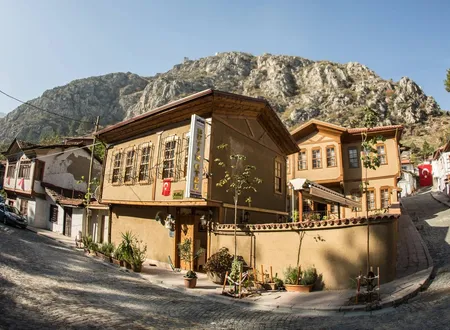
The Fethiye Neighbourhood of Amasya's central district takes its name from a single building at its heart, the Fethiye Mosque. According to local tradition the building was once a church, was later converted into a mosque, was repaired and plastered over the centuries, and lost its minaret to an earthquake and had it rebuilt; it carries much of the neighbourhood's story. Yet the neighbourhood has never been only a mosque. In Hüseyin Hüsameddin Yasar's Amasya Tarihi (History of Amasya), Fethiye appears as an established Ottoman quarter, bounded by a stream on the east, the Hacı Hamza quarter on the west, Kuba on the south and Kılıççı on the north, with its own bathhouse, madrasa and endowments, and a place that produced judges, stewards, preachers and a vizier.
Origin of the Name
The neighbourhood takes its name from the mosque at its centre. According to the common account, the building was converted from a church into a mosque by Fetih Gazi, who served in Amasya in the Danishmendid period, and so received the name Fethiye Mosque. Hüsameddin supports this account with older records: in his words the quarter was formerly registered as "Fetih Gazi's Estate" (Fetih Gazi Mülkü) and only later called Fethiye, which suggests that Fetih Gazi, one of Amasya's guardians, lived there. The same author says the mosque was converted by Fetih Gazi around 510 in the Hijri calendar (1116-1117), and that the name points to this. The Gregorian equivalent of 510 H coincides with the year 1116 that some sources give for the Danishmend Gazi's conquest of Amasya.
The detail Hüsameddin gives in another section is somewhat different. There Fetih Gazi appears as Fetih Han Bey, son of Kılıç Bey, chief of the Koyunlu tribe; he is said to have been governor of Amasya around 506 H (1112-1113), and to have renovated the Eleni Church at the place where he lived, turning it into a mosque and improving the quarter, so that both the mosque and the quarter were named "Fethiye". The same section adds that Fetih Han Bey's tomb stood near the mosque and was later moved to the Cümudar Tomb beside the Burmalı Minare Mosque. A third explanation rests on Vâzıh Efendi's Re'sü'l-Menâbir, according to which the quarter was named Fethiye because it was the first place taken when the city was conquered. The three accounts agree that the name has to do with a conquest; they differ on who the conqueror was and on whether the name comes from the conquest or from a person's name. A precise year would require an inscription or a foundation deed dating the building directly, and the fact that the inventory record leaves its inscription and deed fields empty also explains why the date rests on tradition rather than on a document.
The name of Fetih Gazi is not confined to this quarter. Hüsameddin writes that the Temennâ Quarter was built on the site of a garden belonging to Fetih Gazi, one of the Danishmendid emirs, and that this garden was also called the "Fethiye Garden". The mosque is also known as the Kuba Dede Mosque; no reliable explanation of this name exists.
The name itself carries a plain meaning. Fethiye derives from "fetih" (conquest), and in Ottoman Turkish it usually describes mosques built in memory of a conquest or given that name. Similarly named mosques exist in many towns of Anatolia and the Balkans. The Amasya example can be read as one of the architectural traces of the city's passage from a Byzantine provincial town to a Turkish-Islamic settlement.
Location and Neighbours
Fethiye Neighbourhood belongs to the central district of Amasya. The building is under first-degree monument protection and is maintained by the General Directorate of Foundations. The ministry's publication places the building on Fetih Street, while the municipality's publication gives the address as Küba Street. The two addresses most likely refer to the same area, but the reason for the difference in street names is not explained in the documents.
The old boundaries of the neighbourhood are given by Hüsameddin. According to him, Fethiye lies below Kuba; it is bounded by a stream on the east, by the Hacı Hamza quarter on the west, by Kuba on the south and by Kılıççı on the north. Each of the neighbours sharpens the picture of where Fethiye lay. Kuba stands high up beneath the Köşk Kayası (Pavilion Rock) and takes its name from Cemaleddin Hüseyin el-Fergânî, known in Amasya as "Kubalı Şeyh", who came from the town of Kuba in Fergana and lived there until 810 (1407-1408). Hüsameddin relates that this man's grandson, Şeyh Hüsameddin Hüseyin el-Halvetî, had a madrasa, a mosque beside it, a fountain and his own tomb built in the quarter in 857 (1453); that when these buildings fell into ruin around 1079-1080 the Amasya deputy governor Kubalı Abdî Bey had the mosque repaired, and that his son Mehmed Pasha repaired the madrasa in 1105. The Kılıççı Quarter, to the north of Fethiye, lies on the qibla side of the Burmalı Minare Mosque; there Kılıççı Yusuf Bey, one of Selim I's emirs, built a small mosque beside the stream in 917 (1511-1512).
The Hacı Hamza Quarter to the west is more closely tied to Fethiye, because Hüsameddin introduces it as lying "in a spot separated from the Fethiye Quarter". Isa Beyzade Hacı Hamza Bey, tutor and adviser to Bayezid II during his governorship of Amasya, lived there until 873 (1468-1469) and built a large mosque with a school and a fountain beside it, and his sons Ahmed, Mahmud and Kasım Beys arranged his endowment. When the mosque was damaged in the earthquake of 1057 the Amasya deputy governor Sefer Ağa had it repaired, and the building came to be called the Sefer Ağa Mosque. To the east lies the Dere ("Stream") Quarter. According to Hüsameddin, in a dead-end street there Ma'sume Hatun, sister of the Şeyhülislam Cemalizade Ali Efendi, built a dervish lodge in 922 (1516) with a mosque and a fountain in front of it, and at the mouth of the same street Fatıma Hatun, of the Muharrem Efendizade family, built a mosque and fountain in 951 (1544). By Hüsameddin's day the lodge had vanished, the two mosques were in ruins and the two fountains had run dry. These records show that each of the small quarters around Fethiye took shape around the charity of a single person or family.
The Conversion of a Church into a Mosque
The official records say the church is thought to have been built by Helena, daughter of the Byzantine emperor Phokas, in the seventh century. An encyclopedia entry ties this to a more concrete span, the years 602-610. Phokas is known to have taken the throne in 602 and been killed in 610; the range in the entry matches the years of the emperor's reign. The basis of this account is found in Hüsameddin. According to him, in 1300 H (1882-1883), while the trustee İncezade Hacı Mehmed Arif Efendi was repairing the mosque and working on a minaret to be added on the west side, an inscription carved on a marble block came to light, reporting that the building had been built in the early seventh century by the princess "Elina", daughter of the Byzantine emperor Phokas. Nothing is known of the later fate of the marble, and the text of the inscription has not been published. That the church belongs to the early seventh century therefore remains an item reported by Hüsameddin which cannot be checked today.
The original plan of the building is thought to have been a rectangle in the basilica form. On the east façade there is a hexagonal apse projecting from the wall surface. The mosque was established in the apse section of the church, which is why its east façade is angular, forming a half hexagon. Because the qibla lies south of Amasya, the mihrab was placed on the south side when the building was converted, and entry was provided through a small opening on the north façade. The east-west worship layout of the church was thus re-established in the mosque with this new orientation.
The west façade was altered later. A broad pointed arch was recessed from the wall surface to form a niche-like section, and windows were opened in two tiers in this section. In the upper tier there are three rectangular windows below and two pointed-arch windows above. The building today is covered by a tiled roof. This appearance carries the character of the major repairs of later centuries rather than that of the church.
The real difficulty is telling the old parts of the building apart. According to the shared findings of the sources, very little of the church period survives, and because the walls have been entirely plastered and whitewashed it is today impossible to identify the original wall remains and building material. Hüsameddin too says only that the present form of the mosque shows it was converted from a church. Saying anything concrete about the Byzantine masonry, stonework or decoration of the Fethiye Mosque is difficult until the plaster is removed and a scientific building survey is made.
Repairs and the Minaret
The mosque originally had no minaret. The minaret was added in 1883 by İncezade Hacı Mehmet Arif; the Hijri date of 1300 given by Hüsameddin agrees with this year, and he describes it as a masonry minaret added on the west side. Built of brick, the minaret has a cylindrical shaft rising from a square base and a single balcony; the muqarnas course beneath the balcony is its only decorative element. This minaret has been the feature that marks a building of church origin as a mosque on the neighbourhood skyline.
The repairs Hüsameddin lists show whose hands have supported the mosque since the seventeenth century. In 1048 H (1638-1639) Hacı Hasan Efendi, the chair sheikh (kürsü şeyhi), endowed his property and cash to the mosque and repaired the building. The mosque, damaged in the earthquake of 1057 (1647), was repaired by Mustafa Sıdkî Pasha of Fethiye, who arranged his endowment, in real estate and cash, together with his sister Ayşe Hanım. According to Hüsameddin, Ayşe Hanım was the wife of Can Mirza Pasha. In 1191 (1777) the trustee Hacı Ali Ağa had the mosque repaired once more, and in 1300 the minaret described above was added. Donations to the mosque were not limited to these. The steward Hüsrev Ağa, who came from the neighbourhood, returned to Amasya ill at the beginning of 1036 H (1626) and bequeathed a third of his property to the repair and needs of the Fethiye Mosque; he died a few months later. One of the footnotes in volumes 9-12 of Hüsameddin also records that the mosque had a public fountain (sebil) and an endowment of cash.
In the earthquake of 1939 the minaret collapsed and was rebuilt. The building underwent another repair in 1956 and was reopened for worship after it. Its latest comprehensive restoration was carried out by the General Directorate of Foundations in 2006. The mosque is still open for worship today.
Sıdkı Mustafa Pasha
The name through which the history of Fethiye Neighbourhood touches the Ottoman state at its highest point is Sıdkı Mustafa Pasha. According to Hüsameddin, the Pasha was born in Amasya, in the Fethiye Quarter, into a family from the class of judges; his father was Ahmed Efendi and his grandfather Mustafa Efendi, judge of Amasya. He learned scholarship, literature and fine handwriting under the guidance of his uncle Küçük Mehmed Ali Efendi and, after teaching for a time, changed his career and became secretary to the council of Hâce Ahmed Pasha of Amasya. He rose in the office of the Imperial Council and finally, under the grand vizierate of Bayram Pasha in 1047 H (1637-1638), became reisülküttab, that is, head of the bureaucracy that conducted the Ottoman state's foreign correspondence.
His career did not follow a straight line. Shortly after Sultan İbrahim's accession he was dismissed in Muharram 1050 (April-May 1640) because of the grand vizier Kara Mustafa Pasha's hostility towards his predecessors, and was sent to Amasya. When Kara Mustafa Pasha was executed he returned to Istanbul in Dhu al-Qa'da 1053 (January-February 1644); with a qasida he presented to the sultan's companion Yusuf Pasha he drew close to the palace again, and in 1054 he became reisülküttab for the second time, replacing Hasan Hükmî Efendi, who had died. Hüsameddin writes that the Pasha resigned under the grand vizierate of Fazıl Ahmed Pasha in Rabi' al-awwal 1072 (1661), came to Istanbul, and died in Muharram 1073 (1662) as a "vizier of the dome" (kubbealtı vezir). He describes him as "a scholar, accomplished, prudent, a poet and a calligrapher among viziers"; a passage he quotes from Mehmed Süreyya's Sicill-i Osmânî states that the Pasha had a poetic divan and built a mosque at Kayalar.
He also repaid his debt to his homeland. Hüsameddin records that he saw in the sharia court registers that the Pasha repaired the Fethiye Quarter Mosque, where he was born, had a school built beside it, established a preaching post at the mosque, and allotted salaries from the income of the cash he endowed. The "Mustafa Sıdkî Pasha of Fethiye" who in the first volume carries out the repair after the 1057 earthquake is very probably the same person as the Pasha in the registers. Hüsameddin also stresses separately that he must not be confused with Ebubekir Sıdkı Efendi or Mütercim Sıdkı Pasha, who bore the same epithet.
The Judges' Bathhouse and Madrasa
The best-known buildings of the neighbourhood in the Ottoman period were the Kadı Hamamı (Judge's Bathhouse) and Kadı Medresesi (Judge's Madrasa) near the mosque. According to the information Hüsameddin gives in the first volume, the bathhouse was built by Muslihizade Abdurrahman Çelebi, the judge of Amasya known as "Molla Beylik"; his son, the military judge (kazasker) Molla Vildan Mehmed Çelebi, added a madrasa above the bathhouse, and the latter's son Abdurrahman Çelebi endowed the bathhouse in 912 H (1506-1507). The details of the madrasa are given elsewhere in the same volume: the first building was completed in 900 (1494-1495) by the military judge of Anatolia, Molla Vildan Mehmed Çelebi; its endowment affairs were arranged in 911 by his son Abdurrahman Efendi; and the building was renewed in 945 (1538-1539) by Seydî Pasha of his line and in 1031 (1621-1622) by Hacı Mustafa Efendi, preacher of the Sultaniye.
The madrasa was counted in the Ottoman madrasa hierarchy at the forty-akçe rank ("erbain"). Hüsameddin reports that in the sixteenth century scholars such as Bâlî Beyzade Abdurrahman Çelebi, Niksarlı Emir Sinan Efendi and Senâdî Efendi taught there as professors, and that in 1061 H (1651) the well-known scholar Kara Muhyiddin Efendi took up the post. With its outer walls of stone but its cells and interior of wood, the building could not withstand time; by Hüsameddin's day it had disappeared completely and its site was forgotten. For the bathhouse there is another record: in Hüsameddin's biographies in volumes 9-12 it is told that an Abdurrahman Çelebi who built a "fine bathhouse" in the Fethiye Quarter endowed it to his children and left his farm to his own tomb. Since there were several Abdurrahman Çelebis in the same family, it is not clear whether the two accounts describe the same person. A note in the same volumes mentions the Kadı Hamamı as the endowment of the family known as the Kadızades, which in time split into the Kadızade, Seydî Paşazade, Hatibzade and Muslihizade branches. That the builders, endowers and repairers of the madrasa all came from this family explains why Fethiye was regarded as the judges' quarter.
People of the Neighbourhood
Hüsameddin's records also make it possible to follow a life that turned around the neighbourhood's mosque. Preaching, at least for a period, passed from father to son. Hâfız Osman Efendi became preacher of the mosque in 1115 H (1703-1704), and when he died in Ramadan 1150 (1737) his son Mehmed Efendi succeeded him and died in Sha'ban 1201 (1787). In the same year Hanîfî Mehmed Efendi, son of the Amasya sheikh Abdullah Efendi, was appointed preacher of the Fethiye Mosque, and in 1220 (1805-1806) he handed the post to his sons Hâfız Mehmed and Ali Efendi. Going further back, one meets the name of Abdüllatif Efendi-Hâcezade: a scholar who was the son of Kadızade Mehmed Efendi, known as Küçük Hâce, he was preacher of the Fethiye Mosque and taught in Amasya's madrasas until he died in Dhu al-Hijja 1065 (1655). Abdünnebî Efendi, son of the preacher Nasuh, was also known as a preacher at the Fethiye Mosque and died around 1075. A scholar known as Sevincerli Hâfız Hoca is mentioned as imam and chair sheikh of the mosque; his son Hâfız Mustafa Efendi also served as imam and then as preacher.
There are also people who were born or lived in the neighbourhood without being tied to the mosque. The steward Hüsrev Ağa was the son of Ömer from the Fethiye Quarter. As a cavalryman (sipahi) he served in the campaigns in Georgia and the Caucasus, rose to the posts of Amasya steward and trustee of the Hüseyin Ağa Madrasa endowment, and in 1034 was made deputy governor of the Çorum sanjak in return for the loyalty he showed to the state during the Abaza Mehmed Pasha rebellion of 1032 (1622-1623). Hilmi Abdullah Efendi was born in this quarter in 1080 (1669-1670); his father was Şeyhülkurra Mehmed Efendi. During the Amasya events of 1099 (1688) he moved to Istanbul with his father and grandfather, served as imam of the Bıçakçılar Mosque, taught at the Fatih Mosque, and learned the sülüs and nesih scripts from the calligrapher Karakız Mehmed Efendi. Şükrü Ahmed Efendi was born in the Fethiye Quarter in 1258 (1842), worked in his youth as a tanner, and then attended the lessons of Sûfîzade Mehmed Hulûsî Efendi of Malatya, learning Arabic, jurisprudence and the law of inheritance (feraiz). When Hulûsî Efendi became mufti of Amasya in 1291 (1874-1875) he worked beside him for twelve years as scribe (müsevvit) and keeper of fatwas (emînü'l-fetva).
The neighbourhood was also a stopping place for Sufi circles. Şeyh Süleyman Efendi of Tirebolu was one of the representatives of the Naqshbandi path in Amasya; he came to Amasya in 1292 (1875) and settled in a house in the Ahi Sa'deddin Quarter in the inner city, and, according to Hüsameddin, when his disciples multiplied in the Fethiye Quarter he held his khatm-i khwajagan gatherings mostly in the room set aside for muezzins at the Fethiye Mosque. The same record notes that in Amasya he did not approve of the harsh rhetoric begun by Şeyh Hacı Hamza Nigârî Efendi and took respect for the Companions of the Prophet as his principle.
The Mummies
The bodies taken out of the basement of the Fethiye Mosque in 1855 are the building's best-known story. The inventory record says they are mummies belonging to İzzeddin Mehmed Pervane and his family; today they are preserved in the Amasya Museum. An encyclopedia entry is more detailed and states that the mummies belong to İzzeddin Mehmed Pervane, İşbuğa Nayin, Cumadar, a concubine of Pervane Mehmed Bey, and her daughter and son. Another compilation relates that the same group of mummies was brought from the tombs of the Burmalı Minare Mosque and the Fethiye Mosque.
Hüsameddin's account adds to this picture the events before it, and an objection. According to him the coffins were first kept in a cellar beneath the Fethiye Mosque and were moved around 1271 H (1854-1855) to the Cümudar Tomb in front of the Burmalı Minare Mosque. In the lower chamber of the tomb lay eight coffins, stacked one upon another and covered with a green cloth; in the two coffins at the front lay two persons, their bodies intact and thought to be Arabs, while the bones of the others lay scattered but arranged in order. The people of Amasya did not know who these were. Mustafa Vâzıh Efendi had written that they were Pervane Bey's slaves and concubines, whereas European researchers said they were mummified people from ancient times. Hüsameddin considers both views to be mere guesses. According to the survey of records he carried out, the tomb belongs to Cümudar bin Yaşmut, grandson of Hülagu and governor of Anatolia, and beside him lies buried the Amasya emir Abuşkay İşboğa Noyin. As for the coffins brought from the cellar, he finds it more reasonable that they belong to Fetih Gazi, who converted the church into a mosque, to his son Mahmud Gazi, and to their relatives.
For this reason the sources differ greatly on the identity of the people and on the exact place the bodies were taken from. The common points are these: the bodies were removed from, or moved out of, the basement of the Fethiye Mosque in the mid-1850s, they are said to belong to one family, and they are preserved today in the museum. The century to which the mummies belong and the cause of the natural mummification are not explained in the sources consulted.
Population and Change
The population of the neighbourhood has declined in recent years. The series in a study compiling TÜİK data is as follows: 1,589 in 2012, 1,501 in 2013, 1,476 in 2014, 1,480 in 2015, 1,430 in 2016, 1,359 in 2017, 1,336 in 2018 and 1,343 in 2019. Another section of the same compilation gives a more recent figure, with the year not stated, of 1,161 people (559 men, 602 women). Because the year of this figure is unclear, no year is given.
The drop of 246 people between 2012 and 2019 corresponds to roughly 15.5 percent; between 2015 and 2019 the population fell from 1,480 to 1,343. This trend, common in the neighbourhoods of old city centres, is generally explained by young families moving to newer residential areas. No local study supporting this explanation for Fethiye has been found. These figures are a compilation, not an official institutional publication; for exact data TÜİK should be taken as the basis.
Fethiye Today
Today the neighbourhood is one of the small, quiet neighbourhoods of central Amasya. The Fethiye Mosque is open for worship and is counted among the places to visit within faith-and-culture tourism. The neighbourhood's Ottoman-era buildings such as the Kadı Madrasa and Kadı Bathhouse have disappeared, and neighbouring quarter names such as Hacı Hamza and Kılıççı survive in Hüsameddin's records. No reliable published study has been found on the neighbourhood's daily life, old street fabric or social structure; for this reason no detail is given on the subject.
Chronology
602-610: According to an encyclopedia entry the building was used as a church (the builder is said to be Helena, daughter of Phokas; Hüsameddin bases this on an inscription that came to light in 1883 and is not visible today).
1112-1113 and 1116-1117: According to two separate records of Hüsameddin, Fetih Gazi (Fetih Han Bey) converted the church into a mosque (the exact date is disputed in the sources; some tie it to the Danishmend Gazi's conquest of Amasya in 1116).
1494-1495: The first building of the Kadı Madrasa was completed by Molla Vildan Mehmed Çelebi.
1506-1507: The Kadı Hamamı was endowed.
1638-1639: The chair sheikh Hacı Hasan Efendi supported the mosque with an endowment and repairs.
1647: After the earthquake Sıdkı Mustafa Pasha repaired the mosque.
1777: The trustee Hacı Ali Ağa had the mosque repaired.
1855: Mummified bodies were found in the mosque's basement (Hüsameddin writes that the coffins were moved around this date from the cellar to the Cümudar Tomb).
1883: İncezade Hacı Mehmet Arif had the mosque's minaret built.
1939: After the earthquake the minaret collapsed and was rebuilt.
1956: The mosque was repaired and opened for worship.
2006: Restoration by the General Directorate of Foundations.
Sources
Primary sources
- Hüseyin Hüsameddin Yasar, Amasya Tarihi (Amasya Municipality 2022 edition), volumes 1-4 (e-book pp. 114, 118, 120, 126, 139, 175, 328) and volumes 9-12 (e-book pp. 31, 67-68, 97-98, 111-112, 312, 375, 399-401, 441-442, 499-500, 580, 588, 609) amasya.bel.tr
Official sources
- Republic of Türkiye Ministry of Culture and Tourism, Culture Portal, "Fethiye Camii" (Cultural Inventory, Monument)
- Republic of Türkiye Ministry of Culture and Tourism, Culture Portal, "Fethiye Camii - Amasya" (Places to Visit)
- Amasya Municipality, City Guide, "Fethiye Camii"
Other sources
- Tuğba Bağbaşı, "Amasya Fethiye Camii", Online Türkiye Turizm Ansiklopedisi, 2019
- Amasya Provincial Directorate of Culture and Tourism, "Fethiye Camii"
- nufusu.com, "Merkez Mahalleleri Nüfusu Amasya" (2012-2019 series); nufusune.com, "Fethiye Mahallesi Nüfusu, Merkez Amasya"
Online sources
- https://amasya.bel.tr/uploads/e-kitap/kitap/1-4/files/basic-html/page139.html
- https://amasya.bel.tr/uploads/e-kitap/kitap/1-4/files/basic-html/page175.html
- https://www.kulturportali.gov.tr/turkiye/amasya/kulturenvanteri/fethiye-camii
- https://turkiyeturizmansiklopedisi.com/amasya-fethiye-camii
- https://www.nufusu.com/merkez-amasya-mahalleleri-nufusu