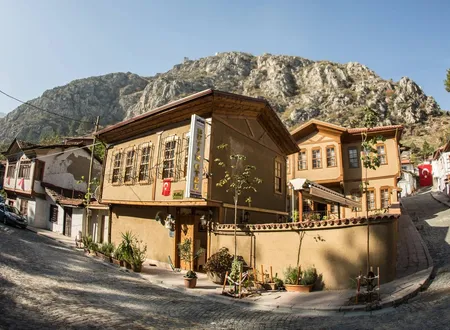
Hacıilyas Mahallesi (also written "Hacı İlyas" in records), in the central district of Amasya, lies on the southern bank of the Yeşilırmak around the Bayezid II Complex, the largest Ottoman building group in the city. Old Amasyans called part of the quarter "İmaret Arkası", "Behind the Soup Kitchen", and the name alone shows how closely the neighborhood's identity was bound up with the complex. Yet the history of Hacıilyas is older than the complex. The quarter bears the name of a bey who settled in Amasya at the beginning of the fourteenth century, and over the following centuries, with its madrasa, its dervish lodges, the mansions of its notables, its riverside gardens and the scholars raised among its residents, it became one of the liveliest quarters of the city. Much of this history we owe to the records in the Amasya Tarihi of the Amasya historian Hüseyin Hüsameddin Yasar; what is known and what remains undocumented are kept apart below.
Origin of the Name and Hacı İlyas Bey
In Ottoman cities most neighborhoods formed around a mosque, a small mosque (mescit), a madrasa, a lodge or a soup kitchen, and usually took the name of that building or of its founder. According to an academic study of Amasya, of the 52 neighborhoods recorded in the first census survey of 1520, 15 were named after mosques, mescits, soup kitchens and madrasas, 15 after scholars, sheikhs and dervishes, and 6 after markets and bazaars. According to Hüsameddin, the quarter took its name from Hacı İlyas Bey, son of Hacı Nevruz Bey, one of the emirs of Amasya; İlyas Bey lived in this quarter and built a mescit and a school here, and the neighborhood came to be called after the founder of these pious works. If this account is correct, Hacıilyas is one of the quarters named after a person who built a mescit.
The genealogy Hüsameddin gives in his biographical section links Hacı İlyas Bey to the line of Baba İlyas-ı Horasanî, who opened a lodge near Amasya in the thirteenth century and is known as the leader of the Babaî movement: el-Hac İlyas Bey was the son of el-Hac Nevruz Bey, the grandson of Şemseddin Mahmud et-Tuğraî, and the great-grandson of Baba İlyas. According to the same entry, İlyas Bey came from Egypt and settled in Amasya in 718 (1318-19), was counted among the emirs of Amasya together with his cousin el-Hac Nureddin Kutlu Bey, and died around 745 (1344-45). He had sons named Hamza, Hızır and Murad. That Baba İlyas settled in the village of Çat near Amasya, known today as İlyas köyü, and that Sufi poets such as Elvan Çelebi came from one branch of the family, is confirmed by other sources as well; but we have not been able to see an inscription or endowment deed belonging to Hacı İlyas Bey himself. The derivation of the quarter's name from this bey should therefore be read as Hüsameddin's account.
İlyas Bey's descendants remained among the leading families of Amasya in later generations and were known as the "Hacı Beyzâdes". Hüsameddin writes that his son Hamza Bey went missing at the Battle of Ankara in 804 (1402), and that his grandson Ahmed Bey died in 837 (1433-34) and was buried beside his brother Murad Bey in the Küpceğiz quarter. Another member of the family, Ca'fer Bey, served in the retinue of Bayezid II while the latter was sanjak governor of Amasya, became bey of Sivas on the sultan's accession, and died around 890 (1485). This family link also bears on the story of the complex: as told below, the plot on which the Bayezid II Complex was built had been the garden of the Hacı Beyzâdes.
There is one more detail that should not be confused with this bey. In the fifteenth century a famous physician called "Hekim Hacı İlyas Çelebi" lived in Amasya; Hüsameddin records that Akşemseddin learned medicine from him and that the celebrated surgeon Sabuncuoğlu Şerefeddin studied medicine with his grandfather Hacı İlyas Çelebi. This family of physicians was called the "Hacı İlyasoğulları". Hüsameddin connects the name of the quarter with the bey's family, not with the physician. There are also other neighborhoods called Hacıilyas in Turkey (in Bursa Osmangazi, Antalya Akseki and Muğla Milas, among others); nothing known about those places should be attributed to the neighborhood in Amasya.
Old Boundaries and Neighbors
Hüsameddin draws the boundaries of the quarter clearly as they stood at the beginning of the twentieth century: Hacıilyas lies west of the Mosque of Sultan Bayezid II, and is bounded on the east by the Sultan Bayezid Mosque, on the west by the Yörgüç Paşa Mosque, on the south by the high road and on the north by the Yeşilırmak. The quarter was also popularly called "İmaret Arkası", and its northwestern end bore the name "İnehan Önü", pronounced "İnehen Önü" in everyday speech. In short, the quarter stood on a long strip between two great Ottoman mosques, squeezed between the river and the main road.
Behind the name İnehan Önü lies a curious story from the period of the Anatolian principalities. According to Hüsameddin, İne Han Bey of the ruling house of the Eretna principality, a grandson of Sultan Eretna Bey, became emir of Kayseri in 790 (1388) after the death of his father Ca'fer Bey, but when Kadı Burhaneddin seized the city he fled and took refuge with the emir of Amasya. He was given land on the western side of the Hacı İlyas quarter, on the bank of the Yeşilırmak; there İne Han built a waterside residence and a garden, and after living there for about twenty years he died around 810 (1407-08). Because his sons Ca'fer, Murad and Hamza Beys lived in the same place, this part came to be called "İnehan Önü" and the family the "İnehanoğulları". Hüsameddin notes that the foundation of the pavilion İne Han built by the river could still be seen in his own day.
The quarter's western neighbor was once another quarter whose name has since been forgotten. On the evidence of the endowment deed of Yakut Paşa, Hüsameddin writes that an old quarter called "Hacı Çaruk Mahallesi" lay west of Hacı İlyas. Named after Emir Sârimeddin Çaruk Şah, who distinguished himself in the Seljuk campaigns against Samsun and Sinop and acted as deputy governor of Amasya, the quarter had a mescit of the emir; the mosque and soup kitchen of Yörgüç Paşa were later built on the site of this mescit. Another detail Hüsameddin records concerns the name "Sîmre", used in the Seljuk period for "Zâhir Amasya", that is, Amasya outside the walls. Old registers written down to the year 857 (1453) show that the name belonged only to the quarters of Üçler, Hacı İlyas, Receb, Şamice, Küpceğiz and Gökmedrese. This record shows that Hacıilyas was among the old quarters of the city before the middle of the fifteenth century.
For centuries the river side of the quarter was full of vineyards and gardens. Hüsameddin writes that the vineyards stretching west from the Sultan Bayezid Mosque along the southern bank of the Yeşilırmak were known in turn as "İnehan", "Yörgüç Paşa", "Hacılar Meydanı", "Ferhad Arası" and "Çalan Köprü", and that the first of these lay in front of the Hacı İlyas quarter. The quarter also had a garden known as the "Anahtar Ağası Bahçesi", endowed by Anahtar Ağası Mehmed Paşa.
Location and Present-Day Geography
Hacıilyas still lies in the center of Amasya. The promotional pages of the Ministry of Culture and Tourism place the Bayezid II Complex on the bank of the Şehzadeler Road, in the Hacı İlyas neighborhood, and the official address of the complex belongs to this neighborhood. Its streets include Agah Efendi Sokak, Emniyet Sokak, Sahra Sokak and Ulubatlı Hasan Sokak. The İstasyon Bridge at the end of Ziya Paşa Bulvarı links Hacıilyas to the İstasyon (Üçler) neighborhood on the opposite bank. The quarter holds one of the most monumental stops along the Ottoman-era line of the city that runs along the Yeşilırmak. We have not found in open sources a detailed study showing how far the boundaries Hüsameddin drew coincide with today's administrative ones.
The Quarter's Bridges
Two bridges linking Hacıilyas to the northern bank stand at the two ends of the quarter. The Meydan Bridge to the west, in Hüsameddin's words, lies at the end of the Hacı İlyas quarter west of the Sultan Bayezid Mosque, opposite the Ahî Sâbıkeddin quarter in front of the castle gate called the Meydan Kapısı. Today it is known as the İstasyon Bridge, after the railway station nearby. The sources differ on its first construction. The Ministry's records state that the first bridge here was built in 1145 by the Seljuk Sultan Mesud I, and that the present structure was raised on the remains of the first bridge, destroyed by earthquakes and floods, in the 1370s by Şadgeldi Paşa, emir of Amasya. Hüsameddin, however, writes that the "Sultan Köprüsü" built by Sultan Mesud around 540 (1145-46) stood about a hundred meters downstream of this bridge and collapsed in the earthquake of 718 (1318), whereupon the present bridge was first built of timber and then rebuilt in masonry by Şadgeldi Paşa around 776 (1374-75). Made of a yellowish stone, with an arch narrower than those of the other bridges so that its middle rose steeply, the bridge could not withstand the great flood of the mid-1820s and was renewed in 1244 (1828-29) by Özlü Hacı Yusuf Ağa, the ayan of Amasya. Consisting of arches between three wide piers of cut stone, the bridge had its deck widened in the 1940 repair, when concrete was poured over it and metal railings were added along its sides.
At the eastern end of the quarter, in front of the Sultan Bayezid Madrasa, stands the bridge the townspeople called "Madenüs" or "Maydanoz". According to Hüsameddin this bridge had always been of timber, and no information about its first construction could be found. It was repaired in 890 (1485), when the Sultan Bayezid Mosque was being built, and afterwards was overhauled in 1031 (1621-22) by Sa'dî Çelebi, in 1063 (1652-53) by Helvacı Mehmed Ağa, in 1130 (1717-18) by Emir Hacı Abdüllatif Çelebi, in 1241 (1825-26) by Rahtuvan Paşazâde Hacı Ali Bey and in 1281 (1864-65) by Ziya Paşa, governor of Amasya, and was then repaired many times by the municipality. The southern head of the bridge was the site of one of the quarter's finest mansions.
The Legacy of the Princes' Era
To understand the age in which the quarter's largest building was founded, one has to know the place Amasya held at the time. From the second half of the fourteenth century to the end of the sixteenth, Amasya was the principal sanjak to which Ottoman princes were sent to gain experience in government; in this period twelve princes served here as sanjak governors. Bayezid II had himself served in this sanjak in the time of his father Mehmed II (the Conqueror), and in 1481 he came to the throne while he was in Amasya. The foundations of the complex were laid in memory of this accession by his son Şehzade Ahmed (Prince Ahmed), then sanjak governor of Amasya.
The same period was also one of physical growth for the city. It is stated that during the 182 years in which princes served as sanjak governors, mosques were built in 13 of the 48 Muslim neighborhoods and 25 mescits in 24 neighborhoods without a mosque, so that 37 mosques and mescits were added to the city in all. The Fethiye Mosque, converted from a Nestorian monastery after the Danishmendid conquest, had long remained the city's great mosque; when the mosque in Hacıilyas opened in 1486, it took over the role of Amasya's Friday mosque.
The Sultan Bayezid II Complex
In Ottoman cities a külliye (mosque complex) was a unit that offered education and services as well as worship. Around a mosque were gathered educational buildings such as a madrasa, a primary school and a library, social service buildings such as a soup kitchen (imaret), a hospice (tabhane) and a kitchen, and sometimes commercial buildings such as a market and an inn; not every complex had to contain all of these. In the princes' era Amasya had three complexes of this scale. The first was the complex built in 1431 in the Gökmedrese neighborhood by Yörgüç Paşa, the lala (tutor-guardian) of Sultan Murad II, consisting of a mosque, a tomb, a soup kitchen and a four-room madrasa. The second was the Bayezid II Complex in Hacıilyas, and the third the complex built by Mehmed Paşa, one of the viziers of Bayezid II's reign, in the neighborhood that bears his name.
Hüsameddin also tells how the site of the complex was acquired. The eastern part of the quarter was the garden of Hamza, İlyas and Hızır Beys of the Hacı Beyzâde family. When Bayezid II came to the throne in 886 (1481), he had this garden bought from its owners and ordered that a mosque, a madrasa, a soup kitchen, a hospice and a fountain be built in its place. His son Şehzade Ahmed carried out the order at once; work on the foundations of the mosque began in Receb 886 (August-September 1481), and the building was completed with all its dependencies in Receb 891 (July 1486). The prince enclosed these pious works with a square masonry wall like a rampart. According to Hüsameddin's description, the wall had six gates, two on the south, two on the north and one each on the east and west; its northern side faced the river entirely, and the mosque was surrounded on all four sides by a garden full of fruit-bearing and other trees.
The complex is described as the largest in Amasya and, like the Bayezid II Complex in Edirne, was built on the bank of a river, here the Yeşilırmak. The mosque stands at the center, with the madrasa to its right and the kitchen-soup kitchen to its left. The mosque lies in the middle of an outer courtyard of about 160 × 120 meters; within this broad area, together with the buildings of the complex, are a garden shaded by trees, two ablution fountains and a timekeeper's house (muvakkithane). The plane trees in the courtyard are said to be as old as the complex, which would mean they have shaded the mosque garden for more than five centuries.
The sources do not fully agree on the date of construction. The Ministry's records place the building in 1485-1486. The three-part thuluth inscription above the main portal and on the two side walls of the mosque, however, states that it was completed in Receb 891 (July 1486); the calligrapher of the inscriptions was Ali bin Mezid. Hüsameddin, for his part, maintains that work began in 1481, right after Bayezid II's accession. According to an account based on İdris-i Bitlisî, the complex was begun as an act of thanks for the gift of the throne and its construction was entrusted to Şehzade Ahmed; Hüsameddin also included in his work the Persian and Arabic lines in which İdris-i Bitlisî, in his Heşt Behişt, praises the mosque's lamps, its minarets, its soup kitchen and its hospice. The complex's endowment deed was drawn up in January 1496. According to the deed, the complex consisted of a mosque, a soup kitchen, a madrasa and a primary school, together with a bridge over the Kızılırmak in the Osmancık district of Çorum; its revenues and services were not confined to the neighborhood.
The mosque is cited as an Amasya example of the Bursa-type inverted-T plan, though it differs from the classic inverted-T mosques. The prayer hall consists of a main space with two domes, the transitions handled by squinches, and wings with three domes on either side. The first dome is about 13 meters in diameter and the second, on the qibla side, about 15 meters; the two are separated by a great arch 2.37 meters wide. The octagonal drums of the domes over the central space each have sixteen windows, and the inner surfaces of the domes and the window arches are decorated with painted ornament. The fact that the side wings could be entered from outside by separate doors gave rise to the idea that these spaces were in fact hospice rooms (tabhane) where guests and dervishes stayed. Semavi Eyice holds this view and notes that the question would be settled for good if traces of chimneys were found in the vaults.
The five-domed portico rests on marble columns; Hüsameddin writes that these columns are monolithic marble colored green and black, that the central dome on the north is made of honey-colored marble, and that the relief flowers above the door are worth seeing. Tile panels with white thuluth script on a dark blue ground can be seen in the window lunettes. The muqarnas portal is, as in Bayezid II's other mosques, the most ornate part of the building. Inside, the mihrab has modest muqarnas and the minbar is of white marble. The wooden door and window shutters, by contrast, are counted among the most valuable elements of the building in terms of workmanship and are cited as fine examples of the fifteenth-century kündekâri (interlocking wood) technique.
One of the two minarets rises on a square base and is decorated with red inlay in a zigzag pattern ending in lily motifs; Eyice says this decoration is seen on no other minaret. The shaft of the other minaret was made with red and white bands, that is, fluted, in keeping with the old Turkish minaret tradition. Both have a single balcony, and the balcony corbels are of muqarnas.
The madrasa stands to the west of the complex and is also known as the Sultaniye. Directly opposite the entrance is a square, domed classroom-mescit. Vaulted, columned porticoes surround the courtyard, which has a fountain at its center, on three sides, and behind them are lined eighteen domed cells with hearths. According to Hüsameddin, the post of professor was given to the muftis of Amasya, and the first professor was the famous şeyhülislam Zenbilli Ali Efendi. The madrasa went on teaching with professors whose names are known until the end of the nineteenth century. Osman Fevzi Olcay counts the Sultan Bayezid Madrasa among the madrasas still active in Amasya at the beginning of the twentieth century, and recalls that an examining board that came from Sivas for madrasa students held its first examination, for the students of the Sultan Bayezid Madrasa, in the building in the mosque courtyard that the army used as a depot. In our own time the madrasa has served as the provincial public library.
The L-shaped kitchen-soup kitchen lies to the east of the mosque; its faces toward the courtyard have pointed-arched, domed porticoes. A document in the archive of the Topkapı Palace Museum records that the soup kitchen consisted of five units: a refectory, a kitchen, a pantry, an oven and a stable. The two large hearths in the plan mark the section where food was cooked; the domed space with cupboards beside it is thought to have been the store for provisions. Because the building was long used as a military depot, the original function of some sections can no longer be made out. Used for a time as a dormitory after restoration, the soup kitchen is today a public kitchen, in keeping with its original purpose. The primary school, however, disappeared without trace within the last century; Hüsameddin's records show that the Qur'an commentator Hızır Efendi, born in the quarter, memorized the Qur'an at the end of the sixteenth century in this "Sultan Bayezid Mektebi". In 2009 the Amasya Special Provincial Administration created the Miniature Amasya Model Museum in the large vaulted room north of the soup kitchen, and the museum opened to visitors in 2010.
Tombs in the Quarter
To the southeast of the mosque, in line with the qibla wall, stands the square, domed Tomb of Şehzade Osman. The tomb is built of cut stone with three courses of brick bonding, and has a wooden entrance canopy in front. Above its door there was an inscription giving the year 919 (1513) by the abjad reckoning, but it no longer exists. The tomb is attributed to Osman Bey, son of Şehzade Ahmed. Some sources state that Osman was killed in 1513 by Selim I (Selim the Grim); the Amasya Provincial Directorate of Culture and Tourism, on the other hand, refers to him as "a son who died young". There is no cenotaph inside today, although İsmail Hakkı Uzunçarşılı mentioned a marble cenotaph here.
Hüsameddin records two more tombs on the high road that formed the quarter's southern boundary. The first of them, the "Şehzâdegân Türbesi", is a solid dome resting on four stone piers, standing at a corner on the north side of the road in front of the Şamice quarter, in the Hacı İlyas quarter, west of the road leading to İnehan Önü. According to its inscriptions, buried inside are Kasım Çelebi, son of Mehmed I (Çelebi Mehmed), Mehmed Çelebi, son of Bayezid II, and Mehmed Şah Çelebi and Mustafa Çelebi, sons of Süleyman Çelebi. The tomb was repaired many times, most recently in 1314 (1896-97) by Gürcüzâde Mehmed Necib Bey. It may be supposed that the building presented in Amasya today as the "Şehzadeler Türbesi" is the tomb Hüsameddin describes; but since we have seen no source connecting the two names, this is an inference.
On the same road, west of the Şehzâdegân Türbesi, lies a square garden that Hüsameddin calls the "Receb Çelebi Türbesi". In the middle of the garden is a grave with stone sides and earth in the middle, and to its south two more graves. The inscription on the stone grave shows that it belongs to İbrahim bin Ali el-Eşca', one of the sheikhs; Hüsameddin established through his own research that beside him lie Sadreddin Receb Çelebi, who gave his name to the neighboring Receb quarter, and Receb Çelebi's grandson, the scholar Hacı Bayram Efendi.
The Hacı İlyas Mescit and the Lodges
The mescit built by Hacı İlyas Bey, who gave the quarter its name, remained for centuries the quarter's own place of worship. It appears in the sources as "the Hacı İlyas Mescit near the Sultan Bayezid Mosque" or "the Hacı İlyas Mescit behind the İmaret". In the eighteenth century the imamate of the mescit passed into one family. According to Hüsameddin, Hafız Ahmed Efendi of Merzifon married the daughter of İbrahim Efendi, imam of the quarter, became imam of the Hacı İlyas Mescit on his father-in-law's death in 1117 (1705-06), and died in 1124 (1712). The imamate then passed to his sons Ali and İbrahim Efendi and from them to his grandsons; the last imams of this family, known as the "İmamhoca-oğulları", were Hafız Mustafa and İsmail Efendi, who served in the mescit after 1239 (1823-24). There were also endowments made to the mescit: Abdülvehhab Efendi, preacher of the Sultan Bayezid Mosque, at the beginning of Receb 981 (1573) endowed his house and garden in the quarter first to his own descendants and, should the line die out, his house to the imam of the Hacı İlyas Mescit and his garden to the imam of the Sultan Bayezid Mosque.
The quarter also had a lodge of the Halveti order, and its founding is told in two different ways in Hüsameddin's work. The section on lodges states that the "Kutub Tekkesi" stood in the Hacı İlyas quarter behind the İmaret, in the lane west of the Sultan Bayezid Madrasa, and was built in 1018 (1609-10) by Sheikh Ahmed Efendi, a Halveti deputy known as "Kutub Dede". The biographical section, by contrast, relates that Muğnîzâde Ahmed Efendi, after becoming Kutub Dede's disciple, built the lodge adjoining the Hacı İlyas Mescit and gave him its leadership. The son of Ali Efendi, imam of the Yörgüç Paşa Mosque, Kutub Dede also held the post of pulpit preacher at the Sultan Bayezid Mosque, then withdrew from that office to devote himself to worship in his lodge. Known among the people and the scholars as "Kutub" and "Kutbeddin", the sheikh died on the fifteenth of Ramazan 1039 (1630). After him the lodge was led by his deputy Sheikh Mehmed Efendi and then by Seyyid İbrahim Efendi.
The story of the lodge at the end of the eighteenth century is tied to a woman benefactor of the quarter. Zeyneb Hatun, daughter of Keklikzâde Hacı Ali Ağa, one of the notables of Amasya, had a school built in the Hacı İlyas quarter, endowed to it three shops and a coffeehouse she owned, and had Ahmed Efendi, known as "Çatal Hafız", appointed as its first teacher. Zeyneb Hatun died in 1205 (1790-91). Hafız Ahmed Efendi gave up teaching the following year, but since he went on living in his cell beside the school, the place turned into a lodge. Çatal Hafız, who had entered the Nakşibendi path and withdrew into seclusion in the room of the Hacı İlyas Mescit, saw his room become, in Hüsameddin's words, a place of pilgrimage for scholars and notables. When he died in 1221 (1806), his funeral prayer was performed in the Sultan Bayezid Mosque. He was succeeded by Apardızâde Seyyid Ahmed Efendi, known as "Yeşil Şeyh" (the Green Sheikh); Hüsameddin calls him "sheikh of the Hacı İlyas lodge" and writes that on his death in 1236 (1820-21) he was buried beside his master. Since the lodges section of the work counts Çatal Hafız and Yeşil Şeyh among the sheikhs of the Kutub Tekkesi, it may be supposed that the names "Kutub Tekkesi" and "Hacı İlyas lodge" refer to the same institution; in that section Çatal Hafız's year of death is given as 1220. Besides these, Abdîzâde Çelebi Mehmed Efendi, retired from the judgeships of Tokat and Kayseri, also had a mescit and a lodge in the quarter; Mehmed Efendi endowed his properties to these pious works and died in 1021 (1612).
Later Centuries of the Complex
Because of its position on the bank of the Yeşilırmak and Amasya's location in an earthquake zone, the complex and the quarter were damaged and repaired many times over the centuries. According to Hüsameddin, in the earthquake of November 1590 the domes and arches of the mosque and the domes of the soup kitchen partly collapsed, and the damage was repaired at once. The destruction was greater in the earthquake of 1668-69: the domes fell in, the minarets were knocked out of true, and the domes of the soup kitchen and the hospice collapsed. The mosque's trustee, Merzifonî İbrahim Ağa, made good all the damage within a year. A few years later it was the river that brought disaster. Hüsameddin relates that in Şevval 1088 (1677) a violent rain fell for three days on Amasya and its surroundings, floods pouring down from the streams destroyed houses, and then the Yeşilırmak burst its banks and turned the central parts of the city into a sea. The Sultan Bayezid Mosque was flooded; the quarters of Hacı İlyas, Eski Kethüda, Devehane and Köprübaşı and the riverbanks of İçerişehir were ruined. An imperial order was issued, on a detailed legal report prepared by the deputy judge of Amasya, exempting the poor who had suffered from that year's taxes.
In the earthquake of 1939, which caused great destruction in Amasya, some of the arches and domes of the portico collapsed; the building was repaired in the 1960s, though this repair can hardly be called a success. The river's floods also remained a constant threat; in the flood of 1980 a deposit 70 centimeters high formed inside the mosque.
Over time benefactors made new additions to the complex. In 1782-83 Hacı Ali Ağa had taps and a water-heating room built on the river side of the mosque so that ablutions could be made with hot water in winter; Ayşe Hatun added a fountain in 1813, and Hacı Osman Ağa a sebil (public drinking fountain) in 1820-21. Between 1909 and 1911, in accordance with the will of the Yamuk Osmanzade family, a library was built at the foot of the courtyard wall, together with a new ablution fountain fed by water brought specially for it.
The muvakkithane is the small building in which prayer times were determined. According to the five-couplet verse inscription above its door, it was built in 1256 (1840) by Kapancızade Hacı Hüseyin Zeki Efendi; some sources give the date as 1842. The rectangular building is in the Tanzimat style and has a porch resting on two posts in front. Its inner walls and ceiling are decorated with very rich painted ornament. Besides various decorative motifs, the paintings show landscapes, trees and buildings; one of these buildings is thought to be the nearby Bayezid Mosque. Views of Istanbul from the nineteenth century also appear under the eaves of the courtyard fountain, and these probably date from the same period as the muvakkithane.
Mansions, Notables and the Fire of 1730
Its position facing the river had also made Hacıilyas a quarter favored by the wealthy families of Amasya. Hüsameddin's records name many families as being "among the notables" of the quarter. Foremost among them were the Mansurzâdes: the family descended from Hacı Mansur Ağa, city commissioner (şehir emini) of Amasya, whom Hüsameddin calls the great ancestor of the Hacı Kadirzâdes. One member of the family, Hacı Hasan Ağa, was warden of the Amasya covered market (bedesten) and a member of the council of notables; he endowed his large garden at Okmeydanı to the preacher of the Enderun Mosque and died in 1076 (1665-66). Hacı Abdülkadir Ağa, son of Hacı Ali Ağa, son of Hacı Mansur Ağa, served several times as city steward (şehir kethüdası) and in 1112 (1700-01) went to the Hejaz as steward of the imperial pilgrimage gifts (surre-i hümayun) in the retinue of his kinsman Sefer Ağazâde Hacı Mehmed Paşa, governor of Damascus and commander of the pilgrimage.
The most powerful resident of the quarter in the eighteenth century was Gürcüzâde Hacı İbrahim Bey, trustee of the Torumtay endowment. Having gained wealth and influence as son-in-law and steward of Muslîzâde Mustafa Paşa of Amasya, İbrahim Bey became chief notable (baş ayan) of Amasya at the beginning of 1142 (1729). Hüsameddin writes that he had a retinue of some five hundred soldiers and many slaves and concubines, that his door was open and he was generous to the poor, and that he imitated the viziers. The whole river side of the Hacı İlyas quarter was his mansion, and its gilded rooms dazzled the eye. İbrahim Bey had also later bought and enlarged the mansion with a garden and pool at the head of the Madenüs Bridge that had belonged to the Qur'an commentator Hızır Efendi, a native of the quarter.
This wealth and influence came back upon the quarter as a disaster. The rivalry between the chief notable İbrahim Bey and Helvacı Hacı İsmail Ağa grew fiercer by the day, and both sides had numerous followers. According to Hüsameddin, on the night of the thirteenth of Zilkade 1142 (1730) a fire broke out in a house near İbrahim Bey's gilded mansion in the Hacı İlyas quarter. Instead of the fire being put out at once, a rumor spread that it had been set deliberately by İbrahim Bey's opponents; the men of the two sides fell upon each other and the fire grew. A whole quarter burned from end to end. With the scholars and sheikhs on one side and the government and police officials on the other stepping in, the fighting was stopped only with difficulty. About ten people were killed on the two sides, many houses were plundered, and complaints rained down on Istanbul. The new governor Selim Paşa, who arrived soon afterwards, had about a hundred people from both sides arrested; İbrahim Bey and his companions were exiled to Samsun and confined in its fortress. Pardoned in 1144 (1732), however, he returned, again became chief notable, distinguished himself in the Iranian wars, and died on campaign in Iran in 1158 (1745).
Mansions continued to figure in the quarter's history in later centuries. The vizier Besim Mehmed Paşa, who settled in Amasya after leaving the governorships of Yanya (Ioannina) and Diyarbakır, fell ill in the mansion of Gürcüzâde Deli Mustafa Bey in the Hacı İlyas quarter where he was staying, and died there on the night of the twenty-seventh of Ramazan 1274 (1858). Ahmed Paşa, son of Yenicelizâde Seyyid Hacı Mehmed Ağa, one of the notables of the quarter, also rose to the rank of pasha after training in his youth in the household of the Amasyan vizier Seyyid Mustafa Paşa.
Scholars and Residents of the Quarter
Living right beside the complex had also made Hacıilyas a quarter of scholars. Hızır Efendi, born in the quarter in 1006 (1597-98), memorized the Qur'an at the Sultan Bayezid school, and after receiving licenses from the famous teachers of the day became assistant teacher at the Sultan Bayezid Madrasa and was later appointed mufti of Amasya several times. Hüsameddin relates that the Sultan Bayezid Mosque overflowed during his lessons in Qur'anic exegesis and hadith, and that because he opposed Köprülü Mehmed Paşa, who became governor of Amasya in 1059 (1649), on certain questions of religious law, he was dismissed from his post the following year.
The quarter kept up the same tradition in the nineteenth century. Mehmed Efendi, known as "Hafız Hâce", who came from the İlarslan district, lived and taught in the Hacı İlyas quarter, preached every Friday in the Sultan Bayezid Mosque, taught the Beyzâvî commentary on the other days, and died in 1267 (1851). Hacı Hasan Efendi from the village of İbik also lived in the quarter, taught in the Sultan Bayezid Mosque and preached there after the afternoon prayer on Mondays and Thursdays. Şefik Mehmed Efendi, born in the Hacı İlyas quarter in 1267 (1850-51), became muezzin of the Sultan Bayezid Mosque thanks to his beautiful voice and held the post for some sixty years; because of his wit and quick repartee, people called him "Şeyh".
Among those the quarter produced were poets and soldiers as well. Zâtî Mehmed Çelebi, son of Hasan Çelebi of the Hacı İlyas quarter, served the Halveti sheikh Musa Dede, was called the "Nightingale of the Lodge" (Tekke Bülbülü) because of his fine voice and gift for music, and died in 1031 (1621-22) as clerk of the treasury for heirless estates (beytülmal). Hüsameddin records that his hymns and poems had been collected, but sadly were burned. Kasab Hacı Ebubekir Ağa, of the people of the quarter, rose as a Janissary after distinguishing himself in the Prut campaign, became serdar of Amasya, commander of the volunteer storm troops (serdengeçti ağası) in the Iranian war and, in 1157 (1744), major charged with guarding the environs of Amasya, and died in 1159 (1746); the descendants of his sons were called the "Kasab Bekiroğulları".
Population and Change
There is no figure at the level of the neighborhood, but there are data that give an idea of the overall size of the city. The 1520 census survey records 1,042 Muslim households, 471 unmarried men and 324 non-Muslim households in Amasya; reckoning five persons per household, the city's population is estimated at about 7,300, and at about 8,000 when palace servants and the military class are added. The same calculations suggest that the population rose to around 10,000 by the end of the century. In other words, when the complex was built, Hacıilyas was a neighborhood of a medium-sized city in Anatolia's great princely sanjak. We have not found in open sources a census record giving the number of households in the quarter in the Ottoman period.
In a compilation based on TÜİK (Turkish Statistical Institute) data for 2023, the population of Hacı İlyas Mahallesi appears as 2,007. Another compilation site gives a different figure (1,565); since its year and source could not be verified, it has not been relied on. For Amasya as a whole, according to 2025 data, the province has a population of 342,242 and the central district 151,433. We found no verified series on the neighborhood's population in earlier years.
Hacıilyas Today
Today, besides the complex, the neighborhood is a center serving the everyday life of the city with the Zübeyde Hanım Üçler Primary School and various health units. The mosque is open for worship, the soup kitchen serves as a public kitchen, the madrasa as a library, and the vaulted room of the soup kitchen as a model museum; the complex is therefore a regular stop for both townspeople and visitors. Its position on the bank of the Şehzadeler Road and its link to the opposite bank by the İstasyon Bridge make it one of the main stops on Amasya's sightseeing routes.
The present state of most of the buildings Hüsameddin mentions, however, is uncertain. We have found no current record showing whether the Hacı İlyas Mescit, the Kutub Tekkesi, Zeyneb Hatun's school or the foundation of İne Han's pavilion still stand. The details of the notables' mansions, of the quarter's tradesmen and of everyday life probably still await field research in the Islamic court registers and endowment records of Amasya.
Chronology
718 (1318-19): According to Hüsameddin, Hacı İlyas Bey, son of Hacı Nevruz Bey, comes from Egypt and settles in Amasya; the quarter takes its name from the mescit and school he built.
776 (1374-75): The Meydan (İstasyon) Bridge is rebuilt in masonry by Şadgeldi Paşa.
790 (1388): İne Han Bey of the Eretna house takes refuge in Amasya and settles on the western side of the quarter; this part comes to be called "İnehan Önü".
1481: Bayezid II comes to the throne while in Amasya; the garden of the Hacı Beyzâdes is bought and the foundations of the complex are laid in Receb 886.
1485-1486: The Bayezid II Complex is built by Şehzade Ahmed; according to the inscriptions, the mosque was completed in July 1486.
1496: The endowment deed of the complex is drawn up.
1513: A tomb is built within the complex for Şehzade Osman.
1573: The preacher Abdülvehhab Efendi endows his house to the imam of the Hacı İlyas Mescit.
1590: Domes and arches are damaged in an earthquake and repaired at once.
1609-10: The Kutub Tekkesi is founded (according to one of Hüsameddin's records).
1668-69: Heavy earthquake damage, repaired within a year.
1677: The Yeşilırmak floods; the Sultan Bayezid Mosque is inundated and the Hacı İlyas quarter ruined.
1730: A fire that breaks out near the mansion of the chief notable Gürcüzâde Hacı İbrahim Bey spreads amid a feud among the notables and burns the quarter from end to end.
1828-29: The Meydan Bridge is renewed by Özlü Hacı Yusuf Ağa.
1840: The muvakkithane and the second ablution fountain are built (1842 in some sources).
1896-97: The Şehzâdegân Türbesi is repaired by Gürcüzâde Mehmed Necib Bey.
1939: The portico is damaged in an earthquake.
1940: The deck of the İstasyon Bridge is widened.
2009-2010: The Miniature Amasya Model Museum is created in the vaulted room north of the soup kitchen and opened to visitors.
Bibliography
Primary sources
- Hüsameddin, Amasya Tarihi, vols. 1-4, pp. 115-116 (entry "Hacı İlyâs Mahallesi" and the Sultan Bayezid Mosque); also pp. 103-104 (vineyards, the Meydan and Madenüs bridges), 141-142 (the Receb Çelebi and Şehzâdegân tombs), 154 (Kutub Tekkesi), 211 (Sîmre), 598 (the flood of 1088), 642 (the fire of 1142)
- Hüsameddin, Amasya Tarihi, vols. 6-8, p. 342 (İlyâs Bey-Hacızâde); also pp. 57 (Gürcüzâde Hacı İbrahim Bey), 94, 120, 157, 189, 221, 225, 343, 385 (İne Han Bey), 418, 504, 546, 548, 554, 560, 586, 604, 634
- Hüsameddin, Amasya Tarihi, vols. 9-12, p. 245 (Zeyneb Hatun Keklikzâde); also pp. 80, 118-119 (Müfessir Hızır Efendi), 172 (Zâtî Mehmed Çelebi), 397, 590 (Abdülvehhab Efendi)
- Olcay, Osman Fevzi. Amasya Hâtıraları: Bildiklerim, Gördüklerim, İşittiklerim ile Amasya. Amasya Municipality Cultural Publications (section on madrasas). amasya.bel.tr
Academic studies
- Semavi Eyice, "Beyazıt II Camii ve Külliyesi", TDV İslâm Ansiklopedisi, vol. 6, 1992 (islamansiklopedisi.org.tr)
- Ahmet Yaşar Ocak, "Baba İlyas", TDV İslâm Ansiklopedisi (islamansiklopedisi.org.tr)
- Selim Özcan, "Amasya'da Sancak Beyliği Yapan Şehzadeler Döneminde Amasya Şehri", Amasya Üniversitesi İlahiyat Fakültesi Dergisi, no. 5 (dergipark.org.tr)
Official sources
- Republic of Türkiye Ministry of Culture and Tourism, Culture Portal, "İkinci Bayezid Külliyesi - Amasya" (kulturportali.gov.tr)
- Republic of Türkiye Ministry of Culture and Tourism, Culture Portal, "İstasyon (Meydan) Köprüsü - Amasya" (kulturportali.gov.tr)
- Amasya Provincial Directorate of Culture and Tourism, "Sultan II. Bayezid Külliyesi" (amasya.ktb.gov.tr)
Other sources
- Tarih Gezisi, "II. Bayezid Külliyesi - Amasya" (tarihgezisi.com)
- Harita Map, "Hacı İlyas Mahallesi" (haritamap.com)
- Atlasbig, "Amasya Merkez'in Mahalleleri", TÜİK 2023 data (atlasbig.com.tr)
- nufusu.com, "Amasya Nüfusu" (2025 data) amasya.bel.tr
Online sources