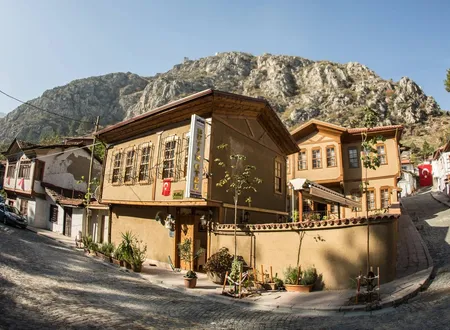
Hatuniye is one of the smallest neighborhoods of Amasya's central district in terms of population, yet most of the image the city presents to the outside world, the timber houses leaning over the Yeşilırmak, lies within its boundaries. Set on a narrow strip squeezed between the slope of Mount Harşena and the water on the northern bank of the river, the neighborhood has taken shape around a mosque complex, a mansion and several rows of riverside houses. Hüseyin Hüsameddin Yasar records it as one of the quarters of "İçeri Şehir" (the Inner City), the old core of Amasya at the foot of the citadel; Osman Fevzi Olcay, in his memoirs of the first half of the twentieth century, remembers by name the families who lived in these streets. The neighborhood's past can be followed through the buildings and also through the records these two local witnesses left.
Origin of the Name
The neighborhood takes its name from the Hatuniye Mosque within its boundaries. The mosque and the complex around it were built in 1510 by Bülbül Hatun, a consort of Bayezid II and the mother of Prince Ahmed (Şehzade Ahmed). The name "Hatuniye" means "the building raised by the lady"; in Ottoman cities complexes founded in the names of dynasty women were called this way and often passed their names to the surrounding neighborhood. In Amasya too the building gave its name to the neighborhood, and the neighborhood found its own identity in the shadow of the building.
Hüsameddin lists the neighborhood eighteenth in his own sequence and draws its limits as follows: Câmi-i Enderûn Neighborhood to the east, Kurşunlu to the west, Karatay to the north, the Yeşilırmak to the south. The same book states that Câmi-i Enderûn Neighborhood lay "in the vicinity of Hâtuniye Neighborhood" and was formed by separation from Karatay, and that Karatay in turn borders Hatuniye to its south. These descriptions confirm that the neighborhood is a narrow strip: Karatay on the mountain foot to the north, the river to the south, and neighboring quarters pressing in from both sides. The neighborhood's name before Bülbül Hatun is unknown; Hüsameddin gives no such name either. Another building bears the same name: in Manisa, the complex built in the name of Hüsnüşah Hatun, one of the consorts of Bayezid II, by her son Şehzade Şehinşah, whose main-gate inscription carries the date 1490-91, is also known as the Hatuniye Complex. The two buildings are unrelated; the founder of the Amasya building is Bülbül Hatun.
Bülbül Hatun and Her Endowment
What is known of Bülbül Hatun's life is limited. Some records give her father's name as Abdullah, a detail that points to a concubine origin; Hüsameddin, however, in a statement he quotes from Amasya endowment records, calls her "Bülbül Hâtun binti Abdulhay." The two spellings refer to the same person, but no document seen in this study settles which one reflects the original record. She is reported to have borne Bayezid II three children, Şehzade Ahmed, Şehzade Mahmud and Hundi Sultan, to have commissioned pious works such as a mosque and a madrasa, to have endowed her properties in 1509 and to have died in Bursa in 1515. Hüsameddin writes that Şehzade Ahmed was born in Amasya in AH 870 (1465-66), that his mother was Bülbül Hatun, and that he was appointed governor of Amasya in AH 886 (1481). Whether Bülbül Hatun was ever in Amasya and how she took part in the construction is not clear in the sources available; her son's governorship here may be seen as a plausible reason for the complex being built in this city.
Hüsameddin writes that Bülbül Hatun endowed her properties and income-bearing real estate to meet the expenses of the mosques, schools and soup kitchens she had built in Amasya and in Lâdik. The date of the endowment deed is AH 915; because that year spans 1509 and 1510, it is not surprising to see both calendar years in the sources. That the endowment continued to operate in later centuries can be understood from scattered records in the same work. Around AH 1020 the administration of the Bülbül Hatun and Sinan Pasha endowments, which had been in the hands of the Amasya alaybeyi İskender Bey, was given to his brother, the müteferrika Mustafa Bey, when the bey died. In AH 1081 (1670-71), when the sheikh of the Mahmud Çelebi Lodge in İçerişehir died, the ten-akçe stipend he had drawn from the Bülbül Hatun Endowment was transferred to a retired scholar. Around AH 1119 (1707-08), Mehmed Bey, a nephew of Küçük Alizade Hüseyin Pasha, became the endowment's administrator. These records show that the mosque was not merely a place of worship but part of an endowment system operating with salaried staff, a lodge sheikh and a school teacher around it. Hüsameddin elsewhere also lists Bülbül Hatun's mosque and bathhouse under the heading "Bahşî Neighborhood"; this name does not agree with the Hâtuniye entry in the main section where neighborhood names are listed, and the source does not explain the difference.
Location and Geography
Hatuniye lies on the northern bank of the Yeşilırmak. The neighborhood extends along a riverbank strip of about 800 meters between the Train Station Bridge and the Government Bridge (Hükümet Köprüsü). The slopes of Mount Harşena rise to the north, and the rock-cut Kral Kaya tombs are visible above the neighborhood; the Hazeranlar Mansion is likewise described in the sources as lying below these tombs. With the river to the south and the rock to the north, the neighborhood is bounded by natural limits on both sides.
Geography decided how building would proceed in this narrow corridor. Since very little level ground remained between the riverbed and the slope, houses either lean against the hillside or sit on the old city wall that runs along the bank. The south-facing fronts toward the river were pushed outward on corbels (eliböğründe) to widen the interior. Amasya lies in a first-degree earthquake zone, and the fire of 1915, the earthquake of 1939 and occasional floods severely wore down the city's housing fabric; Hatuniye is said to be the neighborhood least affected by these disasters. This assessment rests on an expert's account, and no document on the details of the damage was examined.
Olcay describes the part of the neighborhood known as İçeri Şehir as lying beneath the citadel and following today's railway line as far as the head of Meydan (Station) Bridge. In his account of Kuba Neighborhood he says that at the end of the street "one comes out onto the road of Hatuniye Neighborhood"; that is, a pedestrian arriving from the west reached Hatuniye after Kuba. In Olcay's photograph caption the names İçeri Şehir and Hatuniye are used interchangeably: "A street in İçeri Şehir (Hatuniye Neighborhood) where old Amasya houses stand." This usage suggests that in the city's memory the neighborhood was not known only by its official name and that an older name denoting the district also survived.
The Hatuniye Mosque and Its Complex
Hüsameddin describes the complex as follows: a masonry mosque rising within a rectangular enclosure, a minaret beside it, gardens to the east and north, a soup kitchen (imarethane) to the west. The inscription stone above the mosque's door was no longer in place in his time; the date of construction could be deduced only from old documents. The same work counts the mosque's soup kitchen among the five principal soup kitchens of Amasya and notes that each had a tabhane (hospice for travelers) beside it. This institution, where the poor and travelers were fed, was one of the functions that tied the neighborhood to the city's charitable order rather than leaving it only a place of worship and housing.
The complex consists primarily of a mosque, a bathhouse and a primary school (sıbyan mektebi). The mosque is entered through a low arched door on the north. The north façade is closed by a five-bay last-congregation porch formed by six columns joined with pointed brick arches. The walls of this section are higher than those of the prayer hall, and the upper parts of the arches are decorated with a meander motif running across the whole façade. The porch is covered by five small domes; only the central one rests on an octagonal drum, the others being built without drums.
The rectangular-plan mosque has rubble-stone walls. Two piers in the middle of the prayer hall, joined to the walls, divide the interior into six bays; the two central bays, wider and higher than those on the sides, are covered by two domes. A single-balcony minaret of brick masonry rises at the northwest corner. Immediately east of the mosque, facing the same street, stands the primary school. Its pointed-arched, stone-framed entrance is on Hazeranlar Street; the rubble-stone walls show brick courses laid in bands of three. The entrance façade again has three pointed-arched windows, and geometric decorations were achieved above the arches by laying the bricks in different patterns.
West of the mosque stands the bathhouse that Hüsameddin calls "Çukur Hamâm." According to old endowment documents, this bath was built by Rıdvan Bey, one of the emirs of the Seljuk Sultan Mesud; it then passed into the property of the Amasya emir Şadgeldi Pasha and finally, joined to Bülbül Hatun's estate, was included in the endowment in AH 915. Hüsameddin estimates that it was built around AH 550; if this estimate is right, the bathhouse is about three and a half centuries older than the mosque itself. At the western end of the neighborhood, opposite the Upper Bath (Yukarı Hamam), there was also a small mosque (mescit) that Paşa Hatun had built in AH 821 (1418). Paşa Hatun is introduced as the daughter of the emir Yahşi Bey and the sister of the former grand vizier Bayezid Pasha; she arranged the mosque's endowment herself. Hüsameddin mentions a running fountain in this neighborhood belonging to Iydizade Akif Mustafa Efendi and adds that other benefactors may have had fountains too, but their water had stopped.
The school is a single story, its interior laid out as one large room; the floor and ceiling are of wood. In its original state the building was covered by double domes, but the domes later collapsed and the building was closed with a timber roof. The west façade has a low-arched door opening inward and two windows near the top of the wall. Schools of this kind, where small children were taught reading, writing and religious knowledge, were ordinary parts of Ottoman complexes. The school at Hatuniye also takes part in the daily flow of the neighborhood, standing beside the street that links the mosque courtyard to the harem entrance of the mansion.
The later centuries of the Hatuniye School are also documented. According to Hüsameddin, the school was a solid masonry building with well-ordered endowments; the renowned Kavaklı İbrahim Efendi taught here until AH 1210 (1795-96). Because of the school's reputation, it began to be used as a primary school (ibtidaî) in AH 1300 (1882-83). The mosque also had an associated library: in AH 1017 (1608-09) Müeyyedzade Pirî Çelebi had a library built adjoining the mosque and arranged its endowments. Hüsameddin counts it among the eight libraries founded in Amasya by men of benevolence. Hatuniye was thus a place where children learned to read and write, where books were read and where the poor were fed.
Mosque Staff and Notable Names of the Neighborhood
Hüsameddin's biographical volumes give the mosque's staff and some people born in the neighborhood by name. Fazlullah Efendi bin Mustafa, preacher and sermon-giver (hatip and vaiz) of the Hatuniye Mosque, who died in AH 1081 (1670-71), is described in the same source as a famous calligrapher. Around AH 1106 Ali Efendi, the mosque's chair sheikh (kürsü şeyhi), died and İvaz Efendi became chair sheikh in his place. When the preacher Çavuşoğlu Hacı Mehmed Efendi bin Receb died in AH 1172, his son Hafız Ahmed Efendi succeeded him as preacher; Hüsameddin notes that this information is written in the Amasya court registers. The father of Hamza Efendi was also the imam of the Hatuniye Mosque, Ali Efendi, and Hamza Efendi served as a madrasa professor at the Hatuniye Madrasa in Tokat and became the kadı of Amasya in AH 1092. That Şeyh Hızır Efendi, preacher of the Hatuniye Mosque, was at the same time sheikh of the Mahmud Çelebi Lodge is another link joining the mosque to the surrounding lodges. This staff shows the mosque as a center of preaching, teaching and the art of calligraphy.
Two names stand out among those born in the neighborhood. Çavuşzade Hüseyin Bey was born in Hatuniye Neighborhood, the son of Ali Bey, one of the palace couriers; rising in war as a holder of a zeamet, he served four times for one year each as Amasya alaybeyi, in AH 1053, 1056, 1060 and 1064, and died in AH 1065 (1655). The second is Hilmi Mehmed Bey. The son of Ali Hikmet Efendi, who lived in Hatuniye Neighborhood in İçerişehir, Hilmi Mehmed was born in this neighborhood in AH 1277, passed from the Rüştiye to the Kuleli Military Lycée and the War College, graduated in 1298 as a second lieutenant, served in various reserve battalions and came to Istanbul in 1327 with the rank of lieutenant colonel. Hüsameddin writes that he had no merit worthy of praise; he records that his military career ended in 1336 when he was retired and expelled from the army, after which he went to Akşehir. He adds that Hilmi Mehmed was a scholar and by nature a poet, and that he claimed descent from the Emir İmamzade line.
Olcay presents the residents of the neighborhood through his observations from the early twentieth century. In describing the İçeri Şehir section he names Kaleköylü Müderris Hasan Efendi, the professor and sheikh Hacı Eyüp Efendi, the Çaycızade family among the notable (ayan) families, Mahmut Ağa of the Hattatoğulları, the ney player Hafız Mehmet of the Kemeroğulları, Hulusi Efendi of the Madenoğulları, and the brothers Hafız Sabri and Cemal Bey as "the native people of this neighborhood," and writes that he knew them all. He then adds with sorrow that none of the elders of these families remain and that some cemeteries and places of pilgrimage have had their traces erased by being transferred into private ownership. These lines show that the houses now used as hotels and cafés were once homes of professors, calligraphers and notable families.
The Fire of 1687-88
Among the events Hüsameddin records, the one that concerns the neighborhood most directly is a fire. In AH 1099 (1687-88), during the term of the Amasya governor Hüseyin Pasha, on the twenty-seventh night of Rajab, that is the Night of the Ascension (Miraç), a great fire broke out in Eski Kethüda Neighborhood. Driven by the force of the wind, it spread everywhere, and at dawn that night a second fire started in Hatuniye Neighborhood in İçerişehir and burned two thirds of the city. Because the two neighborhoods were counted among the neighborhoods of the notables (ayan), a rumor spread among the people that the fires were revenge taken on the seyyids. It is reported that household goods carried out into the fields and empty places to save them from the fire were stolen by vagabonds and plunderers, among whom were also seyyids; the affair grew because of the looting and turned into a quarrel among the people, the emirs and the seyyids. Today Hatuniye is said to be the neighborhood least damaged by disasters; yet this record shows that the same neighborhood is remembered as the place where a great fire in history began.
The Riverside Houses
The best-known face of the neighborhood is the row of riverside houses (yalıboyu evleri) lined along the river. They are concentrated on the Yeşilırmak bank and on Hazeranlar Street in Hatuniye, and form the most distinct examples in Amasya of late Ottoman Anatolian domestic architecture. Because timber has a limited life, houses from the Seljuk and early Ottoman periods have not survived, and what one sees today is largely late-period building. The houses use the hımış technique, that is, a timber frame with an adobe (mudbrick) infill between the members. The south fronts facing the river are supported by corbels and pushed outward; the windows are mostly guillotine windows arranged in groups of three, and lattices placed before them provide privacy. Some of the houses rise on the thick Roman-period city walls.
According to the architect Mustafa Kazancıoğlu, the value of the riverside houses has risen markedly for tourism over the last decade. The mansions have been restored and have drawn the interest of visitors, and today some of them serve as hotels, cafés and restaurants. That only a few mansions have survived has made it hard to meet the growing demand and has pushed prices up. The new uses of the buildings have helped keep them standing, but they have also changed the everyday life of the neighborhood.
The Hazeranlar Mansion
The Hazeranlar Mansion, east of the Hatuniye Mosque and below the Kral Kaya tombs, is a typical example of the "Turkish house" model in Amasya. It is one of the notable riverside mansions that once lined the walls along the northern bank of the Yeşilırmak like the yalıs of the Bosphorus in Istanbul, most of which have been demolished in recent years. It takes its name from the family nickname of its first owners. There is no firm record of when it was built; it is said to have been built during Ziya Pasha's term as governor (mutasarrıf) of Amasya. Surveys made before restoration found Sultan Abdülaziz's monogram (tuğra) on the north and front pediment of the main selamlık room, and the inscription "maşallah kân 1289" on the projecting pediment above the harem entrance door. Since Ziya Pasha's term lasted about two years, in 1864-1865, it may be accepted that the mansion was built around 1865 and that the date 1289 (1872) marks a year after the completion of construction.
The mansion's architecture is a solution to the walls leaving no level ground along the river. The basement is fitted to the slope of the plot, and the two-story mass above it rests on a projection built toward the river on five timber posts. The building thus gained a wide usable area and a regular, square-cornered geometric form. Perfect symmetry prevails on the south façade facing the Yeşilırmak; the floors and rooms are marked by timber bands in horizontal and vertical lines, and the two corner rooms on the upper floor each give movement to the façade with a projection. The east side of the building has no windows because of earlier party-wall construction; the other façades have vertical windows 90 centimeters wide, in a 1:2 proportion, mostly of the triple sliding type.
The mansion consists of two separate sections. The selamlık entrance opens onto the courtyard of the Hatuniye Mosque to the west; the harem entrance is the double-leaf courtyard door at the end of a narrow cobbled road in the shape of a dead-end street, lying between the primary school to the north and the houses. In the courtyard, in front of the entrance stairs, stand a well, and at the western corner a cauldron hearth integrated with the building, used for cooking molasses and tomato paste and for boiling laundry and water for washing the dead. On both floors of the harem section there is an original example of the central-sofa arrangement joined by stairs; there is a room at each of the four corners, with iwans (eyvan) between them forming extensions of the central sofa. The selamlık is left outside this scheme, extended toward the north and designed separately from the harem in plan and function, connected only with the upper-floor sofa. The entrance opens onto a low-ceilinged space with a brick-paved floor; the revolving cupboard there was placed so that meals prepared in the kitchen on the harem's lower floor could be passed to the selamlık servants. From the hall of the selamlık one passes to a coffee room, a small room and the main room, also called the "pasha's room". Used for large receptions and conversation gatherings, the main room is the brightest space in the mansion with the widest view.
Each of the rooms facing south and west has a bench (sedir) before the windows; plaster sherbet niches showing the influence of the Baroque style are placed in the middle of the opposite walls, and their sides are used as cupboards with doors. The ceiling of the selamlık main room is original; all the timber elements, including doors, windows and stair railings, were rebuilt in the restoration after their original examples. The mansion changed hands several times through inheritance and sale, and at a time when it had reached the point of collapse and its owners were making efforts to have it demolished, it was saved from destruction by expropriation by the Ministry of Culture. The restoration began in late 1979, was completed in 1983, and the mansion opened as a museum on 17 August 1984. In the mansion, where ethnographic objects brought from the storerooms of the Amasya Museum are displayed, the interior order of the remaining old Amasya houses was taken as the basis during the arrangement, and the recollections of elderly people who remembered the mansion's earlier days were also used. The basement, reached by a few steps from the eastern corner of the courtyard, shows the timber construction in full; it houses an exhibition hall, a vaulted section called the "develik", an office and an area set aside for conferences and film screenings.
Population and Change
According to compilations based on TÜİK data, the population of Hatuniye was recorded as 212 in 2012, 184 in 2013, 168 in 2014, 149 in 2015, 141 in 2016, 127 in 2017, 139 in 2018 and 126 in 2019. Over seven years this is a decline of roughly forty percent, and in this period the neighborhood is among the smallest of the central district. A small rise appears only in 2018; the general trend is downward.
The sources give no firm explanation for this shrinkage. The shift of the historic fabric from housing to tourist uses such as hotels and cafés is an explanation that comes to mind, and the restoration of houses for renewed use points in that direction; but its relation to the population figures is not a documented finding.
Hatuniye Today
Today Hatuniye is one of the first riverbanks that visitors to Amasya walk. The mosque and primary school, the museum mansion and the riverside houses are gathered in the same small neighborhood, and the riverside walkway links these buildings. This strip, interwoven along the bank with the neighboring Nergis Neighborhood, is one of the most photographed places in the city. Because the selamlık door opens onto the mosque courtyard, the mansion and the mosque are in practice used as parts of the same space. For the soup kitchen, hospice and library that Hüsameddin mentions, the sources available give no current information about a surviving building.
Chronology
AH 821 (1418): Paşa Hatun is reported to have built a small mosque at the western end of the neighborhood and arranged its endowment.
AH 870 (1465-66): Birth of Şehzade Ahmed in Amasya.
AH 886 (1481): Şehzade Ahmed's appointment as governor of Amasya.
1509: Bülbül Hatun is reported to have endowed her properties.
1510: The Hatuniye Mosque and its complex were built by Bülbül Hatun.
AH 915 (1509-10): Drawing up of Bülbül Hatun's endowment deed; the Çukur Hamam is joined to the endowment.
1515: Death of Bülbül Hatun in Bursa.
AH 1017 (1608-09): Müeyyedzade Pirî Çelebi has a library built adjoining the mosque.
AH 1081 (1670-71): Death of the preacher and sermon-giver Fazlullah Efendi.
AH 1099 (1687-88): Fire on the Night of the Ascension in Eski Kethüda and Hatuniye neighborhoods.
AH 1210 (1795-96): The year until which Kavaklı İbrahim Efendi taught at the Hatuniye School.
AH 1300 (1882-83): The school begins to be used as a primary school.
1864-1865: Ziya Pasha's term as governor; the Hazeranlar Mansion is thought to have been built around this time.
1872 (AH 1289): The date above the harem door of the mansion.
1979-1983: Restoration of the Hazeranlar Mansion.
1984: The Hazeranlar Mansion opens as a museum on 17 August.
Bibliography
Primary sources
- Hüseyin Hüsâmeddîn Yasar, Amasya Tarihi, vols. 1-4, Amasya Belediyesi, 2022, p. 119 (Hâtuniye Neighborhood), p. 162 (Hâtuniye School); also pp. 47, 161, 178, 202, 481, 491, 593, 607
- Hüseyin Hüsâmeddîn Yasar, Amasya Tarihi, vols. 9-12, Amasya Belediyesi, 2022 (entries on Çavuşzâde Hüseyin Bey, Hilmi Mehmed Bey and the staff of the Hâtuniye Mosque) amasya.bel.tr
- Osman Fevzi Olcay, Amasya Hâtıraları, Amasya Belediyesi Kültür Yayınları (section on Kuba and İçeri Şehir neighborhoods) amasya.bel.tr
Official sources
Other sources
- Mehmet Tektaş, "Hazeranlar Konağı", TDV İslâm Ansiklopedisi, vol. 17, Istanbul 1998, pp. 121-122
- İ. Aydın Yüksel, "Hatuniye Külliyesi" (Manisa), TDV İslâm Ansiklopedisi
- Sabah, "Amasya'nın renkli dünyası: Yalıboyu evleri", 8 October 2021 (sabah.com.tr)
- Wikipedia (Turkish), "Bülbül Hatun" entry (based on Necdet Sakaoğlu, Bu Mülkün Kadın Sultanları)
- Nufusu.com, "Merkez Mahalleleri Nüfusu Amasya" (TÜİK/ADNKS data, 2012-2019)
Online sources