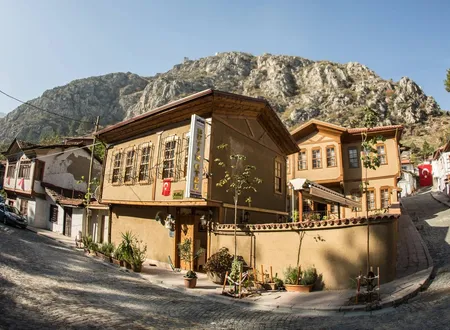
The Hızırpaşa neighbourhood of Amasya's central district takes its name from Hayreddin Hızır Paşa, an Ottoman statesman who in the fifteenth century had a group of buildings raised in the city: a mosque, madrasa, primary school, soup kitchen and bath. In Amasya, a city where princes were raised and which carried real weight in the empire's eastern policy as a sanjak seat, the buildings a pasha endowed drew houses, orchards and gardens around them, and the settlement that grew there eventually became a neighbourhood and took his name. Today Hızırpaşa is one of the city's more populous neighbourhoods, with Hızır Paşa's mosque and bath on one side and the railway station and the constant flow of daily life on the other; an architectural inheritance more than five hundred years old stands on the same slope as traces of the railway age.
Origin of the Name and Earlier Names
The name is linked to the mosque Hayreddin Hızır Paşa had built in 1466. According to the records of the Ministry of Culture and Tourism, Hızır Paşa was the brother of Yörgüç Paşa, the lala of Murad II. A lala, in the Ottoman system, was the experienced statesman who oversaw a prince's education and his work in the sanjak administration. Yörgüç Paşa had been the lala of Prince Murad when he was sent to Amasya; his brother Hızır Paşa is remembered as a statesman who served around the princes raised in Amasya over the following half century.
Hüseyin Hüsameddin Yasar describes the formation of the name more explicitly in his Amasya Tarihi. According to him, after retiring Hızır Paşa had a mosque, madrasa, soup kitchen and bath built in his own quarter of Amasya and in 870 (1465/66) endowed all his property to these charities. Around the buildings he laid out mansions, houses, vineyards and gardens, and settled there people brought from Amasya and elsewhere along with his own slaves; "this place came to be called the Hızır Paşa Quarter." Hüsameddin says the pasha lived in his mansion in this quarter and died in the month of Muharram 889 (1484) (Amasya Tarihi, vols. 9-12, pp. 113-114). The same author records two earlier names for the area. For a time the quarter was known as "Kavak" or "Kavaklar", a rather high locality; before that, because of an account that the palace of the Komnenos family, who held the governorship of Pontus in the Byzantine period, stood here, it was called the "Komnenos Palace" (vols. 1-4, pp. 119 and 308). This palace story is known only through Hüsameddin's retelling; no document or remains of the building have been cited.
No document has been found in open-access sources for the date on which the neighbourhood was officially fixed as "Hızırpaşa". Osman Fevzi Olcay, for his part, describes the quarter in Amasya Hâtıraları under the heading "Yukarı Meydan Mahallesi (Hızır Paşa Mahallesi)"; in other words, at the beginning of the twentieth century the name circulated in two forms, and the older usage, the name of the high square, lived on beside the neighbourhood name.
Location and Boundaries
Hızırpaşa lies in Amasya's city centre; the surface area given by compilation sites is about 0.68 square kilometres. The address of the Hızır Paşa Mosque appears as "Hızırpaşa, Kumru Sokak No:12", and the mosque is described as the building above the railway station. Amasya Railway Station is also shown on İstasyon Caddesi, within the boundaries of Hızırpaşa. The neighbourhood thus extends over terrain that rises from the low area where the station stands to the higher area where the mosque sits.
Hüsameddin places the quarter in the north-west of the city, above the Ok Meydanı (Archery Square), on a high site. He also lists its borders: Hekim Çelebi Quarter to the east, the Şeyh Cui vineyards to the west, Ok Meydanı to the south and the Kırklar Mountain to the north. The neighbouring Hekim Çelebi Quarter takes its name from the physician Bedreddin Mahmud Çelebi, famous around 890 (1485). In Hüsameddin's day it was only a locality after its mansions had fallen into ruin; the author writes that the Eser-i Cedid Mansion was built in 1212 on a large plot donated by Millizade Hacı Süleyman Bey, but that in the war of the Hijri year 1293 the quarter was destroyed entirely, and that nothing remained apart from the mansion's ruins (vols. 1-4, p. 119). One of the two gates of Harşena Castle, according to the same source, also faces this quarter, that is, the west (p. 96).
How the slope shaped the building can be seen in the Hızır Paşa Mosque. In the Bayezid Paşa and Yörgüç Paşa mosques in Amasya the entrance is on the north façade; in the Hızır Paşa Mosque, because of the steep gradient of the site, the entrance was placed on the east and the ablution fountain was set on that side too. That the entrance changes direction in mosques of the same plan family shows that the terrain directly affected the layout of the complex.
Hızır Paşa's Life and Lineage
Hüsameddin tells of the pasha's origins and career in separate places, with details that do not always agree. He writes that Hızır Paşa was the son of Hasan Ağa, a sekbanbaşı (chief of the dog-keepers) in Amasya, that he entered Murad II's palace while young and became agha of the Janissaries, and that in 848 (1444/45) he came from Edirne as governor-general of Amasya. He also records that a bath endowment deed in Çorum describes the pasha as "atîku's-sultân Murâd", that is, a freedman of Sultan Murad. In the same years, the same volumes say, he was sent to escort the daughter of the Dulkadirid ruler, betrothed to Prince Mehmed, to Manisa; he is named as Yörgüç Paşa's brother; and he became known for his effort at the Battle of Varna. As Hüsameddin relays it, the report that he held the sultan's horse by the bridle when the sultan tried to flee the field, and thereby kept him from leaving, is the turning point of that career. In 851 he was called to the Divan as fourth vizier, then served as vizier for about four years, and in 855 returned to Amasya on the second accession of Mehmed II. In 857 he travelled to the Hejaz to carry the imperial surre intended for the Holy Cities, and on his return lived in retirement in Amasya and turned to his pious foundations (vols. 9-12, pp. 113-114).
This account does not agree on every point with the shorter summary that circulates widely about the pasha. In that summary he was placed in charge of Amasya by Mehmed II in 1456 and, after the conquest of Trabzon in 1461, became the first sanjak governor of Trabzon. Hüsameddin, for his part, in his entries for 874 (1469/70) names a certain "Hayreddin Hızır Paşa son of Hasan Çelebi, of Gelgiras" beside Prince Abdullah, who was appointed to Trabzon; he also speaks separately of a pasha of the same name, from the Gelgiras district of Merzifon, who with his son Hasan Paşa built a mosque, madrasa and school there (vols. 1-4, pp. 208 and 478). The available sources do not allow a firm answer as to whether the Hızır Paşa of Amasya is the same person as this namesake; here, as the namesake of the neighbourhood, the man Hüsameddin calls "Ata Beyzade Hayreddin Hızır Paşa", Yörgüç Paşa's brother, is taken as the basis.
The sources also differ on lineage. One report, based on records of the Sivas Evkaf, states that Yörgüç and Hızır Paşa descended from Köse Mihal. Hüsameddin rejects this account outright: as can be understood from the endowment deeds of both pashas and from the records, they belong to the line of Atabeg (Ata Bey), who had a madrasa in Amasya; to count these "Turk sons of Turks" as Mihaloğlu is a legend. Olcay, on the other hand, describing the Mehmed Paşa Madrasa, introduces its founder as "Mehmet Paşa, brother of Hızır Paşa of the Kösemihaloğulları"; Hüsameddin and recent studies of the endowment documents regard Mehmed Paşa as Hızır Paşa's son, and Olcay's brotherhood may be a slip of memory.
The Endowments of Hızır Paşa
Muhammet Okudan's article "Hızır Paşa Vakıfları ve Amasya Hızır Paşa Medresesi", published in 2025 in the İtkan Akademik Araştırmalar Dergisi, makes these endowments the subject of an independent study. According to the article, Hızır Paşa established three endowments in Amasya in 870/1465. When the documents in the Archive of the General Directorate of Foundations, the Ottoman Archive and the sharia court registers are read together, it emerges that Hızır Paşa had a madrasa and a mosque built and created various posts for their needs, such as müderris and muid. Among the deed's conditions is also additional payment to the müderris, muid and students serving in the madrasa built by his brother Yörgüç Paşa. The recitation of the Qur'an at the grave of his grandson, buried in the same madrasa complex, is likewise among the provisions of the deed.
According to the endowment deed of 870/1465, Hızır Paşa endowed agricultural land, vineyards and gardens of various sizes in Suluova, Doğantepe, Ladik and Amasya centre, together with two inns and a bath. Doğantepe belongs to Amasya today and Ladik to Samsun; the endowment's sources of income thus spread over a geography that went beyond the limits of the city. Shortly after the foundation, in 1493, Hızır Paşa's son Mehmed Paşa donated thirteen villages, two hamlets, seven mills, a piece of agricultural land and a shop to add income to his father's endowment.
The endowment's income was generally calculated from produce such as wheat and barley collected from the endowed villages. The inns and shops, at least in part, continued to bring in income, and almost all expenditure went on the upkeep and repair of the buildings and the salaries of the staff. Management had its troubles from time to time; appointments to posts not specified in the deed and the appointment of people who did not meet the conditions of trusteeship are on record. According to the accounting records, the endowment survived until the Republican period.
Hüsameddin also gives a chain of the endowment's trustees. According to him, Hızır Paşa's line could continue only until about 1036 (1626/27), after Mehmed Paşa. Thereafter two branches descended through granddaughters, the Kurdzades and the Hayreddinzades, along with the Keyvanzades, descendants of the pasha's freedman Keyvan Ağa, and they contended with one another for the trusteeship of the endowment. The Keyvanzades took over the trusteeship first; then the Seydibeyzades brought a suit and obtained it, and against them the Hayreddinzades secured a court ruling. Finally, in 1124 (1712), Kurdzade Ali Bey, relying on the influence of Köprülü Ali Paşa, the governor of Amasya, had the trustee Hayreddinzade Ali Bey dismissed and exiled, and from then on the trusteeship remained with the Kurdzades (vols. 9-12, p. 114). According to the report based on Sivas Evkaf records, the Kurtoğlu and Kurt families living today in Amasya and Samsun descend from Hızır Paşa's son Mehmed Paşa.
The Sibling Cluster: Yörgüç Paşa
Hızır Paşa's endowment cannot be considered apart from the buildings his brother Yörgüç Paşa left in Amasya. According to the Türkiye Diyanet Foundation Encyclopaedia of Islam, when Çelebi Mehmed sent his twelve-year-old son Prince Murad to Amasya in 1414 with the governorship of the Rum province, he gave Yörgüç Paşa to him as lala. After Murad took the throne as Murad II, Yörgüç Paşa was appointed governor-general of Rum in 1423, brought the beys who were waylaying travellers around Amasya and Tokat under obedience, and, having secured order in Central Anatolia, received the rank of vizier. He died in Dhu al-Hijjah 845 (April-May 1442) and was buried in the tomb of the mosque he had built in Amasya. The encyclopaedia also notes that different claims exist about the pasha's genealogy, but that, because his father's name appears as Abdullah in his inscription, on his gravestone and in his endowment deed, these genealogies are regarded as doubtful. According to Okudan, Hızır Paşa's endowment also provided additional payment for the madrasa his brother founded; this shows that the two groups of buildings were tied together both by kinship and in financial terms.
Historic Buildings
Hızır Paşa Mosque
The mosque was built in 1466 by Hayreddin Hızır Paşa and is one of the early Ottoman mosques with a zaviye, or inverted-T, plan. This plan also appears in the Bayezid Paşa and Yörgüç Paşa mosques in Amasya. The building has been damaged and repaired many times since it was built, so nothing definite is known about the original roofing system. It is thought that the two central bays were covered by two domes and the side spaces probably by vaults.
Hüsameddin describes the mosque, like the whole group of charities, as built of masonry (kârgir): a small building, graceful in form, with a slender minaret; its madrasa on the east side, a fountain in front of it, and the whole enclosed by a wall. In 1214 (1799/1800) the mosque had Cârîloğlu Hacı Hüseyin Ağa as preacher, and he died in Shaban 1219 (vols. 9-12, p. 51). The complex consisted of the mosque, bath, madrasa and ablution fountain; the list Hüsameddin gives also includes a school and a soup kitchen. Only the mosque and the bath have survived to the present.
The Bath
Hüsameddin describes the bath west of the mosque as a "double bath" and finds it very graceful. He writes that, because women visited it in the hyacinth season and used it as a place for an outing, it was known among the people as the "Hyacinth Bath" (Sümbül Hamamı) (vols. 1-4, p. 119). The bath is an item in the endowment deed; it is counted among the income-producing endowed properties and contributed to the upkeep of the complex.
Madrasa and School
According to Hüsameddin, the Hızır Paşa Madrasa stood inside a separate enclosure that surrounded the mosque on its east and north sides; it was built of stone, its rooms were small and its courtyard pleasant, and in front of each room was a projection for summer days. Its date of foundation is 870. The author says that listing all the müderrises would be burdensome and mentions only the years in which changes occurred. While the post was given in the old manner in turn to senior scholars, this succession was broken in 1098, and Ma'kûlzâde Hacı İbrahim Efendi, then Abdullah Efendi, and in 1115 Hâfız Hasan Efendi became müderris. In later years the post changed hands often, in some years the share was divided between two persons, and Köprülü Mehmed Efendi took office in 1169 and Ürgüplü Hacı Ahmed Efendi after 1183. Within the Ürgüplü family the post of müderris and müftü passed from father to son, and the shares of Hacı Ahmed Efendi's descendants were still running in 1318 (vols. 1-4, p. 168). The ninth volume mentions other names connected with the madrasa: Pîrîzâde Hacı Hüseyin Efendi kept his tie with this madrasa until his death in 1098; Seyyid Hüseyin Efendi of Ladik became müderris in 1154 (vols. 9-12, pp. 32 and 41-42). Olcay, too, at the beginning of the twentieth century, names Ürgüplü Mustafa Efendi as one of the "oldest scholars and müderrises" of the quarter.
Hüsameddin also places the Hızır Paşa School next to the mosque and writes that it was built by the pasha in 870. It was a school with a well-ordered endowment and a strong teaching staff; Hâfız Mustafa and Mehmed Hüsnî Efendi, well-known calligraphers of Amasya, served here as teachers. In the author's time the school stood abandoned (vols. 1-4, p. 162). The madrasa, in Olcay's account, appears as a ruined structure: at the beginning of the twentieth century a mosque and a bath stand in Yukarı Meydan, but no madrasa remains. Okudan's article has brought the deed's provisions on the madrasa back to light.
Cemetery of the Hızır Paşa Mosque
According to the registration records, the cemetery lies to the south-west of the mosque. It contains two marble sarcophagus graves of rectangular prismatic form, hollowed out inside. On the left side of the first sarcophagus, in the middle, is a tulip, with rosette motifs on both sides; the second sarcophagus resembles the first, with zigzag fringes on its upper part, a tulip motif on the head side, and on its side stones a tulip in the middle, cypress trees on the flanks and two rosettes. The cemetery has monumental protection status and the body responsible for its upkeep is the General Directorate of Foundations. The inventory does not say whom the graves belong to.
Hüsameddin partly fills this gap. According to him the cemetery holds the tomb of the pasha's grandson Oruç Bey. Oruç Bey was the son of Kâsım Bey, the pasha's son-in-law; because he died before his grandfather, the latter had a tomb built for him in 870 and endowed Qur'an sections for it (vols. 1-4, p. 136). The condition of Qur'an recitation at the grandson's grave, which Okudan cites from the deed, agrees with this record; it is very likely that the two sources speak of the same person, though neither joins them explicitly. In another account of Hüsameddin, Kâsım and Ahmed Bey are named as the pasha's sons, and "Ahmed Bey, son of Kâsım Bey, and Abdullah Bey, son of Ahmed Bey" are said to have died before the pasha and to be buried in the mosque's cemetery (vols. 9-12, p. 114). Whether Kâsım Bey was a son-in-law or a son remains unclear, since the two passages are written differently. Hızır Paşa himself, according to Hüsameddin, lies in the tomb garden of his son Mehmed Paşa; he writes that the grave of the father is at the head, north of the stone steps in front of Mehmed Paşa's tomb door, and that the stone of the father has an inscription while Mehmed Paşa's has none (vols. 1-4, p. 145).
Family and Surroundings
The pasha's children rose from Hızırpaşa Quarter through the ranks of the state. According to Hüsameddin's records, his son Mehmed Paşa became third vizier of the Divan in 887 (1482/83), was removed from that post in Dhu al-Hijjah 888 and made lala of Prince Ahmed. In 900 (1494/95) he had a mosque, madrasa, soup kitchen, zaviye and tomb built in Amasya, known by his own name; Olcay gives this date as 902 (1496), so there is a one-or-two-year difference between the two authors. One detail Olcay gives about the Mehmed Paşa Madrasa is notable: the madrasa had a bakery and an oven, and its founder had flatbread made there throughout Ramadan and distributed it to the people of the quarter and to the poor.
The other son, Mahmud Paşa, was one of the viziers of Prince Bayezid's administration in Amasya. At the end of the inquiry Mehmed the Conqueror conducted into Bayezid's court, some people were executed in Amasya, and Mahmud Paşa was among them. Hüsameddin writes that this execution grieved the aged pasha greatly (vols. 1-4, p. 479; vols. 9-12, p. 114). The pasha's steward, Hüsameddin Ağa, also appears in the building life of the quarter's surroundings: in 878 he had a school built in the Temenna Quarter and in the same year arranged the well of the spring south of the Meşkgâh (vols. 1-4, pp. 89 and 162).
Among the quarter's later residents, Hacı Hızır Ağa, known as the "meydan ağası" (agha of the square), stands out. Hüsameddin presents him as a man of the Hızır Paşa Quarter, son of Hacı Ahmed Ağa, a sipahi who won the trust of the people and notables by keeping order around Ok Meydanı and who rose to the post of deputy governor of the sanjak of Amasya around 1065. The same Hızır Ağa had a school, a zaviye and a fountain built in the quarter in 1061, and in 1064 a lodge for the Khalwatis at Ok Meydanı. Because Şeyh Ehlullah Efendi, of the Habilzade family, served as sheikh in this lodge until 1110, the building was called the "Ehlullah Lodge" (vols. 1-4, pp. 119 and 150; vols. 9-12, p. 117). A lodge built in 971 by another Hızır Paşa of the same name in the Şamice Quarter, in contrast, must not be confused with this quarter; that lodge burned in the fire of 1143 and its site was lost (p. 151).
Yukarı Meydan and the Station Area
In Olcay's account the Hızır Paşa Quarter lies west of the broad area where the present railway station stands, at the foot of Harşena Castle. The whole of this area, reaching as far as the Şeyh Cui and Akbilek vineyards, is called "Karaağaç Meydanı"; its western section bears the name Yukarı Meydan or Hızır Paşa Quarter, and its middle section "Elekçiler Meydanı". Olcay writes that this name came from the Roma community living there who made sieves and strainers. He adds that in later years the area became a gathering and entertainment place for people of low social standing and was therefore left to the supervision of the security forces. After the First World War this situation vanished; when the state railway was built and the area became a station, the surroundings changed completely, and the place turned into Amasya's most valuable promenade closest to the city. According to Olcay there was at that time in the quarter a mosque, a bath and a ruined madrasa; almost none of the old residents remained, and a quarter was forming anew, but most of its people were refugees coming from the surrounding villages.
Population and Change
Hızırpaşa is one of the more populous neighbourhoods of Amasya Central. According to data from the TÜİK address-based population registration system, the neighbourhood's population is as follows:
- 2012: 5,928
- 2013: 5,733
- 2014: 5,774
- 2015: 5,802
- 2016: 5,896
- 2017: 5,815
- 2018: 5,846
- 2019: 5,972
The eight-year series follows a rather static course. The lowest value is 5,733 in 2013 and the highest 5,972 in 2019, a difference of 239 people. The yearly average is about 5,846; the net increase between 2012 and 2019 is only 44. These figures suggest a city-centre district that held its population, more than a new residential area growing fast in these years. No source was found that traces in figures the process from the refugee settlement Olcay describes to today's crowded neighbourhood.
Hızırpaşa Today
Someone visiting Hızırpaşa today can begin with the two surviving parts of the complex, the mosque and the bath. The mosque's entrance, opening to the east, and its position leaning on the hillside show on the spot how the plan was changed to suit the terrain. Just below stands the railway station, and within the same boundaries the neighbourhood holds the urban fabric produced by fifteenth-century endowment architecture and by the railway age. Since no sourced detail was found on the neighbourhood's tradesmen and daily life, no information is given on that subject.
Chronology
1414: Prince Murad is sent to Amasya with the governorship of the Rum province, accompanied by his lala Yörgüç Paşa.
1423: Yörgüç Paşa is appointed governor-general of Rum.
1442: Yörgüç Paşa dies and is buried in the tomb of his mosque in Amasya.
1444/45 (848 AH): According to Hüsameddin, Hızır Paşa arrives from Edirne as governor-general of Amasya.
1456: Hızır Paşa is placed in charge of Amasya by Mehmed the Conqueror.
1461: After the conquest of Trabzon, Hızır Paşa becomes the first sanjak governor of Trabzon.
1465 (870 AH): Hızır Paşa establishes three endowments in Amasya; according to Hüsameddin the mosque, madrasa, school, soup kitchen and bath are completed this year and Oruç Bey's tomb is built.
1466: The Hızır Paşa Mosque is built.
1473/74 (878 AH): Hızır Paşa's steward Hüsameddin Ağa has a school built in Temenna.
1484 (889 AH): According to Hüsameddin, Hızır Paşa dies; he is buried in the tomb garden of his son Mehmed Paşa.
1493: His son Mehmed Paşa donates thirteen villages, two hamlets, seven mills, a piece of agricultural land and a shop to the endowment.
1651 (1061 AH): Hacı Hızır Ağa has a school, zaviye and fountain built in the quarter.
1712 (1124 AH): The trusteeship of the endowment passes to the Kurdzades.
1799/1800 (1214 AH): Cârîloğlu Hacı Hüseyin Ağa becomes preacher of the Hızır Paşa Mosque.
Sources
Primary sources
- Hüseyin Hüsâmeddîn Yasar, Amasya Tarihi, vols. 1-4 (Amasya Municipality, 2022), especially pp. 89, 96, 119, 136, 145, 150-151, 162, 168, 208, 308, 478-481
- Hüseyin Hüsâmeddîn Yasar, Amasya Tarihi, vols. 9-12, pp. 32, 41-42, 51, 113-114
- Osman Fevzi Olcay, Amasya Hâtıraları, entries "Yukarı Meydan Mahallesi (Hızır Paşa Mahallesi)" and "Mehmet Paşa Medresesi" amasya.bel.tr
Academic studies
- Okudan, Muhammet. "Hızır Paşa Vakıfları ve Amasya Hızır Paşa Medresesi". İtkan Akademik Araştırmalar Dergisi 2/2 (2025), 133-145 (DergiPark)
- TDV Encyclopaedia of Islam, "Yörgüç Paşa"
Official sources
Other sources
- Nufusu.com, "Merkez Amasya Mahalleleri Nüfusu" (TÜİK/ADNKS compilation, 2012-2019)
- Vikipedi, "Hayreddin Hızır Paşa"
Online sources
- https://amasya.bel.tr/uploads/e-kitap/kitap/9-12/files/basic-html/page114.html
- https://dergipark.org.tr/tr/pub/itkan/issue/91336/1652232
- https://www.kulturportali.gov.tr/turkiye/amasya/kulturenvanteri/hizir-pasa-camii-haziresi
- https://islamansiklopedisi.org.tr/yorguc-pasa
- https://www.nufusu.com/merkez-amasya-mahalleleri-nufusu