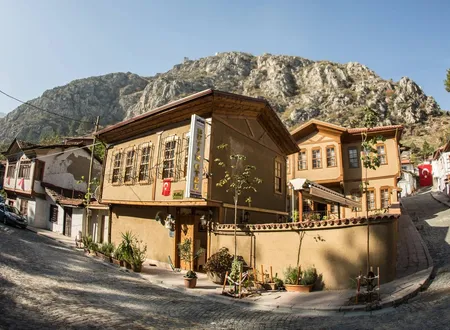
İhsaniye is a neighborhood of refugee settlers in Amasya, lying just north of the Şamlar district and the Şamlar Cemetery. Its name comes from the Arabic word "ihsan" (favor, bounty), and many settlements across Anatolia bear the same name; yet the founding of İhsaniye in Amasya is tied directly to the settlement of Muslim emigrants who fled the northern Black Sea shore and the Balkans in the last quarter of the Ottoman century. The quarter, where Tatars of Crimean and Dobruja origin were resettled, was long known among the townspeople as "the Tatar Quarter," while in official registers and identity papers it appeared under the names "İhsaniye" and "Mecidiye." The story of the neighborhood runs through the question of how these three names are connected.
The Göklüsu Locality of Şamlar
İhsaniye did not arise as an independent village or an old city quarter. It emerged when "Göklüsu," a locality within the Şamlar Neighborhood, came to be treated as a separate neighborhood. Şamlar is one of the old neighborhoods of Amasya; in the land survey registers of 1520 and 1576 it appears as "Şamlular," and the settlement of the people of Damascus there is said to reach back to 1389. Hüseyin Hüsameddin Yasar traces the name to a civil conflict between the Mamluk sultans al-Ashraf Shaban and the Circassian al-Zahir Barquq. According to him, the Damascenes who supported Ashraf were forced to leave their homes in 791, and some of them took refuge in Amasya and were settled in this neighborhood. He finds the account of Vâzıh Efendi, which reaches back to the Umayyad period, strange. Osman Fevzi Olcay, in his memoirs, repeats the story of those who fled Umayyad oppression. On the same page he also describes Şamlar as it was in his own day: nearly all the residents of the neighborhood were refugees who had come from various districts and settled there.
According to Olcay's description, İhsaniye is "the continuation of Şamlar Neighborhood"; it ends at the fork of the road leading to Kulis Hill and the Ziyaret district, and sits at the foot of the broad, commanding hill on which Şamlar stands. The boundaries Hüsameddin draws for the Tatar Quarter agree with this description: the neighborhood lies north of the Şamlar Cemetery, with the paved road on its east, the Ahmak Vineyards on its west, the cemetery on its south, and the locality called "Gülüs" on its north. One face of the neighborhood thus looks toward the road entering the city, the other toward the vineyards and the cemetery.
The name of the locality appears in two forms in the sources. Hüsameddin writes it as "Gülüs" and notes that this place, which covers the northern part of the neighborhood and is otherwise meadow, bears a very old name. He says it can be found in the same form in records as far back as 727, 635 and 573, and that the name therefore predates the conquest of Amasya. He offers an interpretation that takes the name to be a corruption of Archelaus, a commander of Mithridates VI, king of Pontus, or of the Roman general Lucullus who fought Mithridates, but he presents this openly as a guess. For the name "Taraput," given to the vineyards to the northeast, he writes that he could find no document. In Zehra Hizmetli's article the same place appears as "Göklüsu." No record proves the relation between the two spellings; the similarity of sound and the location suggest that the same place is meant, but this is an inference.
The Arrival of the Tatars
The real founding story of the neighborhood begins after the Ottoman-Russian War of the late 1870s. According to Hizmetli's article, the great majority of the Tatars settled in İhsaniye in 1878 came from the town of Mecidiye, in the district of Constanța in the Dobruja region of Romania. For this reason the quarter where they were to settle in Amasya was first called "Mecidiye Neighborhood"; the identity and tax documents belonging to the Tatars give the neighborhood's name as Mecidiye. The name remained in use for a while in the early years of the Republic, after which the area was absorbed into İhsaniye. Olcay's account is somewhat different: according to him, the people of the neighborhood are Crimean Tatars who came from Crimea in 1292 (1876-1877), and the neighborhood was called "İhsaniye" because Sultan Abdülhamid II arranged their settlement.
The sources do not align exactly, so the differences must be stated plainly. Hüsameddin says the Tatars have been settled here "since the year 1295"; Hizmetli reads this date as 1878, and the Hijri year 1295 begins in January 1878. Olcay's 1292 means 1876-1877. If one remembers that the war began in the spring of 1877 and that the great wave of emigration intensified only after it, Olcay's date may be thought to be about a year early; still, this is an interpretation, not a document. On the question of origin, Olcay calls the emigrants "those who came from Crimea," while Hizmetli points to Mecidiye in Dobruja. The two accounts need not exclude each other; Hizmetli also writes that the neighborhood is where Crimean Tatars were settled. Even so, it would not be right to reduce the journey of every family that came to Amasya to a single route.
Hizmetli also reports that the settlement took place in two stages. The Tatars were first to be placed in the region between Gözlek and Kayabaşı, but they left this first site because the area was marshy, because of malaria, and because the newcomers were not farmers. The second site is the old cemetery ground lying between Şamlar and İhsaniye. At the first site the state had granted land, whereas the second they obtained by borrowing from the state, to be paid for in installments. The pattern of settlement and the arrangement of the houses were likewise set by the state. The article mentions samples of the promissory notes issued by the Ziraat Bank's Memleket Sandıkları (provincial funds) for the purchase of these lands. These details show that the neighborhood was founded not as a temporary shelter but as a planned settlement area financed by debt.
The general principles of settlement policy are consistent with this choice. According to the instructions of the period, refugee settlements were to be set up away from marshes, near running water and main roads, and away from damp hollows; settlement officials were to grant land to the newcomers without distinguishing rich from poor, and where it fell short the Ziraat Bank could open credit. Giving refugee settlements names that evoked the sultan's favor or the dynasty was also a recognized practice. The same article cites as examples Güllüce in Amasya taking the name Selimiye and the new village on the Tuzsuz farm taking the name Hamidiye. The idea that the name İhsaniye was likewise given as the sultan's "bounty" agrees with Olcay's account.
Three Forms of the Name
The name İhsaniye cannot be tied to a single record. Hüsameddin says that in the defter-i mîrî, that is, the official registers, the neighborhood was entered as "İhsaniye Neighborhood," while in popular speech the name "Tatar Quarter" prevailed. Hizmetli reports that the documents in the emigrants' hands read "Mecidiye." Olcay ties the name directly to the sultan's settlement grant. It is possible that the three names belong to three distinct layers: the name given by the state, the name the emigrants brought from where they came, and the name of the townspeople's speech. Hizmetli's article, however, contains a second account. Relying on an Ottoman archive document dated 15 May 1905, it writes that a group of Dagestani refugees, made up of 77 households, was settled in the Göklüsu locality of Şamlar, and that this place was made a separate neighborhood and took the name "İhsaniye." Elsewhere the same article also says that the Tatars were settled in this neighborhood "after the Dagestani refugees."
Set side by side by date, these accounts produce a contradiction. If the date 1878 given for the Tatars is correct, the neighborhood named in 1905 must have been founded after the Tatar settlement; yet Hüsameddin's record says the name İhsaniye was entered in the registers for the Tatar settlement. Two possibilities come to mind. The first is that the name was given to the Tatar neighborhood and then, in 1905, was extended to cover the adjoining Dagestani settlement. The second is that the phrase "after the Dagestani refugees" in the article and the 1905 document do not refer to the same event. With the sources at hand no firm judgment can be made on this; all that can be said is that during the reign of Abdülhamid II (1876-1909) the name was used both for the Tatars and for the Dagestanis.
The relation of the Dagestani emigrants to Şamlar also appears in another document. According to Hizmetli, the refugees who had come from Dagestan ten to twenty years earlier and been settled as guests in the Şamlar Neighborhood were living at the locality of Boğazbağları on land they had bought with their own money. A correspondence dated 6 July 1889 records that they numbered 52 households and 165 people in all, 44 households at Boğazbağları and 8 at a place called Leylekli, and that they were engaged in farming. Stating that they had neither houses nor property in Şamlar, that the place where they had settled was two hours away, and that they had difficulty with taxes and levies, they asked to separate from Şamlar, to have their place named "Boğaz Neighborhood," and to have an imam and a headman appointed. This petition belongs not to İhsaniye but to Boğazbağları, yet it shows how new neighborhoods outside Şamlar came into being: emigrants were first entered in the households of an existing neighborhood, and when distance and tax difficulty arose they requested their own headman and imam.
Life and Trades in the Neighborhood
Hüsameddin's brief description shows the neighborhood through the eyes of a local historian. According to him the Tatars living here are "very hardworking" and devout; they built a mosque in the middle of the neighborhood. In the year 1316 Zileli Hacı Velizâde Hacı Hasan Efendi, one of the notables of Amasya, had a school built beside this mosque, thus contributing to the neighborhood and to the spread of learning. Hüsameddin lists the charities of the same Hasan Efendi elsewhere as well. Describing the revival of charitable activity in Amasya after the proclamation of the Constitution, he writes that Hasan Efendi had two schools built, one in the Tatar Quarter and the other in the courtyard of the Sultan Bayezid Mosque. The same book also mentions that some three hundred liras were spent on building the school in the Bayezid courtyard and that its opening took place in Dhu al-Hijjah 1328. What stands out is the date of the school in the Tatar Quarter. The neighborhood entry says 1316, while the post-Constitution account places it within the movement after 1326. If the two records mean the same building, the date is not settled even in Hüsameddin's own text.
The livelihoods of the people of the neighborhood become concrete in Hizmetli's article. Some of the Tatars worked in saddlery, that is, the making of horse tack, carriage harness and saddles. They had been unable to practice their trades at their first settlement; once moved to İhsaniye they were able to set up their workshops. Horse breeding and blacksmithing were also among the neighborhood's occupations. A horse health certificate in the appendix of the article is presented as an example showing that this animal husbandry was carried on under official supervision. The article records, as a general tendency, that tradesmen, craftsmen and merchants coming out of Crimea chose towns rather than farming villages for their settlement.
The migration did not end at one stroke. According to what Hizmetli reports on the basis of Muzaffer Kaan Kırım's master's thesis, the arrival of Tatars in the neighborhood continued off and on until 1950, and the last family to settle there came from Silistra in southern Dobruja. In the intervening time Turkish replaced Tatar as the everyday language, but the language has not been forgotten; the elderly still speak Tatar, and most of the young at least understand it. The neighborly and kinship ties formed with the people of Amasya have, in the article's words, turned the culture of the neighborhood into a new and distinctive structure. The title of Kırım's thesis shows that it studies how the Tatars of the neighborhood reproduce their community and sense of belonging. Because the details of the thesis could not be reached, they are not reported here.
Buildings Around the Neighborhood
Right at the edge of the neighborhood, above the Şamlar Cemetery, rises the tomb of Şirvanlı İsmail Sirâceddin Efendi. Hüsameddin describes the tomb as follows: it is a masonry structure with two domes, with a mosque on its west and the tomb on its east. The tomb was built by the former grand vizier Şirvanizade Mehmed Rüşdi Paşa; in the book the date of construction appears as 1284 in one place and 1286 in another, while the settlement of its endowments is given as 1290. Inside the tomb lie Sheikh İsmail Sirâceddin of Shirvan, his son Ahmed Hulusi Efendi, who had served as judge of Istanbul, and his son-in-law Hacı İsa Rûhî Efendi. Hüsameddin also writes that before İsmail Sirâceddin was buried there the hill was called "Şamlılar Üstü." Olcay's account joins this information: Mevlana Siraceddin İsmail Şirvani, of the Naqshbandi-Khalidi order, who lies at the very commanding point of the hill, is the father of the grand vizier Mehmed Rüşdi Paşa and the teacher of Mir Hamza Nigâri. Hüsameddin also notes that the courtyard of the tomb has a mansion and a fountain, and that the water flowing to the fountain of the Şamlılar Neighborhood was later diverted entirely to this tomb and cut off from the fountain. The place of the neighborhood also becomes clear on the same page: south and east of the tomb is cemetery, and north is the Tatar Quarter.
The Ahmak Vineyards west of the neighborhood also appear in the description. Hüsameddin writes that these vineyards were planted after the year 1300 and were called "Ahmak Vineyards" because they had no water, though the air was healthy and the location pleasant. Some wits added three dots to the word "ahmak" to make "Uçmak Vineyards," that is, Paradise Vineyards. The Alagöz Baba Tomb at the edge of the Şamlar Cemetery is in the same surroundings. Hüsameddin writes that this very old structure is attributed to the Danishmendid Melik İsmail Gazi and that its form resembles works of the sixth Hijri century. The tomb took its name when Sheikh Şemseddin Ahmed Baba, who died in 807, was buried there; apart from rumor, no document could be found that İsmail Gazi lies there.
A District at the City's Entrance
In Olcay's book the İhsaniye and Sofular neighborhoods are printed side by side, and the texts under the two headings are interleaved in columns. After the İhsaniye paragraph comes the account of Sofular, which lists the notable people of the district one by one. Among them are Ali Bey, a samovar repairman among the refugees from Oltu; Lütfü Bey, who served in the Istanbul security organization and was a finance accountant in Amasya in the years of the armistice; and the poet Sebâtî Hoca and his son Ali Hâver Bey. Among these lines is a sentence saying that a neighborhood, though it is the entry point of the city, shows no development. From the text it is not clear whether the sentence means İhsaniye or Sofular. For this reason it would not be right to write these names as residents of İhsaniye.
The short paragraph Olcay devotes to İhsaniye is nevertheless valuable. It records, from the mouth of a witness, the reason for the neighborhood's founding, that is, the settlement of the Crimean Tatars, and the source of its name. Similar observations exist in the same book for other neighborhoods: the residents of Şamlar are "refugees who came and settled from various districts"; in Aşağı Savadiye, refugees from Shirvan live together with Turks. These lines show that İhsaniye was not the only neighborhood of Amasya shaped by migration, but one of those that took its name directly from this migration.
Population
According to a compilation of TÜİK/ADNKS data, the population of İhsaniye Neighborhood ran as follows between 2012 and 2019:
- 2012: 2,000
- 2013: 1,959
- 2014: 1,988
- 2015: 2,005
- 2016: 2,054
- 2017: 2,112
- 2018: 2,240
- 2019: 2,364
After falling to 1,959 in 2013, the population returns to the 2012 level in 2015, begins to rise from 2016, and reaches 2,364 in 2019. The eight-year increase is about 18 percent. No data exist showing what share of today's population descends from Tatar families; Hizmetli's article speaks of a community that still carries on the neighborhood's culture today but gives no numerical share. Different figures circulate on compilation sites for more recent years; because they could not be verified, they are not used here.
What the Research Leaves Open
The sources that could be reached on the neighborhood are limited, and some questions remain open. The name of the Tatar mosque, whether it still stands, and the fate of the school built by Hacı Hasan Efendi do not appear in the sources consulted. How many households the neighborhood was founded with in 1878 is not known; a figure of 77 households is given only for the Dagestani group of 1905. The thesis and archive documents on which Hizmetli relies may contain these details. If the Islamic court registers, land records and the registers of the Refugee Commission were searched, the names and numbers of the neighborhood's first residents might come to light.
Chronology
1389: The settlement of the people of Damascus in the Şamlar Neighborhood is said to reach back to this date.
1520 and 1576: In the land survey registers the neighborhood appears under the name "Şamlular."
1284/1286-1290: Şirvanizade Mehmed Rüşdi Paşa has the tomb above the cemetery built for his father Sheikh İsmail Sirâceddin and arranges its endowments.
1292 (1876-1877): According to Olcay, the Tatars who came from Crimea are settled in the neighborhood; it is named İhsaniye because of the bounty of Sultan Abdülhamid II.
1295 (1878): According to Hüsameddin, the settlement of the Tatars has continued since this date; Hizmetli writes that the Tatars from Mecidiye in Dobruja were settled in 1878.
1889: Dagestani refugees ask to separate from Şamlar and become a separate neighborhood under the name Boğaz Neighborhood, with an imam and a headman.
1316: Zileli Hacı Velizâde Hacı Hasan Efendi has a school built beside the Tatar mosque; in another account the same charity is placed after the Constitution.
15 May 1905: According to an archive document, a group of Dagestani refugees of 77 households is settled in Göklüsu and the neighborhood takes the name İhsaniye.
1950: The last Tatar family settles in the neighborhood, coming from Silistra.
2012-2019: The neighborhood's population rises from 2,000 to 2,364.
Bibliography
Primary sources
- Hüseyin Hüsâmeddîn Yasar, Amasya Tarihi, Amasya Belediyesi Kültür Yayınları, 2022, vols. 1-4 (Tatar Quarter entry; e-book p. 113).
- Hüsâmeddîn Yasar, Amasya Tarihi, vols. 1-4 (Şirvanlı Tomb and Ahmak Vineyards; e-book p. 101).
- Hüsâmeddîn Yasar, Amasya Tarihi, vols. 1-4 (Hacı Hasan Efendi's schools; e-book p. 179).
- Osman Fevzi Olcay, Amasya Hâtıraları, Amasya Belediyesi Kültür Yayınları (section on the Şamlar, İhsaniye and Sofular neighborhoods). amasya.bel.tr
Academic studies
Other sources
Online sources