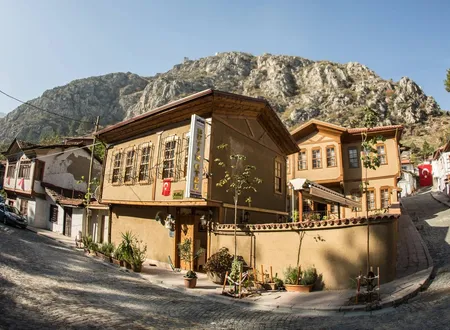
Most neighborhood names in Amasya come from a mosque, a dervish lodge or a statesman who once lived nearby. Mehmetpaşa Neighborhood belongs to this kind. Recorded in older documents as Mehmed Paşa Neighborhood, it lies on the bank of the Yeşilırmak close to the old core of the city, and it takes its name from the vizier who had a complex built here at the end of the fifteenth century. That was not the neighborhood's first name, however. Before it, the area carried the name of a Seljuk hunting emir and his small mosque, and when the complex was built that older name faded gradually. The madrasa and the soup kitchen of the complex have vanished, while the mosque, the tomb and the neighboring bath still stand. The history of the neighborhood is therefore read in several layers: the mosque and tomb of Tuğrak Bey, the complex of Mehmed Paşa, the lodge of the Halveti sheikhs, the madrasas, and the long-lived family of the endowment's trustees.
Origin of the Name
The name comes from the most important building within the neighborhood, the Mehmed Paşa Mosque and Complex. According to the TDV Encyclopedia of Islam, the complex was built by Hızır Paşazâde Mehmed Paşa, a vizier of Sultan Bayezid II and the lala of Şehzade Ahmed. A lala was the experienced statesman assigned to a prince, responsible for his education, for the administration of his sanjak and for his dealings with the men around him; in princely sanjaks such as Amasya the post in practice also covered the running of the sanjak.
Hüseyin Hüsameddin Yasar treats the neighborhood as a separate entry in the first volume of his Amasya Tarihi and states plainly how the name changed. According to him the neighborhood was formerly known as Dugrâkiye (Tuğrakiye) Neighborhood; from the year 890 (1485) it began to be called Mehmed Paşa Neighborhood, and the old name remained only as the name of the madrasa. This date agrees with the year Hüsameddin gives, in the same work, for the lodge that Mehmed Paşa built for Habib Karamânî. The Seljuk name goes back to an old small mosque right beside the mosque of the complex, whose story is told separately below.
The sources part ways over the date of the building. The two-line Arabic inscription over the main portal of the mosque, according to the TDV entry, records completion in Muharram of the year 891 (January 1486). The Amasya Governorate's list of mosques gives 1485. Hüsameddin separately reports a translation of the inscription and writes the date of construction as Muharram of the year 900 (October 1494); he gives the same year 900 for the madrasa and the lodge. The gap may arise from the way the inscription was read or from the parts of the complex having been finished in different years; there is no document at hand to settle it. Below, the date on the inscription, 891, is taken as the basis and Hüsameddin's date is noted separately. The date of Mehmed Paşa's death is disputed in the same way: the TDV gives 900 (1495), another academic study gives 904 (1498), and Osman Fevzi Olcay dates the madrasa to 902 (1496).
Location and Surroundings
The TDV Encyclopedia of Islam places the complex "in Amasya, near the Yeşilırmak, in the Mehmed Paşa neighborhood". Hüsameddin also gives the boundaries: the neighborhood lies east of the Tımarhane (the old hospital), and is bordered on the east by the Pirinççi and Yâkûtiye neighborhoods, on the south by Ya'kûb Paşa neighborhood and on the north by the Yeşilırmak. Among its neighbors, Yâkûtiye takes its name from the Ottoman commander Sinaneddin Yâkût Paşa, while Pirinççi is named from 912 (1506-07) after Pirinççi Sinan Bey, who built a small mosque and a school there. In the Ya'kûb Paşa neighborhood to the south begins the area of the Halveti sheikhs known as the Lower Pîrs (Aşağı Pîrler).
Today the mosque stands on Pirinççi Street, part of which is called Mehmet Paşa Street, and it lies in the city center next to the Mustafa Bey Bath. Olcay describes the boundaries of the early 1900s as somewhat different from today's. He places the Tuğrakiye Madrasa on the bank of the Yeşilırmak in Pirinççi Neighborhood, next to the flour mill of Sudur Efendi; in other words the same run of streets was attached sometimes to one neighborhood and sometimes to the other. This account suggests that neighborhood boundaries shifted over time.
The Mosque and Tomb of Tuğrak Bey
Two and a half centuries before Mehmed Paşa, a Seljuk building already stood on this bank. According to its inscription, a small mosque was built in the year 631 (1233-34), in the time of Sultan Alâeddin Keykubad I, on the order of the Hunting Emir Hacı Tuğrak. According to Hüsameddin, Tuğrak Bey was the son of Sadreddin Suli Bey, chief of the Kimârlu clan, and the younger brother of the emir Mübârizeddin Behrâm; he became governor of Amasya in 627 (1229-30) and died around 632 (1234-35). The same source mentions him as a disciple of Baba İlyas Horasânî. The office of hunting emir in the Seljuk state organization belonged to the man who directed the sultan's hunts, which also served as rehearsals for war; the rich woodland and water's edge of Amasya suited this work.
Although the inscription speaks of a small mosque, the building was later called a madrasa. Hüsameddin explains this as follows: in the Ottoman period, because the Mehmed Paşa Complex was built right beside it, it lost its function as a mosque and was converted into a madrasa. In popular speech the name Tuğrakiye turned, for ease of pronunciation, into Dugrâkiye, Durâkiye and Doğrakiye. İsmail Hakkı Uzunçarşılı, in his collection of inscriptions published in 1927, saw the building on the bank of the Yeşilırmak close to collapse, with the inscription over its door. Olcay describes a two-story wooden madrasa with a large garden and, judging by the inscription on the door, writes that the building had originally been of masonry and was rebuilt in wood after a fire or an earthquake. Today there is no madrasa of this name in Amasya.
Next to the madrasa, in front of the Mehmed Paşa Imaret on the road, there was a tomb. Hüsameddin describes it as a long stone building with a fish-back dome of masonry, its foundations and side walls very solid, extending toward the west. Inside lie Tuğrak Bey, his son Şemseddin İnanç, his grandson İzzeddin Balaban and other members of the family. The building was once known as the İnanç Tomb; in time people forgot İnanç and his children, and the name turned into the Tomb of the Cows (İnekler Türbesi). According to the story, the cows of a woman returned with wet feet on a day when no rain fell, during the Flood of Noah; the woman understood from this sign that the flood had begun, and because she was saved she took the name Selâmet Hatun. Hüsameddin rejects this tale categorically: İnanç belongs to the seventh and Selâmet Hatun to the ninth century of the Hijra. Selâmet Hatun was a real benefactor who in 857 (1453) had the Yâ Vedûd Lodge built in Pirinççi, and it is impossible to put the two in the same age.
The Mehmed Paşa Complex
The original complex consisted of a mosque, a madrasa, a soup kitchen (imaret), a tomb, a guest hall (tabhâne), a lodge (zâviye), a fountain and a cemetery. Only the mosque, the side rooms attached to it that were probably the guest hall, and the tomb have come down to the present. According to Hüsameddin, the group of buildings was surrounded by a large enclosure: the minaret stood on the west of the mosque, the imaret and the madrasa in front of it, the pasha's tomb on the east, and the Halveti lodge on the south. Buildings of this kind are classified in Ottoman architectural history as "mosques with lodges (guest halls)". In these mosques the tabhâne is the set of side rooms where travelers, dervishes and madrasa students stayed and were given hot meals.
Family ties also played a part in the founding of the complex. In the ninth volume of Hüsameddin's Amasya Tarihi, the wife of Mehmed Paşa is named as Şehzâde Hatun, daughter of İshak Paşa of Amasya, a former grand vizier. When her husband became lala of Şehzade Ahmed, she came with him to Amasya; she had a school built near the mosque and endowed the property inherited from her father and her husband for the expenses of the school and of her own tomb. Mehmed Paşa's father Hızır Paşa was the brother of Yörgüç Paşa, the lala of Murad II. Yörgüç Paşa's son Mustafa Bey had a bath built in the neighborhood in 840 (1436-37); so the same family developed this strip along the Yeşilırmak twice, half a century apart.
The Mosque
The mosque is built entirely of cut stone. The prayer hall measures 8.70 × 8.60 meters; the dome, with squinches at the corners, rests on a twelve-sided drum, and its interior is decorated with polychrome painted ornament. The hall has ten windows. The marble mihrab is a very plain niche with five sides, topped by five rows of small shell-like hoods. The portal projects forward and is enriched with fine moldings and graceful hourglass motifs; small mihrab-like niches with six sides are cut into its two side walls. The door, with its flattened arch, and the foundation inscription are set within a deep niche with a round arch. The building is described as having an inverted-T plan, with a square main prayer space covered by a dome on an octagonal drum.
The two rooms on each side, linked to the hall by doors from the east and the west, are square in plan and, except for the room that holds the minaret, each is covered by a dome on an octagonal drum. The rooms at the two ends have hearths and cupboards, which shows that they were actually arranged for lodging and for preparing food. A porch 33.37 meters long runs the full width in front of the hall and the side rooms. Seven octagonal marble columns and round arches that rest on the porch wall, made of red and white stones laid in alternation, carry its covering. The part above the door is covered by a barrel vault and the remaining sections by domes without drums. Every face of the column capitals is decorated with rosettes and bosses. This arrangement gives the otherwise plain mass a rhythm on the exterior more than inside.
The minaret stands on the right, wedged between the porch wall and one of the guest-hall rooms. Its stone shaft is sixteen-sided and has a single balcony. In front of the porch, on the main axis, stands a fountain with an octagonal basin and a roof carried on eight columns. The wooden door leaves, regarded as important examples of woodcarving, are kept today in the Amasya Museum. A photograph in Albert Gabriel's Monuments Turcs d'Anatolie shows that the original window shutters were of the same quality.
The Minbar
The mosque is architecturally simple, but its minbar is a work of art that all the sources single out. According to the TDV Encyclopedia of Islam, almost the whole surface of the marble minbar is covered with intricate rûmî and arabesque ornament in low relief. Above the kiosk, which has Arab-style arches, there is a small onion-shaped dome. The minbar door has a pointed arch and a frame decorated with curling branches, and it is crowned by a rectangular panel bearing the Throne Verse (Âyetü'l-kürsî). Hüsameddin likewise calls the minbar "gâyet musanna'", that is, extremely finely worked, and draws attention to the flowers carved in relief on the marble.
The Tomb and the Cemetery
The tomb stands on a platform raised about 0.80 meters above the floor of the mosque. It measures 4.60 × 3.85 meters and is covered by an eight-segment dome on an octagonal drum. Its pointed-arch door is on the north, and the east face is a wide arched opening. The sarcophagus inside carries no inscription. The TDV entry reports that Mehmed Paşa's grave is the second in a row of graves in front of the door, and that it is not inside the tomb; the first grave belongs to his father Hızır Paşa and the third to Habib Karamânî. An article on the Halveti lodges describes this arrangement somewhat differently: Hızır Paşa lies inside the tomb, and in front of the door the grave of Mehmed Paşa lies beside those of Habib Karamânî and his successor Seydi Halife. In both accounts it is common ground that Mehmed Paşa lies in a simple grave next to the sheikh.
A cemetery grew up around the tomb. On its east side, attached from outside to the enclosure wall, stood a plain fountain with a pointed arch. The fountain is known only from a photograph in Gabriel's book and no longer exists.
The Mehmed Paşa Madrasa
Hüsameddin describes the madrasa as a separate enclosure in the courtyard of the mosque, wrapping around its north and east sides. Built solidly of masonry, with large and pleasant rooms, it stood in his words at the "sittîn" rank, that is, the sixty grade; in the Ottoman ladder of madrasas this corresponds to an upper-middle place. Olcay sees the madrasa as one lecture hall with eleven rooms and recalls 902 (1496) as the year of its foundation. He names the founder as Mehmet Paşa, brother of Hızır Paşa of the Kösemihal family, whereas Hüsameddin and the TDV take Mehmed Paşa to be Hızır Paşa's son. It should be kept in mind that Olcay was writing from memory and that, on these matters, he is a later source than Hüsameddin. The same author adds that beside the first room on the Yeşilırmak side there were a bakery and an oven, and that during Ramadan flatbread was baked here and distributed to the poor of the neighborhood.
Hüsameddin lists the teachers of the madrasa at length. When Çelebizâde Ömer Efendi died in 1095 (1684), the vacant post passed to Çorumlu es-Seyyid Hâfız Mehmed Efendi; after his death in 1143 (1730-31), since his son was in the Hijaz, Diyarbekirli İsmâ'il Efendi was appointed. A year later, when the son returned, Seyyid Ahmed Sa'îd Efendi took the post; in 1179 (1765-66) his son Abdurrahîm Efendi did, and in 1197 (1782-83) his three sons became joint teachers. In 1247 (1831-32) all these shares were abolished and Mörekli Hasan Efendi was appointed; after his death his son İsmâ'il Efendi and then his grandson Hâfız Ahmed Efendi became teacher in 1318 (1900-01). The list shows how a single madrasa passed among a few families for two centuries.
The names of some of the students who studied here have also survived. According to Hüsameddin, the Amasya judge dismissed in 962 (1555) retired at this madrasa, and in 967 (1560) a judge pardoned out of respect for his learning and age was retired with the teachership of this madrasa. In 1023 (1614) Hakâlalızâde Seyyid Bahâeddin Mehmed Efendi, as teacher of this madrasa, also took on the deputy leadership of the descendants of the Prophet (nakîbü'l-eşrâf) in Amasya. In a later generation, during the brawls between the Janissaries of recruited origin and the native Turks, Mahmûd Efendi from the village of Gelik in Mecidözü was studying here; beaten and insulted in the market by a convert Janissary, this student became, in Hüsameddin's phrase, the one who "first raised the banner of Turkishness". In 1263 (1846-47) Hüseyin Fevzi, who came to Amasya from the village of Kışlacığı and later rose to the rank of pasha, stayed at this madrasa, where his maternal uncle lived. Osman Fevzi Olcay, describing his own schooling, writes that he began primary school at the Çukurkonak Primary School in the Mehmet Paşa Neighborhood and then continued madrasa education at the Mehmet Paşa Mosque.
Habib Karamânî and the Mehmed Paşa Lodge
According to information based on Hüsameddin's Amasya Tarihi, a lodge was built south of the mosque, on the road, in 890 (1485) in the name of Habib Karamânî, one of the Halveti sheikhs. Habib Karamânî, who was born in the town of Ortaköy near Niğde and married and founded endowments in İskilip, was a successor of Seyyid Yahyâ Şirvânî. He has an important place in the spread of the Halveti order in Anatolia; in Amasya he added a new branch to the Halveti tradition that had begun with Pîr İlyas. The sources give his death as 902 (1496) or 903 (1497). The lodge, together with the neighboring Mehmed Paşa Madrasa, became an educational and spiritual center run by Halveti teachers.
After Habib Karamânî the lodge was headed in turn by his successor Seydeddin Ali, known as İmâmzâde Seydî Halife, by Habib's son Hasan Efendi, and by Hasan's son Mehmed Efendi, nicknamed "Yamak Şeyh". When Mehmed Efendi went to Istanbul in 961 (1554), his brother Ömer Efendi and then another Mehmed Efendi became sheikh. When Mehmed Efendi died in 1078 (1667) his son Abdurrahman Efendi followed; when Abdurrahman died in 1107 (1696) his son Ömer Çelebi; and when Ömer Çelebi died in 1151 (1738) his son Mehmed Çelebi became sheikh. Hüsameddin records that the sheikhdom passed in 1202 (1788), at the death of Ahmed Efendi, to his sons Ömer, Ali and Mehmed Efendi, and in 1225 (1810) to Abdullah Efendi; because the post passed from father to son, he adds, the actual work of guidance was carried out by those serving as deputies. In 1296 (1879) Caucasian refugees were settled in the building, and the lodge became a private dwelling and never recovered its former function.
The importance of the lodge within the Halveti circle is tied to a few well-known names. Pîr Sinaneddin Yusuf, a former teacher of the Mehmed Paşa Madrasa who attached himself to Seydi Halife and gave up teaching, became the sheikh and preacher of this lodge. It is also reported that the same Seydi Halife sent Sultan Mehmed the Conqueror a letter complaining of Şehzade Bayezid's conduct in Amasya, and that on this letter the sultan sent a commission; on its report the execution of three of the prince's companions was ordered, one was executed, and two fled to Iran and Baghdad. The lodge thus also served as a place where a political voice close to the princely court in Amasya made itself heard.
The Bath, the Fountains and Other Charities
Hüsameddin separately lists the works built around the complex in later centuries. The bath west of the mosque was built by Yörgüç Paşazâde Mustafa Bey in 840 (1436-37). Known today as the Mustafa Bey Bath or the Mehmet Paşa Bath, it consists of a cold room, a warm room and a hot room. The walls of the dressing room are arranged on the inside with large niches, and the niche tops are decorated with muqarnas. The hot room has a plan in the form of a cross with four arms; there is a dome in the middle and two private cells on the west. A cistern and the furnace stoke-house lie behind it. The bath is still in use as a bath today and is the responsibility of the General Directorate of Foundations. Olcay writes that between the bath and its furnace stoke-house stood a high coffeehouse, that its regulars were fanciers of turkeys and roosters and hunters, and that on some nights roosters were fought there for stakes.
On the qibla side of the mosque, Oruç Bey had a fountain built in 910 (1504-05). In the same direction, the large fountain on the street is the work of Rüstem Ağa, regarded as the chief of the merchants; according to Hüsameddin, Rüstem Ağa endowed five shops and assigned their rents to the fountain's expenses, and he died around 1075 (1664-65). In the neighborhood, in 987 (1579-80), the judge Hayreddin Efendi had a small mosque and a school beside it built; his descendants were known as the Hayreddînzâdes. East of the bath stood a school for Qur'an reciters (dârü'l-kurrâ) built by Şeyh Mehmed Ağa; Hüsameddin gives its date as 1071 (1660-61) in the neighborhood entry and as 1073 (1662-63) in the entry he devotes to such schools. According to the same entry, the institution stood behind the bath, inside the street, and ten shops in the row of the Yâkûtiye Mosque and a mill were among its revenues. Earlier, Nûh Bey had also built a school for Qur'an reciters in the neighborhood.
Madrasas multiplied as well. In 1148 (1735-36) Fâtıma Hanım, the daughter of Hüseyin Paşa, built a madrasa in the neighborhood, endowed her property to it and appointed Hâfız Hüseyin Efendi as its teacher. In 1257 (1841-42) Ahıshalı Müftüzâde Ali Efendi built a madrasa inside the east gate of the Mehmed Paşa enclosure, beside the tomb; in 1308 (1890-91) the mosque's trustee Kurdoğlu Mehmed Bey built one more, a wooden madrasa of five cells, on the road west of it, and its first teacher was Dîvân Efendisizâde Hâfız Mehmed Nûrî Efendi. The last two madrasas show that the complex was still being extended with new buildings even in the last century of the Ottoman state.
The Endowment and Its Trustees
Over the centuries the management of the Hızır and Mehmed Paşas Endowment also shaped the politics of the neighborhood. Hüsameddin names several of the trustees of this endowment. In 1124 (1712) Hayreddînzâde Ali Çelebi, then head of the endowment, lost the suit over the trusteeship that Kurdoğlu Ali Bey had brought and was sent into exile in Ankara. The death of a Kurdoğlu trustee named Hacı Hüseyin Ağa is recorded around 1158 (1745); in one of the later death records the trustee Kurdoğlu Hacı Mahmud Bey is mentioned, and the trusteeship is said to have been given to his son Mehmed Bey. The Kurdoğlu family thus appears to have held the endowment for well over a century. When the trustee Nuri Bey died at the end of 1323 (1905-06), in Hüsameddin's words the old distinction was gone from the house of Kurdoğlu.
Olcay also knew the same family closely. He describes Kurdoğlu Mehmet Bey as a descendant of the Kösemihaloğulları, generous and charitable, and the trustee of the Mehmet Paşa Mosque. He relates that when the poet Ziya Paşa came to Amasya as governor (mutasarrıf) in 1282 (1866), Kurdoğlu Mehmet stood surety for him, and that on this event Payaslızâde Hacı İsmail Efendi composed the lines "Bu çargâhta kuzum rahat eyle kim neylesin / Ki onun râ'i-yi hâmisine kurt oldu kefil" (roughly: what could a flock do but rest easy, when the wolf himself stands surety for its protecting shepherd). The couplet plays on the name Kurdoğlu and the word for wolf. His mansion stood next to the house of the Telegraph Director Baba Efendi. The Mehmet Bey Madrasa, according to Olcay, was a charming two-story wooden building facing the Yeşilırmak; the bakery and shops behind it were endowed to the madrasa, and Nuri Hafız Hoca was its teacher.
The Notables of the Ottoman Period
The people that Hüsameddin's biographical section calls "from among the notables of Mehmed Paşa Neighborhood" show that the residents were once linked to an important network of state and learning. Sa'dullâh Bey, of the Selâm Beyzâde family, is one of them. A notable of the neighborhood, Sa'dullâh Bey took part in the Hungarian and Cretan campaigns under the grand vizierate of Köprülüzâde Fâzıl Ahmed Paşa, then became sanjak governor of Jeddah, and died in Istanbul in 1102 (1690-91). Another figure from the neighborhood is the Harem Steward Süleyman Ağa; the son of Hacı Hasan Ağa of the Şiyavuşoğlu family, he went to Istanbul, entered the household of Nevşehirli Damad İbrahim Paşa, and in 1140 (1727-28), when the pasha's son Mehmed Paşa became a son-in-law of the sultan, became his steward. Çiğdem Beyzâde Seyyid Mehmed Paşa, son of Hacı Ali Ağa from the notables of the neighborhood, was taken into the Enderun and trained through the favor of the Chief Black Eunuch Dördüncü Beşir Ağa. Hüsameddin also mentions Râif Mehmed Efendi, a son of a Harem Steward, from the neighborhood; he served as endowments clerk in Amasya and in 1263 (1846-47) went to Sivas as the secretary of the Amasya governor Sivaslı Saîd İbrahim Paşa.
The pulpit sheikhship and preaching post of the Mehmed Paşa Mosque were also filled from this scholarly circle. Hâfız Hüseyin Efendi, after teaching for years at the Mehmed Paşa Madrasa under the nickname "Ders-i âm", became the pulpit sheikh at the mosque and a teacher at the Osmân Çelebi Dârülhadîs; known as "Zanbak Dedezâde", he died after 1147 (1734-35).
The Neighborhood in the Early Twentieth Century
The streets of the neighborhood in the last Ottoman years can be pictured through Osman Fevzi Olcay's Amasya Hâtıraları. Olcay describes the neighborhood as a run of streets, door by door. First comes Kemerpaşazâde Hüsameddin Efendi. A plump, short, humorous teacher with a strong gift for conversation, his friends were Captain Ali Veysi of Samsun, Captain Count Sabri of Merzifon, the divan clerk Halid, the private secretary İrfan Bey, Karahafızzâde Necip Ağa and Topçuzâde Salih Bey. They sat on the balcony of the Şirket Gazinosu looking onto the river, and met sometimes at the barber Tokaç Ahmet Ağa's salon and sometimes in their own houses. Olcay recalls teasing the teacher one day as he walked unsteadily arm in arm with the tall İrfan Bey, and the teacher turning on him with a heavy curse. Of Hüsameddin Efendi's three sons, Sabit, İnayet and Ahmet, and two daughters, his son Sabit Bey died while serving as director of the Fener district. The sight of the teacher and his neighbor, the bailiff Tevfik Efendi, going home in the evening each with a bunch of fish strung on a rope, the fish called ılganıs, or "fresh fish", was one Olcay often saw.
Across from the teacher's house stood the homes of Captain Halil Efendi of Erzincan, commander of the third company, and of İbişoğlu Kadir Ağa. On entering the dead-end street one meets in turn Hacı Bekir Ağa, Horozoğlu Hafız Mehmet Efendi, Abdülkadir Ağa, the muezzin of the Mehmet Paşa Mosque, and Kestekoğlu Ahmet Ağa. Farther on is the house of Saatçi Yusuf Efendi; his eldest son was Celal and his middle son Nail, who finished the Imperial Military Medical School and became a doctor and was a schoolmate of Olcay at the İdadi school. His youngest son Sezai worked at the telegraph office. The next house is that of Deli Şakir Efendi, who had two daughters and a son named Raif. Then come the households of Salih Efendi of Çankırı and Mustafa Efendi of Kırampa. Salih Efendi's second son Hamdi Efendi was very clever and fond of literature; he would go into seclusion and not come out for days, writing novels and reading at home. Olcay compares him to Neyzen Tevfik of Istanbul. The mosque's muezzin Abdülkadir Efendi, being his friend, enjoyed teasing him, and would stick his head out of the window and call: "Müezzin senin kazlarınla Şakir'in kızlarının sesinden illallah." (Roughly: Muezzin, between your geese and Şakir's daughters, we've had enough of the noise.) Macid Bey, the governor of Amasya before the Constitutional Revolution, was very fond of Hamdi Efendi.
Farther on come a bachelor known as the Fragrant Captain, who spent his whole life in the army and never married, a fastidious man; Baldudakoğlu Ali Ağa and his wife, called "Grandma Baldudak"; Hayatlı Ahmet Efendi Hoca, whom their daughter married; a foundation house; the house of the grocer Hacı Vahit Efendi; the house of a family from Ladik; and, in the large house with the bay window opposite, Hacı Hayreddin and his wife, Circassian Safiye Hanım. On the right of the slope that follows this side of the neighborhood stand Safiye Hanım's house, in the next house Ali Efendi, the Village Headman, and across from it Captain Mustafa Ağa, a Circassian. In the tall mansion at the corner of the next block lived Mirliva Ahmet Hakkı Paşa, from Nevşehir, commander of the Amasya Reserve Division. Olcay served under this pasha in the Balkan War and calls him "magnanimous, extremely serious, a clean soldier"; the pasha's eldest son Turgut was Olcay's pupil at the İdadi school. With the house of the police officer Ziya Efendi, the house of Elmacıoğlu Rıza Efendi and the house of the Müderriszâdes, Olcay ends this part of the neighborhood. Most of the people he describes have died, and many of the houses no longer exist.
While the author was growing up in his own neighborhood, Sofuzâde, the courtyard of the Mehmet Paşa Mosque, the Bimarhane, the Mustafa Bey Bath and the front of the Çevikçe School were the children's main playground. Olcay also mentions that on the mosque street, behind the flowing fountain, there was a ruined four-room madrasa; a teacher named Laz Şakir Hoca taught there, but its founder was unknown.
Repairs and Losses
The repairs the building has undergone can be followed from the inscriptions over the doors of the mosque:
- A four-line inscription in thuluth script above the second side door to the left (east) of the main portal records a repair dated 15 Shaban 1236 (18 May 1821).
- A four-line inscription in ta'liq script above the side door to the right (west) of the main portal records the repair carried out in 1280 (1863-64) by Mahmud Beyzâde Mehmed Bey.
- The mosque and the tomb, badly damaged in the earthquake of 1939, were repaired by the General Directorate of Foundations.
The TDV entry reports that the madrasa and the imaret burned down and gives no date. Since Hüsameddin and Olcay write that the madrasa still housed students in 1318 (1900-01) and in the early twentieth century, the destruction must fall after that date. The Tuğrakiye Madrasa disappeared after the ruined state in which Uzunçarşılı saw it in 1927, and the lodge building, given to refugees in 1296 (1879), lost its earlier function once it had become a private dwelling.
Population
According to the table compiled from TÜİK address-based population records, the population of Mehmet Paşa Neighborhood by year is as follows:
- 2012: 1,844
- 2013: 1,821
- 2014: 1,847
- 2015: 1,815
- 2016: 1,881
- 2017: 1,904
- 2018: 1,887
- 2019: 1,889
Over these eight years the population fluctuated between 1,815 and 1,904, the lowest figure appearing in 2015 and the highest in 2017. The difference between 2012 and 2019 is only 45 people, an increase of about 2.5 percent. The neighborhood neither grew nor shrank noticeably in this period. Such stability is to be expected in neighborhoods that lie within the historic fabric and have limited room to expand into new housing areas, but this interpretation is a guess drawn from the figures. Figures for more recent years could not be verified.
Mehmetpaşa Today
Today Mehmetpaşa is a neighborhood of the central district of Amasya, set within the historic fabric on the bank of the Yeşilırmak. The Mehmed Paşa Mosque and its tomb are open to worship and to visitors as a cultural asset; the Mustafa Bey Bath is still used as a bath. The wooden door leaves of the mosque are in the Amasya Museum, and the only trace of the neighborhood's Seljuk age, its inscription, is preserved in the records of Uzunçarşılı and Hüsameddin. On Mehmet Paşa Street there are also a few hotels converted from old Amasya houses. No detailed record exists of the neighborhood's present-day tradesmen, new construction or conservation work.
Chronology
631 (1233-34): Construction of the small mosque on the order of the Hunting Emir Hacı Tuğrak (inscription of the Tuğrakiye Madrasa); Tuğrak Bey dies in 632 (1234-35).
840 (1436-37): The bath built by Yörgüç Paşazâde Mustafa Bey (Hüsameddin and the Cultural Inventory).
890 (1485): Construction of the lodge in the name of Habib Karamânî; according to Hüsameddin, from this date the neighborhood begins to be called Mehmed Paşa Neighborhood.
891 (January 1486): Date of the inscription announcing the completion of the Mehmed Paşa Mosque; the Amasya Governorate dates the building to 1485 and Hüsameddin to 900 (1494).
900 (1495): Death year of the founder Mehmed Paşa according to the TDV Encyclopedia of Islam (904/1498 in another source).
902 (1496): Construction of the Mehmed Paşa Madrasa according to Olcay.
910 (1504-05): Oruç Bey has a fountain built on the qibla side of the mosque.
987 (1579-80): The judge Hayreddin Efendi builds a small mosque and a school in the neighborhood.
1073 (1662-63): Foundation of the school for Qur'an reciters of Şeyh Mehmed Ağa.
1124 (1712): Hayreddînzâde Ali Çelebi, trustee of the Hızır and Mehmed Paşas Endowment, loses the trusteeship suit and is exiled to Ankara.
1148 (1735-36): Fâtıma Hanım builds a madrasa in the neighborhood.
1257 (1841-42): The madrasa of Ahıshalı Müftüzâde Ali Efendi.
1296 (1879): Caucasian refugees are settled in the lodge building.
1308 (1890-91): Kurdoğlu Mehmed Bey builds a madrasa west of the mosque.
1821: Repair of the mosque (15 Shaban 1236 / 18 May 1821).
1863-64: Repair by Mahmud Beyzâde Mehmed Bey.
1927: Uzunçarşılı sees the Tuğrakiye Madrasa in a ruined state.
1939: Repair of the mosque and tomb, damaged in the earthquake, by the General Directorate of Foundations.
Sources
Primary sources
- Hüseyin Hüsâmeddîn Yasar, Amasya Tarihi, Amasya Municipality, 2022, vols. 1-4, pp. 130-131 (Mehmed Paşa Neighborhood), p. 137 (İnekler Türbesi), p. 155 (Mehmed Paşa Lodge), p. 163 (schools for Qur'an reciters), p. 170 (Dugrâkiye Madrasa), p. 176 (Mehmed Paşa and Mehmed Bey Madrasas), pp. 632, 650, 680 (endowment trustees).
- Hüseyin Hüsâmeddîn Yasar, Amasya Tarihi, vols. 9-12, pp. 38-40, 55-56, 127-128, 151-153, 194, 201, 207, 262, 302, 337, 417, 425 (notables of the neighborhood, madrasa teachers and endowment trustees). amasya.bel.tr
- Osman Fevzi Olcay, Amasya Hâtıraları, Amasya Municipality Culture Publications (Mehmet Paşa Neighborhood, the Mehmet Paşa and Mehmet Bey Madrasas, the Tuğrakiye Madrasa, the mansion of Kurdoğlu Mehmet Bey). amasya.edu.tr
- Sosyal Bilimler Araştırmaları 13, Amasya University Publications, 2024 (the Tugrakiye Madrasa in the context of the inscriptions of Uzunçarşılı and Hüsameddin; hunting and Amasya among the Seljuks of Türkiye).
Official sources
- Ministry of Culture and Tourism, Culture Portal, "Mehmet Paşa (Mustafa Bey) Hamamı".
- Ministry of Culture and Tourism, Culture Portal, "Mehmet Paşa Camii - Amasya Gezilecek Yerler".
Books
- Albert Gabriel, Monuments Turcs d'Anatolie, Paris 1934 (via the references in the TDV Encyclopedia of Islam entry).
Other sources
- Ebru Karakaya, "Mehmed Paşa Külliyesi", TDV İslâm Ansiklopedisi, vol. 28, 2003, pp. 511-512.
- Kadir Özköse, "Amasya'da Bulunan Halvetiyye Tekkeleri", Akademiar, no. 5, December 2018, pp. 103-113.
- Şerif Baldıran, "Mehmet Paşa Camii", Online Türkiye Turizm Ansiklopedisi, 2019.
- Amasya Governorate, "Camiiler".
- nufusu.com, "Merkez Mahalleri Nüfusu Amasya" (2012-2019 TÜİK compilation).
- "II. Bayezid Dönemi Amasya Çevresinde Yerel Bir Bani: Hızır Paşa Oğlu Mehmed Paşa" (academic study, consulted only through its abstract).
Online sources