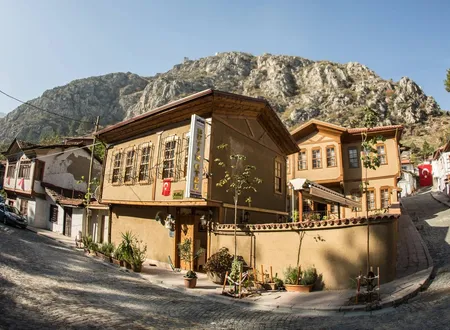
Pirinççi Quarter belongs to the central district of Amasya and lies on the banks of the Yeşilırmak, within the historic core of the city. Judged by its present population it is a small quarter; yet within its bounds stand the only surviving Ilkhanid-period work in Amasya, a complex built by the tutor of a prince in the reign of Bayezid II, and a bath surviving from the fifteenth century. None of these gave the quarter its name; the name comes from the nickname of an emir who came out of palace service and settled in Amasya in the retinue of Prince Ahmed. Hüseyin Hüsameddin Yasar's Amasya Tarihi records this emir, the mosque he built, the hadith college founded in the quarter, a tekke that was a woman's pious foundation, and the old medrese on the riverbank, each separately. Osman Fevzi Olcay's Amasya Hâtıraları describes the streets, bath-keepers and neighbours of the early twentieth century.
Origin of the Name
In the section where he lists the quarters of Amasya, Yasar mentions Pirinççi as the seventh and says plainly where the name comes from. Pirinççi Sinan Bey, one of the emirs of Sultan Bayezid II, lived in this quarter, built a mosque and a school, and endowed his properties to them. For this reason the quarter has been called Pirinççi since the Hijri year 912 (1506-1507). The biographical section of the same work introduces the man in more detail: Sinaneddin Yusuf Bey was a Bosnian by origin, a devshirme recruit and a slave of Bayezid II. He rose to prominence as a "rice-man" (pirinççi) in palace service and then joined the emirs of Prince Ahmed's retinue. According to Yasar he lived in Amasya for more than forty years, and the quarter became known by his nickname. The same passage says that he was "annihilated" (münadim) in the events of 918 (1512). Yasar does not explain the event; yet he says that Tokatlı Sinan Bey, mentioned on the same page, "joined the missing" in the same affair, which suggests that he means the dispersal of the emirs around Prince Ahmed.
According to Yasar, then, the name has nothing to do with rice production or trade; it comes from a person's nickname. Yasar does not explain what the "pirinççi" actually did in palace service; he only writes that Sinan Bey rose to prominence as "the rice-man of the imperial palace." There is also a small inconsistency in the source. While the name is said to have been used from 912 on, the same work describes the lodge that Selâmet Hatun built in 857 (1453) as lying "in front of the Pirinççi Quarter." This may be read as the author applying a name that had since become established to an earlier time. The name outlived its bearer, who disappeared in 1512, and has been preserved to this day.
Location and Boundaries
According to Yasar's description, Pirinççi Quarter lies on the western bank of the Savakça Stream, below the palace. It is bounded on the east by the Savakça Stream, on the west by Mehmed Pasha Quarter, on the south by Yakup Pasha Quarter and on the north by the Yeşilırmak. The entry for Mehmed Pasha Quarter in the same work confirms this neighbourhood: that quarter lies east of the Tımarhane and is bounded on the east by Pirinççi. By this description the area of the Mehmed Pasha Complex lies immediately west of Pirinççi, which agrees with the TDV article placing the complex near the Yeşilırmak, in Mehmed Pasha Quarter. Since the bimarhane, the Mehmed Pasha Mosque and the Mustafa Bey Bath are today given Pirinççi addresses, one may suppose that the quarter's boundaries shifted over the century and that the name spread westward. This inference is not Yasar's and should not be taken as documented.
One detail about the south of the quarter is also in Yasar: because the vizier Ali Şefik Pasha of Gümüşhane lived in this quarter, the land south of the chaussée road used to be called "Şefik Pasha's Garden." As will be told below, the name of this garden is also mentioned together with the disappearance of a pious foundation in the quarter. The green area on the riverbank is now known as the Pirinççi Promenade. A study by Gülcan Canik, published in the Forestry Journal of the Faculty of Forestry at Düzce University, treats this area as one of the landscape arrangements on the bank of the Yeşilırmak and examines how the use of the riverbank has changed in its relation to the city. In Amasya the waterfront was never merely scenery. The river gave the city its road, its water and its trade, and it also determined the line along which buildings were arranged; endowed buildings such as the bimarhane, mosque, bath and medrese came to stand side by side along it.
The Ilkhanid Period and the Bimarhane
The best-known building of the quarter is the Amasya Bimarhane (Darüşşifa), today visited as the Sabuncuoğlu Şerefeddin Museum of Medicine and Surgery History. The building was commissioned in 1308-1309 by Anber bin Abdullah in the name of the Ilkhanid ruler Sultan Olcaytu Mehmed and his wife Uduz Hatun. That it is the only work to survive in Amasya from the Ilkhanid period makes it especially important for the history of the city. After the weakening of the Seljuk state this part of Anatolia had passed under Ilkhanid control, and the bimarhane is the clearest architectural trace this political period left in Amasya. In his memoirs Osman Fevzi Olcay dates the building to the Hijri year 606 (1209), citing its inscription. This date does not agree with the usual view of 1308-1309, which corresponds to Hijri 708. Although Olcay says he read it from the inscription, an error in the date or a misreading is likely; but the contradiction cannot be settled conclusively.
The front facade in particular is valuable as art. On the facade the traditional column capitals of Anatolian Seljuk architecture are used, that is, geometric and leaf-decorated capitals with muqarnas. It is noted that the inverted column capitals made of Turkish triangles were tried for the first time in Anatolian Seljuk architecture on the edges of this building's facade. The building is built of cut stone, and cylindrical buttresses were added to its two corners. As a detail unique to the Amasya Bimarhane, the keystone of the doorway carries a relief of a kneeling human figure.
The bimarhane is known as the first hospital in Anatolia to practise treatment with music, and this practice gives Amasya a place of its own in Anatolian medical history. The reputation of the institution was upheld in the Ottoman period by physicians trained there. Sabuncuoğlu Şerefeddin, grandson of Sabuncuoğlu Mevlânâ el-Hâc İlyas Çelebi, chief physician of Çelebi Sultan Mehmed, probably trained at the Amasya Dârüşşifâ under Burhâneddin Ahmed en-Nahcuvânî and practised medicine here for fourteen years. After spending some time in Kastamonu in the time of the Candaroğlu İsfendiyar Bey, Şerefeddin presented his book Cerrâhiyye-i İlhâniyye, regarded as the first Turkish surgical work, to Mehmed the Conqueror. His family's name is also kept alive by a quarter in Amasya today called Sabuncuoğlu (Hacı İlyas).
Since 2011 the building has been converted into a museum and has taken the name Sabuncuoğlu Şerefeddin Museum of Medicine and Surgery History. Thus the building's tradition of patient care, which spans more than seven hundred years, continues in a museum named after the most famous physician of that tradition. In the early twentieth century the front of the bimarhane was the playground of the neighbourhood's children. Olcay writes that the open ground in front of the bimarhane, the Mustafa Bey Bath and the Çevikçe School was the chief playing place of his generation, and that the courtyard of the Mehmed Pasha Mosque also lay around this area.
The Mehmed Pasha Complex
The second great building of the quarter is the Mehmed Pasha Mosque. From the two-line Arabic inscription written in thuluth script over the main door, the building was completed in Muharram 891 (January 1486). Its founder was Hızır Paşazade Mehmed Pasha, vizier of Bayezid II and lala (tutor) of his son Prince Ahmed; he died in 1495. The lala was the person responsible for the prince's education and for the administration of the sanjak. That the lala should have built such a complex in the city during the years when Prince Ahmed was in Amasya also shows the importance Amasya held for the Ottoman dynasty.
The mosque is classed among the Ottoman buildings with zawiya or tabhane wings and is built entirely of cut stone. The prayer hall is a square space measuring 8.70 × 8.60 metres; it is covered by a dome resting on a twelve-sided drum with squinches, and the interior of the dome is decorated with polychrome painted work. The mihrab is made of marble, a plain five-sided niche topped with five rows of conches. The minbar, also of marble, by contrast, counts as a true work of art. Almost its whole surface is decorated in low relief with intricate rumi and arabesque motifs, and above its Arab-style arched kiosk sits a small onion-shaped dome. The doorway of the minbar has a frame adorned with curling branches, and it is crowned with a rectangular panel on which the Throne Verse is written.
The last-congregation porch on the north facade of the mosque is divided into six bays by seven marble columns of octagonal section, and each bay is closed by a dome or vault. The columns are joined to one another by round arches worked in alternating red and white stone. The mosque is entered through the door in the third bay from the left, which bears the construction inscription. The wings of this door, set in a deep niche and counted among the finest examples of wood carving, are displayed today in the Amasya Museum. The minaret stands on the right, sunk between the wall of the porch and one of the side rooms; the stone minaret with a sixteen-sided shaft has a single balcony. In front of the porch, on the main axis, stands a shadirvan with an octagonal pool and eight columns.
The east end of the complex is completed by the tomb on a platform raised about eighty centimetres above the floor of the mosque. The tomb measures 4.60 × 3.85 metres and is covered with an eight-segment dome resting on an octagonal drum. The sarcophagus inside carries no inscription. Mehmed Pasha's own grave is outside the tomb, the second grave in front of the door; the first belongs to Mehmed Pasha's father Hızır Pasha, and the third to the Halveti sheikh Habib Karamani. To the east of the graveyard there used to be a plain fountain with a pointed arch, adjoining the enclosure wall. This fountain, whose existence is known from a photograph in Albert Gabriel's Monuments Turcs d'Anatolie, has not survived.
In its original form the complex consisted of a mosque, medrese, imaret, tomb, tabhane, zawiya, fountain and graveyard. Only the mosque, the side rooms attached to it that probably served as a tabhane, and the tomb have come down to the present. Since the medrese and the imaret, which should have stood at the edge of the shadirvan courtyard, were destroyed by fire, nothing can be learned about the architecture of these buildings. The mosque and tomb were damaged in the earthquake of 1939, and their repair was undertaken by the General Directorate of Foundations. Earlier repairs are also documented by inscriptions: the inscription over one of the side doors commemorates the repair of 1280 (1863-64) commissioned by Mahmud Beyzade Mehmed Bey, and the other a repair dated 15 Shaban 1236 (18 May 1821). According to Yasar, the tekke south of the mosque, on the road, was built in 890 (1485) in the name of Habib Karamani, one of the Halveti sheikhs.
In the nineteenth century the foundation affairs of the mosque were run by families of trustees. Two names appear in Olcay's memoirs as trustees of the Mehmed Pasha Mosque. One of them, Kurdoğlu Mehmet Bey, was of the Kösemihaloğulları; he is remembered as generous and as one who helped the poor. According to Olcay, when the poet Ziya Pasha came to Amasya as governor in 1282 (1866-1867), a guarantor had to be found, and Kurdoğlu Mehmet Bey stood surety. A quatrain by Payaslızade Hacı İsmail Efendi, who heard of it, appears in Olcay's text as follows: "Rest easy in this fold, my dear, what could it matter, / For the wolf himself has become surety for its shepherd." In Olcay's childhood the trustee was Nuri Bey; Olcay counts this man, whose wife was from Taşova, among his friends.
The Mustafa Bey Bath
Another building of the quarter is the Mustafa Bey Bath. The bath was built in 1436 by Mustafa Bey, son of Yörgüç Pasha, the lala of Murad II. Thus in this quarter the trace of buildings founded by lala families can be followed back to the reign of Murad II, about fifty years before the Mehmed Pasha Complex. The bath consists of a cold room, a warm room and a hot room. The changing room has a square plan; the cold room is domed with muqarnas niches, while the hot room is a domed space surrounded by four large niches. The walls are built of rubble stone and brick.
The liveliest information on how the bath operated at the beginning of the twentieth century is again in Olcay. According to Olcay, the Mustafa Bey Bath stood in front of the bimarhane and, together with the Sinan Bath in Selağzı, was run by the bath-keeper Dubaracıoğlu Hacı Ali Hafız Agha. The women's section was managed by Hafız Agha's wife, Ayşe Hanım. In the evening after the bath closed, the attendants of the two baths took turns firing the furnace. Hafız Agha had three wives, and Olcay recalls with amazement that he managed them quietly side by side. After the evening meal the agha would sit on the bench opposite his street door, neighbours would come and drink coffee, and he would ride out with his dog to hunt in the Göllü and Köle Mezarı vineyards. According to Olcay, one of his sons killed and was killed by Şadi, son of Şefik Paşazade Bey, and the family's fortunes changed completely afterwards. A man named Seyyid Agha is also mentioned among the bath's employees.
Selâmet Hatun and the Yâ Vedûd Tekke
One of the most striking foundations of Pirinççi in the fifteenth century was a woman's pious work. Yasar mentions a tekke northeast of Pirinççi Quarter, on the qibla side of the Tomb of Dersi Tamam Efendi. This tekke was built in 857 (1453) by Selâmet Hatun, daughter of the Amasya kadi Nizameddin Abdurrahman Muslihî, known as "Molla Beylik", who also arranged its endowments. The same work says that Selâmet Hatun was the sister of the poet Zeyneb Hatun, was known as a pious and devout woman, and died after 870 (1465-1466). According to another entry in Yasar, Selâmet Hatun joined the Halveti order and built a zawiya near Kuşköprü, in front of Pirinççi Quarter, with a tomb attached to it. She had her endowment deed drawn up during her father's term as kadi and endowed two farms, whose income was spent at the zawiya on food and stipends for dervishes and sheikhs. Yasar does not link the two entries, but the same date, the same founder and the same locality strongly suggest that they are the same building. Only, in one entry the tekke is associated with Naqshbandi sheikhs and in the other with the Halveti order, and the reason for this difference is not explained.
The tekke took its name from the Naqshbandi sheikh Abdulvedud Efendi. According to Yasar, Sun'ullah Buhârî, one of the successors of Sa'deddin Kâşgarî, and his son Abdulvedud Efendi were sheikhs here, and the tekke became known by reference to Abdulvedud. Among the later sheikhs are counted Edhem Çelebi and Mehmed Çelebi; in 1099 (1687-1688) Mehmed Efendi and in 1110 (1698-1699) Mustafa Efendi became sheikh and zawiya-keeper by trusteeship. On this sheikh's death in 1121 (1709) his son Mehmed Çelebi, and in 1149 (1736-1737) his other son Osman Çelebi, took over the post; in 1153 (1740-1741), on Osman Çelebi's death, his sons Abdullah and Hasan became sheikhs. The following year, 1154, the teaching scholar Seyyid Hâfız Hüseyin Efendi, as sheikh and trustee, turned the tekke into a lecture hall. After him his son Seyyid Mustafa Efendi, in 1178 (1764-1765) Mahmud Çelebi, and in 1210 (1795-1796) Mustafa and his brother Seyyid Mehmed served as sheikhs. In 1223 (1808) the sons of Fazlîzade Seyyid Hacı Abdülkadir Efendi, the notables Seyyid Mehmed Said and Mustafa Efendi, took over the post by inheritance and, according to Yasar, ruined the tekke. Yasar reports the final state as follows: while its mosque still stood, its endowments were entered in 1315 (1897-1898) in the name of the education administration as "defunct" (münderis), and today only Selâmet Hatun's tomb stands.
Yasar's section on tombs also tells the end of the zawiya. The Tomb of Selâmet Hatun lies on the qibla side of the Tomb of Dersi Tamam, that is, to its southwest, about twenty metres farther on. The zawiya she built in 857 was lost because Şefik Pasha unjustly seized it and turned it into a garden; only the tomb was preserved. Yasar also takes care to note that the lady has nothing to do with the legend, current among the people, of "a woman left from the flood of Noah." The "Şefik Pasha's Garden" of the preceding section may be the same place as this garden; but Yasar does not link the two pieces of information. The neighbouring tomb, the Tomb of Dersi Tamam, stands at the head of Kuşköprü, on the west bank of the stream. This cell, at first open to the sky and made up of four walls, was given a roof in 1314 (1896-1897) by İstanbullu Mehmed Mazhar Bey, director of correspondence at Amasya. Because it has no inscription, it was, according to Yasar, only after seven years of research that the man inside could be identified as Müftüzade Hacı Ömer Efendi, known as "Dersi Tamam."
The Dârülhadis Medrese
The most deeply rooted institution in the educational history of Pirinççi is the building Yasar calls the "Dârü'l-Hadîs Medresesi." The medrese stood in the quarter on the stream bank, opposite the Hacı Hamza Efendi Mosque. Since Yasar says this mosque is in Bayezid Pasha Quarter, it is clear that the medrese stood on the edge of the quarter, face to face with its neighbour. The kadi Seydî Alizade Hacı Osman Çelebi had this medrese built in 933 (1526-1527) as a hadith college. In the biographical section Osman Çelebi is introduced as the son of Seydî Ali Çelebi, of the Amasya ulema; he studied in Istanbul and Amasya, above all with Kemal Paşazade Ahmed Şemseddin Efendi, became a müderris and kadi, and after serving as kadi of Kastamonu came as kadi of Amasya in 944 (1537-1538). When Prince Mustafa became governor of Amasya he retired in 947 (1540-1541), endowed his property and land for the expenses of the hadith college he had built in Pirinççi, and died around 952 (1545-1546). His son Hacı Ahmed Efendi also served as kadi.
The medrese was of wood when first built and burned many times in the following centuries. After the fire of 1011 (1602-1603), the founder's granddaughter Ayşe Hatun bint Ahmed Çelebi rebuilt it in 1018 (1609-1610), left the trusteeship to her son Şaban Agha and his children, endowed her properties and had the deed drawn up at length. The building burned again in 1098 (1686-1687) and 1143 (1730-1731) and was rebuilt in 1100 (1688-1689) and 1151 (1738-1739). Since its revenues were lost, the müderris' salary was met from the endowment of a farm in the district of Hakala. When Yasar wrote, the building awaited repair. After the last rebuilding in 1151 the first müderris was Ahmed Efendi; on his death in 1163 Hâfız Hüseyin Efendi took up the post, followed in 1178 by Fenarcızade Evliya Halil Efendi and in 1201 by Soruklu Hâfız Ali Efendi. In 1253 İnepazarlı Seyyid Hacı İsmail Hakkı Efendi was appointed.
The Dugrâkiye Medrese
The oldest building on the riverbank in the quarter goes back two and a half centuries before the Mehmed Pasha Complex. Yasar describes the Dugrâkiye Medrese as lying northwest of the Mehmed Pasha Mosque, on the road, on the bank of the Yeşilırmak and adjoining the Tomb of the Cows (İnekler Türbesi). The governor of Amasya, Emir Nureddin Tuğrak, built it in 631 (1233-1234), in the time of Alâeddin Keykubad, as a mosque; the Arabic inscription over its door names Hacı Tuğrak Emîr-i Şikâr. When Mehmed Pasha built his great mosque nearby, he converted this mosque into a medrese in 900 (1494-1495) and gave it the name "Dugrâkiye"; among the people it was called "Durâkiye." Until 1098 müderrises of the forty (erbaîn) grade taught here; when it burned in 1099 the building remained an empty plot for a time, and in 1111 (1699-1700) Tâceddînzade Ali Bey, trustee of the Mehmed Pasha endowment, rebuilt it. When his müderris Ömer Efendi died in 1132, Abdurrahman Efendi took the post, and in the following century names such as Hâfız Mustafa, Hâfız Ömer, İbrahim Şakir and Hacı Mahmud Efendi served in turn as müderris.
The end of the medrese is connected with the river. While Hâfız Hasan Efendi was müderris the building fell into disrepair; in 1296 (1879) a flood of the river destroyed it completely and the endowment revenues were lost as well. Then the scholar Canikli Mehmed Efendi, with cash donations he collected, rebuilt it in 1308 (1890-1891) and took on the post of müderris as an honorary duty. The building Olcay describes in his memoirs is very probably this one. According to Olcay the medrese stood on the Yeşilırmak bank of Pirinççi Quarter, right beside the flour factory of the chief justice Sudur Ahmed Efendi; it was a two-storey wooden building with a large garden, on the main street. According to the inscription over its door, the building had once been of masonry and had been rebuilt in wood after a fire or an earthquake. Olcay writes that the tomb of the person called the medrese's founder stood next to it, that both were demolished by the Amasya Municipality, and that the plot was sold to a man named Ekrem and then, changing hands, passed to Muammer, son of Hocazade Saffet. That Yasar places the medrese around the Mehmed Pasha Mosque and Olcay places it within Pirinççi shows once more that the two authors drew the quarter's boundaries differently.
The Mansion of Rüşdü Pasha
The vicinity of the hadith college was the scene of another event in the second half of the nineteenth century. A Shirvani sayyid sheikh, whose detailed biography Yasar writes, came to Amasya for the third time in 1281 (1864-1865) and stayed for a while in Yakutiye Quarter. According to Yasar, Şirvanî Hacı İsmail Efendizade Mehmed Rüşdü Pasha had a large mansion built for him in Pirinççi Quarter, near the Osman Çelebi Hadith College, in the month of Shaban 1288 (1871-1872), and settled him there. When Mehmed Rüşdü Pasha went to Istanbul in 1289 and became grand vizier, the Ali-Muawiya question came to the fore. According to Yasar, one side openly denounced and cursed Muawiya and his partisans, while the ulema defended the Ahl al-Sunna; the sheikh and his disciples came to be viewed among the people as "Shia-yı Aleviyye," and a great division arose in the city.
Yasar writes that in 1291 (1874-1875) extraordinary events began at the mansion. At night the mansion was stoned by unseen hands, and by day the goods and clothes kept in chests burned; those responsible could never be identified. The sheikh therefore left the mansion and moved to a rented house in Gümüşlüzade Quarter, and when the same events continued there, he went to Merzifon in 1293. In 1294 he returned to Amasya and stayed in the mansion of the chief justice Ahmed Hulûsî Efendi in Eski Kethüda Quarter; in 1297 he withdrew to Merzifon again because of a murder in which one of his disciples was implicated. In Yasar's own words, the sheikh later became a neighbour of the Yasar family in Çeribaşı Quarter. In 1301, when accusations of smuggling arms and preparing a revolt were telegraphed to Istanbul, he left Amasya. Where the mansion stands today, and whether it still stands, cannot be learned from the sources.
People from the Quarter
The first and most important name of the quarter is Pirinççi Sinan Bey, whose story was told above. The next most detailed account concerns Siyavuş Agha. According to Yasar, at the beginning of Hijri 1058 (1648) the sanjaks of Amasya and Karahisar-ı Şarkî were given to Alıc Beyzade Çolak Hüseyin Pasha, a native of Amasya, and until the pasha arrived Siyavuş Agha, one of the notables of Amasya, was left as mütesellim. Siyavuş Agha was a sipahi, the son of Abdi Agha, one of the notables of Pirinççi Quarter.
The biographical section of the work adds the man's earlier career. Siyavuş Agha had wandered through various places as silahdar of Serhoş Mehmed Pasha; when the pasha was killed he attached himself to Çolak Hüseyin Pasha and showed service and valour in the wars of Revan and Baghdad. In 1052 (1642-1643) he became kethüdayeri, in 1055 he was assigned to the Cretan war, in Shawwal 1057 he became kethüdayeri of Amasya, and at the beginning of Muharram 1058 mütesellim of the sanjak of Amasya. Once he was mütesellim he removed Bağdatlıoğlu Osman Agha, who was the subject of everyone's gossip, from the post of city kethüda and installed in his place Kara Abdi Bey, of the notables of Kuba Quarter. In the month of Safar of the same year, however, he was accused of having forced himself on a woman and fathered a child, and was removed from office; Sarı Ali Bey, one of the zeamet holders, became mütesellim in his place.
Yasar's two accounts complement each other but differ on one point. The biographical section writes that it was proved that Siyavuş Agha had forced himself on a woman and a child had been born, and that he was executed for this. In the history section, however, it is said that the case was proved in court, and it is then noted that the affair was also called a slander devised by the former city agha, Bağdatlıoğlu. Yasar himself does not pass judgment on the matter; he only records the rumour of the time as well. These lines also shed light on the internal politics of mid-seventeenth-century Amasya, in which the son of a quarter's notable could rise to the head of the city's administration and, because of rivalries, lose both his office and his life within a few months.
The family that left the greatest mark in the quarter was the Seydî Alizades. Osman Çelebi's father Seydî Ali Çelebi went to Istanbul in Hijri 896, won the favour of Bayezid II, became kadi of Sofia and kadiasker of Rumelia, and died around 910. Of his three sons, Yakub Çelebi was molla of Edirne and the commentator on the Şir'a; Osman Çelebi built the hadith college in Pirinççi, Amasya, and Hızır Çelebi also served as kadi. Yakub Çelebi's children stayed in Istanbul, and the others settled in Amasya. The medrese and endowment arrangement in the quarter continued down to this family's descendants, since Ayşe Hatun, who had it rebuilt in 1018, was of the same family.
The Streets in the Early Twentieth Century
Olcay's memoirs show the quarter a generation after Yasar, in the last decades of the Ottoman Empire. According to Olcay, part of the quarter belonged to the Çukur Konak district; among the houses listed in this part were the house of Şirvanlı Abdullah Hoca, the house of his brother Şirvanlı Balaş Efendi, who kept Indian cocks, the house of the perfumer Attar Kerim Efendi, who traded next to the shop of Şehzade Mustafa Efendi in Selağzı, and the mansion of the poet Tahir Efendi of the Şirvanlızades and of the Hacı Mahmut Efendizades. Olcay also names families from Pirinççi: Hulusi, son of Keresteci Hatip Hoca, with his children, and Terzi Ali Efendi appear among the residents of Pirinççi Quarter. A greengrocer named Şirvanlı Mehmet Efendi also lived in Pirinççi and worked in his shop on the main street.
Another part of the quarter began, according to Olcay, at the French School known as "Joziyet." This building later became the Şehr-i Yâri School, and the houses lined up along the continuation of the Savadiye Stream stretched to the place called "Dersi Tamam." This description agrees with Yasar's placing of the Tomb of Dersi Tamam in the northeast of the quarter. Since in another place Olcay calls the district where the French School stood Bayezid Pasha Quarter, the boundary between the two quarters was not clear-cut even then. Olcay writes that from here on the row following the city's main street has kept its present form, and that only the medrese, the tomb and the mill have disappeared.
Population and Change
According to the series compiled from the results of the address-based population count of TÜİK, the population of Pirinççi Quarter is as follows:
- 2012: 535
- 2013: 535
- 2014: 497
- 2015: 487
- 2016: 471
- 2017: 421
- 2018: 435
- 2019: 414
Over seven years a decline of about 120 people is seen. This table fits a trend common in historic city centres: over time, public buildings, museums and shops replace dwellings. It must also be said that the series ends in 2019 and that more recent figures could not be found. No figure for the quarter's household count in earlier centuries could be found either; Yasar does not give household numbers by quarter.
Pirinççi Today
Today Pirinççi is one of the quarters most often passed through by visitors to Amasya. The museum, the mosque and the bath are within walking distance of one another, and the Governorate building stands opposite the museum. The promenade along the river is also a walking route for the townspeople. The tekke and hadith college that Yasar describes have disappeared, and the Dugrâkiye Medrese that Olcay saw has been demolished; small structures such as the tomb of Selâmet Hatun and the cell of Dersi Tamam are mentioned as the tangible traces of the quarter's fifteenth-century women's foundation and its tradition of learning.
Chronology
1233-1234: The governor of Amasya, Emir Nureddin Tuğrak, builds the mosque that will later become the Dugrâkiye Medrese (Hijri 631).
1308-1309: The Amasya Bimarhane (Darüşşifa) is built in the Ilkhanid period.
1436: The Mustafa Bey Bath is built by Mustafa Bey, son of Yörgüç Pasha.
1453: Selâmet Hatun, a kadi's daughter, builds a tekke (zawiya) northeast of Pirinççi (Hijri 857).
1485: A tekke is built south of the mosque for the Halveti sheikh Habib Karamani (according to Yasar).
1486: The Mehmed Pasha Mosque is completed (Muharram 891).
1494-1495: Mehmed Pasha converts the Tuğrak Mosque into a medrese (Hijri 900).
1495: Hızır Paşazade Mehmed Pasha, founder of the mosque, dies.
1506-1507: Because of Pirinççi Sinan Bey's mosque and school, the quarter begins to be called "Pirinççi" (Hijri 912).
1512: Pirinççi Sinan Bey disappears with the dispersal of the emirs around Prince Ahmed (Hijri 918).
1526-1527: Seydî Alizade Osman Çelebi builds the Dârülhadis medrese in Pirinççi (Hijri 933).
1602-1603: The Dârülhadis is damaged by fire; Ayşe Hatun rebuilds it in 1609-1610.
1648: Siyavuş Agha, of the notables of Pirinççi, becomes mütesellim of Amasya, is soon dismissed and executed (Hijri 1058).
1686-1687 and 1730-1731: The Dârülhadis burns twice; rebuilt in 1688-1689 and 1738-1739.
1821: A repair is made at the Mehmed Pasha Mosque (15 Shaban 1236).
1863-1864: The repair commissioned by Mahmud Beyzade Mehmed Bey takes place (Hijri 1280).
1871-1872: Mehmed Rüşdü Pasha has a mansion built in Pirinççi near the Dârülhadis (Hijri 1288).
1879: The Yeşilırmak floods and the Dugrâkiye Medrese collapses; Canikli Mehmed Efendi rebuilds it in 1890-1891 (Hijri 1296 and 1308).
1896-1897: The Tomb of Dersi Tamam is repaired (Hijri 1314).
1939: An earthquake damages the mosque and tomb; the General Directorate of Foundations repairs them.
2011: The Bimarhane opens as the Sabuncuoğlu Şerefeddin Museum of Medicine and Surgery History.
Sources
Primary sources
- Hüseyin Hüsameddin Yasar, Amasya Tarihi (Amasya Municipality e-book edition, vols. 1-4 and 9-12): entry on Pirinççi Quarter, the Yâ Vedûd Tekke, the tombs of Selâmet Hatun and Dersi Tamam, the Dârü'l-Hadîs and Dugrâkiye medreses; biographical section (Pirinççi Sinan Bey, Osman Çelebi, Siyavuş Agha, the Shirvani sayyid sheikh).
- Hüseyin Hüsameddin Yasar, Amasya Tarihi, vols. 1-4, e-book page 572: the Siyavuş Agha affair.
- Osman Fevzi Olcay, Amasya Hâtıraları: neighbourhood memories of Çukur Konak and Pirinççi, the Mustafa Bey Bath, the Hacı Tuğrak Emir-i Şikâr Medrese. amasya.bel.tr
Academic studies
- Gülcan Canik, "Amasya Tarihi Kent Merkezinde Yer Alan Pirinççi Promenad Alanının Nehir ve Kentle Olan İlişkisi Üzerine Bir Değerlendirme," Düzce Üniversitesi Orman Fakültesi Ormancılık Dergisi. amasya.bel.tr
Official sources
- Republic of Türkiye Ministry of Culture and Tourism, Culture Portal: "Mehmet Paşa Camii" entry.
- Republic of Türkiye Ministry of Culture and Tourism, Culture Portal: "Sabuncuoğlu Museum of Medicine and Surgery History" entry.
Other sources
- Ebru Karakaya, "Mehmed Paşa Külliyesi," TDV İslâm Ansiklopedisi, vol. 28, Ankara 2003, pp. 511-512.
- Amasya Merkez Mahalleleri Nüfusu (TÜİK address-based records, 2012-2019 series).
Online sources