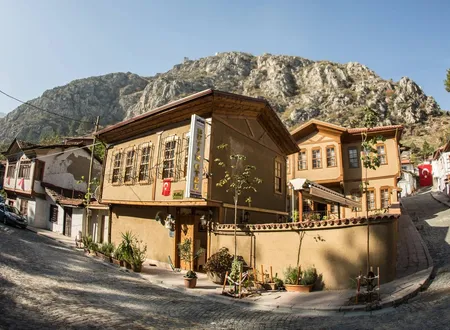
Savadiye is a small neighbourhood in Amasya's central district, about one kilometre from the city centre. Today it looks like a quiet residential quarter, but behind its name lie the story of one of Amasya's old dervish circles, of a stream and a line of orchards, and of the upheavals of the early twentieth century. Two main sources describe it. Hüseyin Hüsameddin Yasar, in his Amasya Tarihi (History of Amasya), records the neighbourhood under its older name, Savakça, and explains where the name came from. Osman Fevzi Olcay, in Amasya Hâtıraları (Memoirs of Amasya), describes it as a witness of the last Ottoman decades, through the years when its orchards were felled and its houses were carried off by a flood. Read side by side, the two show how the place now called Savadiye changed over the centuries.
The Name: From Savakça to Savadiye
In the section where he lists Amasya's fifty-three city quarters, Hüsameddin enters "Savakça Mahallesi" in thirty-third place and explains the origin of the name. Above the neighbourhood stood the lodge of the Halveti sheikh Abdurrahman of Erzincan. The sheikh had a fountain built in front of the lodge and, below the fountain, a small wooden water trough. A wooden trough placed beneath a fountain was called a "savak", a stone one a "havud". The neighbourhood took its name from this trough, the savak, and in time the word became a proper name for the quarter. Hüsameddin adds that in common speech the name was pronounced "Savahça".
The present form "Savadiye" came later. According to Hüsameddin, some writers wrote the name as "Sevâdiye" and this form entered the official registers; but that spelling dates from after 980 in the Islamic calendar, that is, after 1572, and the older records give the quarter as "Savakça". He finds it hard to connect the neighbourhood with the Arabic words "sevâdiye", meaning "sparrow", or "sevâd", meaning "dark patch, the outskirts of a town", in other words he does not accept an explanation tied to an Arabic root. This debate should not be overlooked, because later writers use "Sevâdiye" directly. Even in Hüsameddin's own biographical volumes, when he speaks of earlier periods, the phrases "the present Sevâdiye Mahallesi" and "notables of the Sevâdiye Mahallesi" appear. Once settled, the name left the older form behind, and by Olcay's time the neighbourhood was spoken of in two parts, Upper and Lower Savadiye.
Location and Boundaries
Hüsameddin describes the position as follows: it lies below Soğuk Pınar, at the far eastern end of Amasya; its east is bounded by Lokman Mountain, its west by the stream, its south by Soğuk Pınar and its north by Âhûr Önü. He also writes that Lokman Mountain descends from behind the Savakça quarter as far as the front of the Kibrithane. Olcay's boundary looks at the same terrain from other points. In his account Lower Savadiye is the continuation of Upper Savadiye; on one side lies the Saraydüzü district, on the other the Savadiye Stream, and to the east the boundary runs from the east of the road to the Tomb of Mir Hamza Nigâri along the Ahırönü locality and the Ayvasıl district. The two descriptions agree: the neighbourhood occupied a narrow belt to the south-east of the palace hill, descending from the mountain foot towards the river.
The names around it also help to place the neighbourhood. Ahırönü, as Olcay explains, is the name given to the street running parallel to the Ayvasıl road, and it is the frontage of the road behind the Mir Hamza Mosque and Tomb; the road that descends from the first street of this quarter reaches the Bayezid Pasha Mosque, and on the near side of the Kunç Bridge stands the Kumacık Bath. Hüsameddin links the name Ayvasıl with a church from the period of the Greek patriarchate in Amasya; according to him, the names "Ayvasıl" and "Ayavasıl" in the places reaching as far as the front of the Kibrithane keep alive the memory of the "Church of Ayavasilus". Âhûr Önü, which bounds the neighbourhood on the north, appears in Hüsameddin's list of orchards and gardens as a line running east from the Bayezid Pasha Mosque and joining the Ayvasıl and Kirazlıdere orchards.
Soğuk Pınar and the Savakça Stream
It was water that shaped the life of the neighbourhood. Hüsameddin writes that the orchards and gardens on both sides of the stream to the south-east of the palace, and the stream itself, are called "Soğuk Pınar" (Cold Spring). The water flowing from it is also called "Soğuk Pınar Suyu". Upstream the stream runs through a pleasant forest full of hazel and other fruit trees; the water flowing through its middle is abundant and cold, turns the mills on both banks, irrigates the orchards and keeps alive the quarters below. The water rises on Lokman Mountain, around the grave of the physician Reşîdeddin Lokman. Hüsameddin also records that Gümüşlüzâde Tâceddin Mahmûd Çelebi fed the many fountains he built in his own quarter from this water; that is, the same source reached the fountains of other neighbourhoods below Savakça.
When he lists the three streams that run through Amasya, Hüsameddin puts the Savakça Stream first; the second is the Çakallar and the third the Karakaya. He names the Çakallar Stream, which descends to the river from Selağzı, as the most dangerous of them, and describes how, after heavy rain in 1271 (1854-55), a flood swept away bridges and houses. He also says that the Savakça Stream was the eastern boundary of the Pirinççi quarter; in Olcay's text the same watercourse appears under the name "Savadiye Stream" and flows beside the rows of houses of Pirinççi that begin at the French School and extend to the place called "Dersi Tamam". The two different names of the same stream are another trace of the shift from Savakça to Savadiye.
The palace side is also tied to this water. Hüsameddin writes that the Amasya Palace remained a princely residence for the Ottoman dynasty for nearly three and a half centuries, that Çelebi Mehmed lived there for sixteen years, Murad II for twenty and Bayezid II for twenty-six, and he attributes the palace's complete collapse into an empty plot to the earthquake of 1241 (1825-26). To the south-east of the palace, where the gardens on both sides of the stream begin, he also mentions the Cold Fountain (Soğuk Çeşme) and, accompanied by a couplet, likens it to "a garden of Iram". The air and water that made the neighbourhood a promenade came from the nearness of this fountain and stream.
Lodge, Fountain and Madrasa
The historical weight of Savakça rests on a sheikh. Abdurrahman Celâleddin of Erzincan was one of the caliphs of Safiyyüddin Erdebilî; according to what Kadir Özköse reports on the authority of Ali Budak, his own sheikh sent him to Amasya to guide the people, and he came to the city in the time of Emir Nûreddin Kutlu Shah, settled in the Savadiye quarter and founded a lodge there. He taught the religious sciences, won the respect of the people and died in 775 (1373-74). Hüsameddin, for his part, mentions the "Tomb of Abdurrahmân Baba" on the mountainside east of Savakça as a place of visitation that everyone frequented until recently, and reports that the tomb, the lodge and the fountain in front of it gradually vanished. The two sources meet at one point: the sheikh's tomb stood on the mountainside to the east of the neighbourhood, and its site is unknown today. A lodge and a tomb are also associated with the name Abdurrahman of Erzincan in other places; here only the records concerning the sheikh in Amasya have been used, and no identification with those other places has been attempted.
The buildings Hüsameddin lists for the neighbourhood are the Murâd Ağa Mosque, the Abdurrahmân Madrasa and the Savakça Fountain. The mosque was built around 1029 in the Islamic calendar, about 1620, by Murâd Ağa, one of the palace couriers. Hüsameddin writes that nothing remained of these buildings in his own time, while the fountain still stood but its name had changed. The old fountain of Savakça thus lived on as a fountain whose name had been forgotten. The "Rahmâniye Madrasa" is also recorded in Hüsameddin's section on madrasas: on a high spot on the mountainside east of the Savakça quarter, around the tomb of Abdurrahman Erzincanî, it was built in 1206 (1791-92) by Hacı Feyzullâhzâde el-Hâc Abdurrahman Ağa, a former mütesellim of Amasya. According to the description of Canikli Ali Efendi, who studied in Amasya for fifteen years, the madrasa stood on the southern side of Âhûr Önü and was built of wood; it fell into ruin towards 1275 (1858-59), and by the time Hüsameddin wrote even its site was lost. This religious cluster on the highest ground of the neighbourhood, the sheikh's tomb, a madrasa and a fountain, had dispersed before Hüsameddin's time.
One of the neighbourhood's notables was Hüsrev Bey. According to Hüsameddin's biographical volumes, Hüsrev Bey was the son of Murâd Bey, "of the notables of the Sevâdiye quarter", and a descendant of Hüsrev Pasha, the commander of Lepanto. Orphaned when his father died, he came of age in 1052 (1642) and became a zeamet holder, and in 1072 (1661-62) he became a mirliva with the support of the grand vizier Köprülüzâde Fazıl Ahmed Pasha. In 1083 (1672-73) he became Bey of Jeddah and Şeyhülharem, was dismissed two years later and returned to Amasya, and died after 1088. Because the columns of the text are set in a tangled order, this record is hard to read in places; the details above rest on the legible parts.
Upper Savadiye and the Orchards
According to Olcay, before the First World War began in 1914, Upper Savadiye was Amasya's most refined and most beautiful promenade. The air and water of the neighbourhood were so admired that Christian families in particular preferred to live in this district. The neighbouring Soğukpınar Orchards were also part of this orchard character; the abundant cold water and the mills on its two banks that Hüsameddin describes are the line that fed these orchards. The two writers see the same place at different times: Hüsameddin recalls the area with its hazel trees, its mills and its freshness, while Olcay remembers the same place as a lost promenade.
After the declaration of the war this picture changed. According to Olcay, the military garrison, wanting to repair the ruins of the Palace of Bayezid II at Saraydüzü, had every tree in the Soğukpınar Orchards cut down, leaving not a single one. The felled wood was burned in a lime kiln to make the lime needed for the palace repairs, and the promenade was ruined in this way. Olcay names the man responsible as Pertev Bey, nephew of the army commander Vehip Pasha the Albanian, head of the Amasya Recruiting Office and acting divisional commander. He adds that he was working in the Office at that time on the special orders of the Ministry of War and had witnessed these events himself. The account rests on a single source; the details have not been confirmed by any other document. The earlier use of the palace site appears in Hüsameddin: when the Amasya Preparatory School burned in the fire of 1311, a new school was built to the west of the palace garden, and in 1316 (1898-99) a barracks rose in the middle of the old palace and was completed in 1318. The area above the neighbourhood was thus already being reused for military and educational purposes long before the repair attempt Olcay describes in the war years.
The Flood of 1948
Olcay links the cutting of the trees to Amasya's later catastrophe. According to his account, the flood that struck the city on 3 June 1948 caused the deaths of eighty-eight people, 149 houses in this district were completely destroyed and swept into the Yeşilırmak, and some five hundred houses were damaged. The author is of the opinion that had the trees of the Soğukpınar Orchards in Upper Savadiye not been destroyed, this flood would not have happened. This is the interpretation of a memoirist; it should not be read as a technical assessment of the causes of the flood or its relation to the orchards. Even so, its meaning for the neighbourhood is clear. A stream descending through a narrow valley to the river is, as Hüsameddin wrote long before of the Çakallar Stream in the flood of 1271, a watercourse that can carry bridges and houses before it, and the Savakça Stream is one of the three streams that cut through Amasya.
Its Inhabitants
According to Olcay's description, the majority of Lower Savadiye's people were Turks and migrants from Shirvan; before the deportation, Christians also lived in this part. For Upper Savadiye he writes that after the deportation not a single Christian remained. Among the photographs in his book is one showing a wedding ceremony of the Christians of Savadiye; this image offers a visual hint of the neighbourhood's mixed past. A document concerning the neighbourhood's Christian population appears in Sabit Genç's article: among those tried at the Tokat Court Martial in 1894 was one Tiftikçi Nikoğos of the Savadiye quarter, who was sentenced to five years in a fortress. This record shows that Armenian residents lived in the neighbourhood in those years; since the details lie in the document itself, they are not expanded on here.
Olcay's notes on the neighbouring quarters also show the social fabric around Savadiye. Most of the residents of the Mir Hamza Nigâri quarter were disciples and admirers of Hamza Nigâri, and his relatives and fellow townsmen from Shirvan also lived there. The Bayezid Pasha quarter is the district where the French School stood, and it is the first quarter on the south-east of the Yeşilırmak as one enters the city from the west of the Kunç Bridge. Savadiye and these two quarters appear together in one of Olcay's photographs; the 1927 view from before the fall of the Bayezid Pasha Mosque's minaret shows an urban fabric right next to the neighbourhood.
Buildings
No registered monument is found in the neighbourhood today. Place listings show the Savadiye Neighbourhood (Nur) Mosque on Selvi Street; no source exists on the age or founder of the building. Of the older buildings Hüsameddin mentions, the Murâd Ağa Mosque, the Abdurrahmân Madrasa, the Rahmâniye Madrasa and the Tomb of Abdurrahman Baba have vanished; the Savakça Fountain is recorded as a fountain whose name had changed. The present fabric of the neighbourhood carries almost no concrete trace of the past described.
Population
Compilations based on TÜİK figures give the neighbourhood's population as 1,115 in 2007, 1,154 in 2008, 1,003 in 2009, 1,311 in 2010, 1,181 in 2011 and 1,150 in 2012. They continue with 1,148 in 2013, 1,152 in 2014, 1,111 in 2015, 1,044 in 2016, 977 in 2017, 961 in 2018 and 941 in 2019. The figures for 2020 to 2025 are 873, 828, 759, 832, 762 and 713. The 2025 data show 353 men and 360 women. Despite a few small fluctuations, the general trend is a decline from around 1,150 to the 700s.
The series shows the neighbourhood shrinking by about a third since 2007. Today Savadiye is a residential neighbourhood close to the city centre with a declining population. Since no sourced information could be found on daily life, tradesmen and festivities, these subjects have not been entered into. For further detail, the sharia court registers and the tahrir and temettuat registers would be the primary sources to consult.
Chronology
775 (1373-74): Death of the Halveti sheikh Abdurrahman Celâleddin of Erzincan (Özköse, citing Budak). His lodge stood beside the savak that gave the neighbourhood its name.
After 980 (1572): The name Savakça begins to be written as "Sevâdiye" (Hüsameddin).
1029 (about 1620): Building of the Murâd Ağa Mosque (Hüsameddin).
1052-1088 (1642 to after 1677): Mirliva rank, Jeddah governorship and death of Hüsrev Bey of the Sevâdiye notables (Hüsameddin).
1206 (1791-92): Building of the Rahmâniye Madrasa (Hüsameddin).
1271 (1854-55): Flood of the Çakallar Stream (Hüsameddin; on the streams around the neighbourhood).
1894: Tiftikçi Nikoğos of the Savadiye quarter sentenced to five years in a fortress at the Tokat Court Martial (Genç).
After 1914: Trees of the Soğukpınar Orchards felled by the military garrison (Olcay).
3 June 1948: 149 houses in this district destroyed in the Amasya flood (Olcay).
2007-2025: Neighbourhood population falls from 1,115 to 713.
Sources
Primary sources
- Hüseyin Hüsameddin Yasar, Amasya Tarihi, vols. 1-4, Amasya Belediyesi, 2022 (accounts of Savakça Mahallesi, Soğuk Pınar, Rahmâniye Madrasa, Tomb of Abdurrahman Baba and the Savakça Stream; pp. 53-54, 150-151, 177-178, 207-208, 291). amasya.bel.tr
- Hüseyin Hüsameddin Yasar, Amasya Tarihi, vols. 9-12, Amasya Belediyesi, 2022 (entry on Hüsrev Bey, around pp. 355-356).
- Osman Fevzi Olcay, Amasya Hâtıraları: Bildiklerim-Gördüklerim-İşittiklerim İle Amasya, Amasya Belediyesi Kültür Yayınları (Neighbourhoods section).
Books
- Kadir Özköse, "Amasya'da Bulunan Halvetiyye Tekkeleri", Akademiar, no. 5, 2018, pp. 91-118.
- Sabit Genç, "XX. Yüzyıl Başlarında Amasya Sancağında Ermeni ve Rumlardan Kaynaklanan Asayiş Problemleri", ASOBİD, no. 9, 2021, pp. 219-258.
Other sources
Online sources