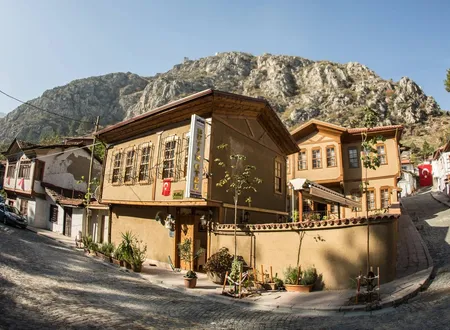
Yukarı Mahallesi belongs to Amasya's central district, yet it is not a neighbourhood one looks for in the middle of the city. It is one of the two main neighbourhoods of the town of Ziyaret, about three kilometres from Amasya; the other is Aşağı Mahalle. Its name is no more than a description of position: the part on the slope was called upper, the part along the stream lower. In older records the same neighbourhood also appears under the names "Bâlâ" and "Dânişmend Mahallesi". No monograph, endowment-register survey or excavation report exists for the neighbourhood itself, so its history can be drawn only from the history of Ziyaret and from the scattered entries in Hüseyin Hüsameddin Yasar's compilation on the city. Information that cannot be shown to belong specifically to the neighbourhood is given with that caveat where it occurs.
Origin of the Name
In the first volume of his Amasya Tarihi, Yasar lists Ziyaret as the twenty-fifth quarter of Amasya and writes that the settlement was regarded as two parts, called "Aşağı Mahalle" (Lower Quarter) and "Yukarı Mahalle" (Upper Quarter). The name Yukarı therefore reflects a distinction that reaches back at least to the records Yasar used. In an entry in volumes nine and ten the quarter is called "the Bâlâ quarter of Ziyare, otherwise known as Dânişmend Mahallesi". The name Dânişmend may be connected with the tradition that the settlement was rebuilt in the Danishmendid period and given the name "Dânişmendiyye"; Yasar does not draw that link himself.
The settlement's own name has followed a more eventful course. According to Yasar, the very old name of present-day Ziyaret is Zemendu or Semendu, and it was once known as a fortified castle and a pleasant township. Among the people the name gradually turned into "Ziyere". Yasar states plainly that no firm document exists for the origin of the name and lists the views in circulation. According to Vâzıh Efendi, Ziyere was the name of a monastery; Yasar does not rely on this, noting that the author was in the habit of presenting old names he did not know as the names of monasteries. It is also suggested that the "Sanit-Sanlı" Turks living in Amasya called the place Sanit, which later became corrupted to Semendu. According to another view, the Seljuk Sultan Mesud visited the place often on spring days and stayed in its pavilion, so that Zemendu came to be called "Ziyare". The French scholar Perrot, for his part, linked the village's name to the many visits paid to the nearby Aynalı Mağara; Yasar rejects this reading, since the cave was never regarded among Muslims as a tomb to be visited.
The present form "Ziyaret" is relatively recent. According to Songül Keçeci Kurt, the village's name was changed to "Ziyaret" after the proclamation of the Republic because of the heavy visitation to the tomb of Hicabi Baba located there, while the people went on saying "Ziyere" for some time. An article surveying the settlements renamed in Amasya also lists Ziyaret among the places formerly called Ziyere and cites it as one of the examples in which the new name was chosen to recall the old. The settlement thus changed its name twice: the first name is a legacy of the castle, the second of the tomb.
Location and Geography
According to Yasar, Ziyaret lies at the north-eastern end of Amasya, on the foot of a small mountain that separates from Akdağ and descends towards the Yeşilırmak, on the eastern bank of the stream in front of it. It was once surrounded by a wall, which can be inferred from the foundation stones and wall remains seen at the edge of the vineyards and on the mountain foot. Kurt gives a similar description for the town and puts its altitude at 382 metres. For the neighbourhood's own surface area a figure such as "15.78 km²" circulates in compilations; since its official basis could not be verified, it has not been used.
The old records praise the settlement's water and air. Yasar writes that the water is very cold and the air healthy; he adds that the lands on the east are entirely vineyard, melon patch and garden, that the best apples come from here, and that the yield is abundant and every kind of it well regarded. The same pages say that the air at the old castle is heavy, because it lay in the north of the city in a gulf-like spot. According to Yasar, the castle's remains are visible only "very faintly", and of the Zemendu Castle to which the emir of Sivas was banished no visible trace survives today.
The road between the city and the settlement also appears in the old records. Yasar mentions, on the Ziyare road near the point where the stream joins the river, a bridge attributed to the Seljuk Sultan Mesud, and he names the Aynalı Mağara on the Ziyare road as well. The vineyards of "Ziyare" are listed among the excursion spots Amasya people visited in the vineyard season, and in the list of vineyards in Osman Fevzi Olcay's Amasya Hâtıraları the "Ziğere (Ziyere) Vineyards" appear as a heading of their own. Trade ran in the other direction as well: according to Olcay, the highland herders of Ziyere were regular customers of the greengrocer's shop of Madenüzcü Hacı Mustafa Ağa in the market, and the best clotted cream, milk and yoghurt came to that shop.
Narratives of the Seljuk and Danishmendid Periods
Yasar presents Ziyare as a stopping place for the commanders who toured Amasya from the time of the Islamic conquests onward. The report that the Umayyad commander Mesleme came to Amasya and Semendu is traced to sources such as Taberî and Ikdü'l-Cümân; Yasar concludes that there can be no doubt that Semendu lay near Amasya. The event dated 493 (about 1100), in which the Danishmendid emir Melik İsmail took refuge here when the Crusaders entered Amasya and the whole city was burned, is mentioned in the same context. The banishment of the Sivas emir Kır Han to the Zemendu Castle in the thirteenth century is a record of İbn-i Bibi.
The most solid records of buildings in the settlement reach back to the end of the thirteenth century. According to Yasar, the Seljuk emir Hoca Muhibbeddin Mevdud-ı Ziyarî had built here, around 680 (the last quarter of the thirteenth century), a mosque with a stone foundation, walls and minaret of red brick and a timber upper structure, two baths, and a lake enclosed within a large wall to the north-west of the stream. Kurt's summary places the same lake to the north-east of the stream; the difference between the two accounts shows that the direction given varies from source to source. The wall of the lake was surrounded with a solid masonry to protect the water inside from floods. Yasar also writes that Bayezid II, while governor of Amasya, built the lower lake around 870 (1465-1466) and turned the vineyards below it into imperial gardens; these gardens remained under a steward answerable to the chief gardener until 1143 (1730-1731).
Mevdud's line also ties Ziyaret to the history of learning. According to Yasar, Hoca Muhibbeddin Mevdud was in 690 (about 1291) the well-known müstevfî of the land of Rum, that is, the official in charge of financial records. His grandson Sa'deddin Mevhub died in 787 (1385) and was buried in front of the Tomb of Şadgeldi Paşa; his fame is carved on his gravestone. This family, called the Ziyârîs, appears in Yasar's records with its judges, teachers and deputies as a distinct lineage in the fourteenth-century intellectual life of Amasya. The town's own municipal history likewise states that the Danishmendids settled in the town in the 1100s and that a scholar named Muhibbeddin Mevdud was raised here in 1291. Whether these buildings stood within the present borders of Yukarı Mahallesi or in Aşağı Mahalle can be told for only some of them. That the mosque (which was later to be called the Keçioğlu Mosque) and the bath were in Aşağı Mahalle is stated plainly in Yasar; the location of the lakes is not given. It would therefore not be right to count them among Yukarı's buildings.
The Mosque and Benefactors of Yukarı Mahalle
The clearest entry in Yasar's survey of the quarters that belongs to Yukarı Mahalle concerns its mosque. According to him, the chief steward of Amasya, Hacı Mehmed Çelebi, had a mosque built in Yukarı Mahalle around 1080 (1669-1670); Çilingiroğlu Hacı Ali Efendi, one of the local notables, enlarged it in masonry in 1198 (1783-1784) and added a minaret beside it, and the building was repaired once more in 1243 (1827-1828). Next to the mosque there is a bath and a primary school. Yasar gives the building no particular name; for that reason, calling it "the Yukarı Mahalle Mosque" is closer to the truth than giving it a name today. There is no other clue to the identity of Hacı Mehmed Çelebi, but among the persons who became city stewards of Amasya at about the same time in Yasar's chronology the name of "Keçioğlu Mehmed Çelebi of Ziyare" appears; since it cannot be shown whether the two names belong to the same person, this can be mentioned only as a possibility.
Another contribution is mentioned in Yasar's entries in volumes nine and ten: Sarı Osmanzâde el-Hac Halil Ağa, one of the notables of Ziyare, before his death in 1210 (1795-1796) had a "pheasant-fine" stone minaret built for the mosque in the Bâlâ quarter of Ziyare, that is, Dânişmend Mahallesi, and had his name inscribed above its door. This entry seems to conflict with the one in the first volume, which says the minaret was added by Çilingiroğlu. The two entries may point to repairs of the same mosque in different periods; Yasar does not explain this, so each should be cited with its own source. In any case the end of the eighteenth century is the time when the mosque of Yukarı Mahalle was renewed with a stone minaret.
Yasar attaches Ziyare's other buildings not to a separate quarter but to the town in general. To the north of Aşağı Mahalle, Hacı İbrahim Çelebi of Ziyare built in 1075 (1664-1665) a small mosque with a fountain in front of it. Beside the Keçioğlu Mosque there are a lodge, a bath and a school. The madrasa built by the Ziyare notable Hacı Mustafa Ağa, according to the records, found its first teacher around 1197 (1783). Yasar writes that in the last quarter of the sixteenth century Ali Ağa, of the Keçi Beyzâdes, also had a mosque, school and bath built, endowed his property to these charities and "beautifully enlivened" Ziyare, and that through the efforts of such benefactors the settlement became a flourishing town. He also records that in the same period, in 1011 (1602), the brigands who entered Amasya from the Ziyare side, where Deli Zülfikâr Ağa lived, burned Aşağıpazar and closed the second historical era of the city. According to Yasar, Deli Zülfikâr came from the people of the Ziyare quarter of Amasya, was the son of the sipahi Mehmed Ağa known as "Baloğlu", and later rose to the vizierate.
Yukarı Mahalle in the Censuses of 1840 and 1844-1845
The first solid period in which we can see Yukarı Mahalle at household level is the middle of the nineteenth century. In her study based on the 1844-1845 temettuat registers, Kurt reports that at that date Ziyere was a village attached to the Akdağ district of the Amasya sanjak of the Sivas province, made up of three neighbourhoods: Soğukpınar, Aşağı and Yukarı. The household counts given by the censuses are as follows.
- According to the 1840 population register, Yukarı Mahalle has 129 households (Soğukpınar 54, Aşağı 70). Non-Muslims were not counted in this census.
- According to the 1844-1845 temettuat registers, Yukarı Mahalle has 151 households, 23 of them non-Muslim. Soğukpınar has 43 and Aşağı 59 households; the village total is 254 households.
- Assuming an average of five people per household, Kurt estimates the village population at about 1,270. This is a calculation, not a census result.
Yukarı is the most populous neighbourhood of the village, and the non-Muslim population lives here as well. Among the household heads, alongside names such as Mehmed, Mustafa and Ali, the non-Muslim heads include the names Mikail, Kareki and Nikola. According to Kurt, the largest family of the neighbourhood is the "Kara Mustafa" family with five households; it is followed by Kara Şaban (four households), Kumlıoğlu (three), and Kürdoğlu and Culhaoğlu (two each). Most of these names do not survive today, although according to Kurt's oral interviews some of the nicknames are still used in the town to tell families apart. No link has been established between these family names and the Keçioğlu or Ziyareli families mentioned by Yasar; what the registers show is that in the middle of the nineteenth century the neighbourhood consisted mainly of small farming and gardening households.
Gardens, Mulberries and Goats
The temettuat registers show the daily life of Yukarı Mahalle in surprising detail. According to Kurt, of 151 household heads 101 are gardeners and 7 are shepherds; a neighbourhood imam, a barber, a seller, five day labourers, a servant and a labourer are also recorded. Gardening is by far the most common occupation in the village as a whole. That a neighbourhood imam is recorded, read together with the mosque Yasar describes, suggests that the "neighbourhood imam" in the records may have been attached to this mosque, but the registers do not give the mosque's name.
The land is almost entirely garden and vineyard. The cultivated and planted land of Ziyere totals 627 dönüm, of which 400 dönüm are mulberry, 167 dönüm grapes and 60 dönüm field. In Yukarı Mahalle there are about 227 dönüm of mulberry garden (207 dönüm Muslim, 20 dönüm non-Muslim) and 104 dönüm of vineyard (79 dönüm Muslim, 25 dönüm non-Muslim). The mulberry is the basis of silkworm raising. Kurt reports that Amasya was an important silk centre second only to Bursa and that silkworm disease sharply reduced production after 1865. Today the mulberry has given way to fruits such as cherries.
In livestock too Yukarı is in the lead. According to Kurt's fourth table, of the 1,821 animals in the village, 1,511 are in Yukarı Mahalle. The neighbourhood counts 747 goats, 427 kids, 70 donkeys and 20 mules, and 14 beehives are also recorded. The goat is described as the villagers' easiest source of income because it can be fed on coarse fodder; donkeys and mules were used for transport.
Hicabi Baba and His Surroundings
Hicabi Baba, who gave Ziyaret its modern name, is known as Abdülbâki Hicâbî Efendi. Born in Bahçesaray in Crimea, he came to Anatolia when the Russians occupied Crimea and settled in Amasya. One source dates his arrival to 1774, another to 1777; later, as a Naqshbandi sheikh, he began his guidance activity in Ziyere. Yasar writes that the Hicâbî Lodge lies beside the Keçioğlu Mosque and that Hicâbî built a lodge there in 1212 (1797-1798); that after his death his successor and son-in-law İbrahim Zühdi Efendi became sheikh, and that after his death too the building was turned into a school. In separate entries it is stated that Hicâbî died in 1238 (1822), and that after that date his son-in-law İbrahim Efendi, the imam of the Keçioğlu Mosque, took over the lodge's sheikhdom and the mosque's preachership; Hicâbî's Crimean brother İbrahim Kemâleddin Efendi and his grandson İbrahim Efendi (who became a teacher in Lâdik) also appear in Yasar's records. It is also recorded that Ziyareli Müftüzâde Süleyman Efendi, a chair sheikh at the Keçioğlu Mosque, kept attending Hicâbî's circle of remembrance and died in 1243.
The Hicabi Baba Mosque and tomb adjoin the Keçioğlu Mosque, which Hicâbî repaired and whose name he gave; according to Yasar this mosque lies in Aşağı Mahalle. It follows that the tomb that gave Ziyaret its name is in Aşağı Mahalle, not in Yukarı Mahalle. Hicâbî's work Zübdetü'l İslam was published in simplified form by Ziyaret Municipality Publications in 2013.
One confusion needs mentioning. The Tomb of İsmail Şirvani, known in Amasya as the "Yukarı Türbe" (Upper Tomb), stands, according to the Directorate of Culture and Tourism, on a high hill in the Şamlar neighbourhood and takes its name from being high up. It has no direct connection with Yukarı Mahalle in Ziyaret.
Population and Change
According to Kurt, in the 1914 records (before the First World War) 796 Muslims and 23 Greeks live in the Yukarı Mahalle of Ziyere; Soğukpınar has 285 Muslims and 27 Greeks, Aşağı has 292 Muslims, and the village total is 1,423 people. The same study notes that the village was attached to the Amasya centre at that date. That 23 non-Muslim households were counted in 1844-1845 while the Greek population is written as 23 people in 1914 cannot be compared directly, since households and persons are not the same measure; it nevertheless shows that non-Muslims continued as a small minority in the neighbourhood.
For recent figures one can use a compilation said to rest on TÜİK/ADNKS data, whose accuracy is not guaranteed. In this compilation, for Amasya Merkez "Yukarı Mah." 1,418 people are given in 2012, 1,434 in 2013, 1,481 in 2014, 1,490 in 2015, 1,469 in 2016, 1,529 in 2017, 1,502 in 2018 and 1,455 in 2019. Over eight years the population follows a flat line between 1,400 and 1,500. That the series belongs to the Yukarı Mahallesi of Ziyaret is inferred from reading together the municipality's address (Yukarı Mahalle, Muhsin Yazıcıoğlu Caddesi) and Kurt's list of the town's neighbourhoods; the compilation does not say so itself. The town total is 3,965 in 2020 and 4,084 in 2021.
Yukarı Today
In Kurt's study of 2016, based on Ministry of the Interior data, it is stated that the town consists of the neighbourhoods Aşağı, Yukarı and Saraycık, and that Yukarı Mahalle has 512 buildings (Aşağı 481, Saraycık 67). The old Soğukpınar no longer exists as a separate neighbourhood; it survives as a street name within Aşağı Mahalle. Ziyaret Municipality was founded in 1958 and its seat is in Yukarı Mahalle.
Kurt also writes that fruit growing is still practised on most of the cultivated and planted land, that the mulberry has given way to species such as cherries, and, on the basis of interviews, that some families such as the Kazançlar, Tokmaklar and Celeboğulları still keep livestock. The gardening and small-livestock pattern seen in the registers of 1844-1845 thus continues, in changed form, in the neighbourhood's livelihood.
Chronology
Late 13th century: According to Yasar, Hâce Muhibbeddin Mevdud Ziyari has a mosque, two baths and a lake built in Ziyaret (the mosque and bath are in Aşağı Mahalle).
1291: Muhibbeddin Mevdud is mentioned as the müstevfî of the land of Rum.
1465-1466: According to Yasar, Bayezid II, as governor of Amasya, has the lower lake built here.
1664-1665: Hacı İbrahim Çelebi of Ziyare has a small mosque and fountain built to the north of Aşağı Mahalle.
Around 1669-1670: The Amasya steward Hacı Mehmed Çelebi has a mosque built in Yukarı Mahalle.
1774: Following the occupation of Crimea, Hicabi Baba comes to Anatolia (1777 in one source).
1783-1784: Çilingiroğlu Hacı Ali Efendi rebuilds the Yukarı Mahalle Mosque in masonry.
1797-1798: The Hicâbî Lodge is built beside the Keçioğlu Mosque.
1827-1828: The Yukarı Mahalle Mosque is repaired once more.
1840: According to the population register, 129 households are recorded in Yukarı Mahalle.
1844-1845: The temettuat census records 151 households in Yukarı Mahalle (23 of them non-Muslim).
1914: 796 Muslims and 23 Greeks live in Yukarı Mahalle.
1958: Ziyaret Municipality is founded.
2019: In the compilation series the population of Yukarı Mahallesi is 1,455.
Sources
Primary sources
- Hüseyin Hüsameddin Yasar, Amasya Tarihi, vols. 1-4 (Amasya Municipality, 2022), vol. 1, pp. 140-145 (entry "Ziyâre Mahallesi") and the entries on the Hicâbî Lodge and events in vols. 1-4.
- Hüseyin Hüsameddin Yasar, Amasya Tarihi, vols. 9-12 (Amasya Municipality, 2022), entries on the Ziyare notables and the Keçioğlu Mosque (Halil Ağa, Süleyman Efendi, the Ziyârî lineage); vols. 6-8, entries on Hicâbî's relatives and the sheikhs of the Hicâbî Lodge.
- Osman Fevzi Olcay, Amasya Hâtıraları (Amasya Municipality Cultural Publications), list of vineyards and market memories. amasya.bel.tr
Academic studies
- Songül Keçeci Kurt, "1844-1845 Temettuât Defterlerine Göre Ziyere Köyü'nün Sosyal ve Ekonomik Durumu", Journal of History Studies, vol. 8, no. 3, September 2016, pp. 57-81 (historystudies.net).
- Bekir Başalan, "Amasya İlinde İsimleri Değiştirilen Yerleşim Yeri Adları Üzerine Bir İnceleme" (DergiPark).
Official sources
Other sources
- Türk Edebiyatı İsimler Sözlüğü, "Hicâbî, Abdülbâki (Gül Baba)".
- nufusu.com, "Merkez Mahalleleri Nüfusu Amasya" (2012-2019 series; compilation based on TÜİK/ADNKS data).
- Republic of Türkiye Amasya Provincial Directorate of Culture and Tourism, "Yukarı (İsmail Şirvani) Türbesi".
- Wikipedia, "Ziyaret, Amasya" (town population, municipality founding year, location).
Online sources
- https://www.historystudies.net/1844-1845-temettuat-defterlerine-gore-ziyere-koyunun-sosyal-ve-ekonomik-durumu_808
- https://amasya.bel.tr/uploads/e-kitap/kitap/9-12/files/basic-html/page139.html
- https://teis.yesevi.edu.tr/madde-detay/hicabi-abdulbaki-gul-baba
- https://dergipark.org.tr/tr/download/article-file/4249891
- https://www.nufusu.com/merkez-amasya-mahalleleri-nufusu