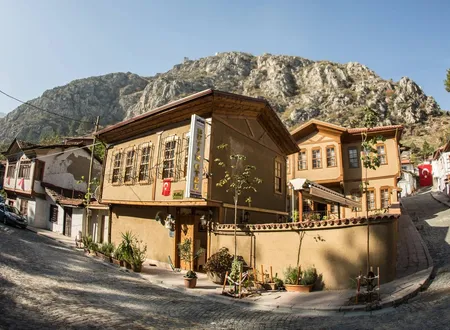
In the historic center of Amasya, among the neighborhoods squeezed into the narrow corridor of the Yeşilırmak valley, Dere is not large by population or by area. Yet its name comes up often when the city's history is told, because it holds one of the early examples of Anatolian Seljuk architecture: the Burmalı Minare Mosque, known for its minaret whose shaft is twisted into a spiral, stands within today's Dere neighborhood. The relationship between the neighborhood and the mosque is less simple than it looks. Hüseyin Hüsameddin Yasar, counting Amasya's neighborhoods one by one, places the mosque not in Dere but in a neighboring quarter, while Osman Fevzi Olcay, recalling the Amasya of his childhood, gathers Dere Mahalle and the district of the Burmalı Minare under one name. In the gap between these two accounts lie the neighborhood's old boundaries, its small endowments, its floods and its families.
Origin of the Name and Old Boundaries
In Turkish, "dere" means a stream bed, a hollow between two slopes. In the neighborhood list of Hüsameddin's Amasya Tarihi, Dere comes twenty-second, as a neighborhood below Kuba. Çakallar Stream lies to its east, the Fethiye neighborhood to its west, Kuba to its south and Kılıççı to its north, and according to the author the name comes from its founding on the bank of a stream. This description is the oldest and clearest record of the name's origin; the same author says elsewhere that Amasya has three separate streams and that the most dangerous of them is Çakallar Stream. Which stream Dere was built beside, that is, whether the name rests on Çakallar Stream or on a smaller line of water flowing into it, cannot be settled from the text.
The neighborhood's boundaries have shifted over time. In Hüsameddin's list the Burmalı Minare Mosque stands within the Pervâne Bey neighborhood, which has Uzun Mustafa to its east, Acem Ali to its west, Çırakçı to its south and Hoca Süleyman to its north; the neighborhood took its name from İzzeddin Mehmed Pervâne, who is said to have lived there until around 1300. The neighborhood on the qibla side of the mosque was called first Kılıç and then Cumûdâr, and took the name Kılıççı after Kılıççı Yusuf Bey, later counted among the emirs of Selim I, built a mosque on the stream bank in 1511-12. The present official Dere neighborhood, by contrast, places the mosque's address, on Taşhan Street, within its own boundaries. It appears that the small Dere Hüsameddin describes and today's Dere cover different areas; the accessible documents do not say by what arrangement this difference arose, though it probably results from the merging of neighboring neighborhoods over time.
Location and Geography
Dere neighborhood lies in the city center of Amasya, that is, in the Merkez district. The city is built on a narrow corridor stretching along the Yeşilırmak, and this general layout holds for Dere as well. Hüsameddin describes Kuba as a high spot below Köşk Kayası and places Dere beneath it; because Çakallar Stream forms the boundary on the east and Fethiye on the west, the neighborhood lies right beside the waters coming down the slope and the flood bed. Both the name of the neighborhood and the danger of flooding come from this position.
Çakallar Stream and the Floods
Hüsameddin lists the three streams within Amasya as Savakça, Çakallar and Karakaya, and writes that the most terrible of them is Çakallar Stream. The stream descends to the river from Selağzı, and according to the author it has caused many disasters. The best-known flood followed the rains of the Hijri year 1271 (1854-55). It destroyed the bridges and houses on the stream and swept them along, dropped a dome stone onto the dome of the Sinan Bath west of Selağzı, and poured animals, carts, timber and people into the river. Many people struggled to bring down the stone that remained on top of the bath. The Sinan Bath had been built by Sinan Paşa, a former beylerbey of Sivas and a freedman of Hızır Paşa, in 1511-12. Because the mouth of the stream met the paved road running along the river, the danger was constant, and Amasya's governor Ahmed Cevdet Bey had a tunnel dug under the road in 1907-08 to cut the foot of the stream off from it.
Olcay remembers this line from his youth. According to him, the market at Selağzı had the stream covered with wooden and plank bridges to hide the floods coming by way of Çakallar, Hamzadüzü, Kuba and the Temenna neighborhood, and the dirty water flowing into the city; shops stood partly over the stream, and most of them were coffeehouses and barbershops. The watercourse of Dere thus stopped being merely a geographical term and entered the everyday life of the town. The coffins that Hüsameddin writes were moved around 1271 from the vault under the Fethiye Mosque to the Cumûdâr Tomb also changed place between these neighboring quarters; Fethiye is the western neighbor of Dere.
The Old Charitable Foundations
The only detail Hüsameddin gives for Dere is two small endowment buildings set at the inner end and the mouth of one of its dead-end streets. Inside the dead-end street, Ma'sûme Hatun, sister of the Shaykh al-Islam Cemâlîzâde Ali Efendi, had a lodge, a mescit in front of it and a fountain built in the Hijri year 922 (1516-17), and established an endowment. At the mouth of the street, on the stream bank, Muharrem Efendizâde Fâtıma Hatun added a second mescit and a fountain in front of it in 951 (1544-45). By Hüsameddin's time the lodge had disappeared, the two mescits were in ruins and the two fountains had run dry; only Ma'sûme Hatun's endowment survived. The first founder was a woman of a family that had reached one of the highest offices of the learned hierarchy of her day; the father of the second founder, Muharrem Efendi, calls to mind the Şeyh Muharrem Efendizâde family, whose members served as judges of Amasya in the seventeenth century in Hüsameddin's chronology, but the author does not make that link. In the Ottoman period the neighborhood was thus shaped by small endowments set in a narrow street by two women of means, and none of them has survived to the present.
The Burmalı Minare Mosque
The building that comes to mind first at the mention of Dere is the Burmalı Minare Mosque, counted among the most valuable works of early Turkish architecture in Amasya. With its rectangular plan extending along the qibla axis, the mosque is a small and plain example of the early mosque types of Anatolia. The encyclopedia entry treats this plan as a smaller application of the type used in Amasya's Torumtay Mosque and the Great Mosque of Divriği. Hüsameddin describes the building as a sturdy structure with no Seljuk-era grandeur or ornament on its façade, with walls of cut stone and a wooden roof; it has two tombs, a library and one minaret. The author's phrase "wooden roof" does not agree with the domed and vaulted covering reported by later sources. The roof covering may have been changed in the repairs, but no document shows it.
Founder and Date of Construction
On who built it, the sources largely agree. According to the intricately written inscription above the door, the mosque was built in the reign of the Anatolian Seljuk Sultan Gıyâseddin Keyhüsrev II by his emir Ferruh (in some readings Ferah) b. Selçuk. The inscription is worked as if written with a finger in wet lime and then filled in, so it could be read only with great difficulty. According to Hüsameddin there is one more plain line under the writing, which states that "the huntsman emir, the poor servant Ferruh b. Selçuk b. Yusuf el-Hâzin" repaired the building; the date at the end of the line is read as 690 (1291-92). According to İsmail Hakkı Uzunçarşılı's reading, the name of his brother, the treasurer Yusuf, also appears in the inscription. Some writers, understanding the word "amere" in the inscription as meaning repair, have thought that Ferruh Bey only had the mosque repaired; yet this word is used for every kind of work that is newly built or developed. The encyclopedia entry finds wrong Hüsameddin's attribution to Cuinet of the claim that the mosque rests on a Byzantine church of the Komnenos period: Cuinet's work does not mention the Burmalı Minare, only a remnant of a church of the Komnenos period in Amasya. Hüsameddin himself writes that he sees nothing in the mosque that recalls a church and only thinks that a Komnenos church may once have stood on its site.
The year of construction cannot be tied to one date. The Amasya Governorship places the building between 1237 and 1247, the encyclopedia entry gives 1237-1246, a 2020 article on the endowment accepts 1242, and the cultural inventory 1243. The date 690 in the inscription lies far beyond this range and may point either to a later reconstruction or to a mistaken reading. In another part of his work Hüsameddin writes that Ferruh served as deputy governor in the Hijri year 655 (1257) as steward of Amasya's governor Torumtay, and that in 681 (1282-83) he was appointed governor of Amasya as treasurer. The author takes the name "Ferruh bin Selçuk bin Yusuf" at the door to be the Arabicized form of "Buruk" and adds that the name "the great emir Necmeddin Buruk" appears in old documents dated 665 (1266-67). These records leave open the possibility that the mosque was built or repaired in different stages of Ferruh's political career.
Ferruh Bey's son-in-law İzzeddin Mehmed Pervâne had an endowment deed drawn up for the mosque in the year 699 (1299-1300). The deed is kept in the Archive of the General Directorate of Foundations and forms the main source of the academic study that treats the mosque, together with Ottoman-period endowment records, within the Seljuk endowment tradition. Hüsameddin's dates do not agree with one another here either: in the neighborhood section he writes that Pervâne lived here until 700, and in the historical section that he died suddenly in 697 (1297-98) and was buried inside the mosque beside Cumûdâr. The date of the deed and the researchers' placing of Pervâne's death in 1300 weaken the second date.
Architecture
What makes the mosque plain from outside is that only the entrance façade is built of cut stone with finer workmanship, while the other faces are laid in rubble stone. The interior is divided into three aisles by piers arranged parallel to the mihrab axis. Three domes in a row on the central axis rest on piers joined by pointed arches; the side aisles have barrel vaults. Right after the entrance comes a last-congregation area, also barrel-vaulted. A passage in the wall with the door opens onto the upper floor of the adjoining tomb, and from here a stairway also leads up to the gallery above the entrance.
There is no great decorative program. The pointed arch of the stone doorway is framed with relief and carved ornament, and there are mihrab-shaped niches on both sides of the entrance and colonnettes at the corners. A frame of dark blue tiles is seen on the mihrab, and in the rectangular frame above it the inscription "work of Muhammad b. Mahmûd el-Errânî" is read. Gabriel noted that it cannot be understood whether this person was the architect of the mosque, only the maker of the mihrab, or the master who made the tiles. The wooden minbar is also inscribed and is given separate importance within Seljuk minbar art; its relationship to the minbar of the Great Mosque of Divriği has been the subject of academic studies. The mosque is also called the Mahkeme (Court) Mosque. A detail given by Hüsameddin suggests where this name came from: the place east of the mosque, beside the fountain, was once used as a court, and when the court moved in 1115 (1703-04) to a house next to the Iğnecizâde Tomb, this plot passed to other use. The author does not link the Mahkeme name explicitly with this fact, so the connection does not go beyond an inference.
The Burmalı Minare
The minaret that gives the mosque its name rises to the right of the entrance façade, separate from the building. As in old Seljuk tombs, it rests on a cut-stone pedestal with chamfered triangular corners. At the base, half-round rods beginning as pointed reliefs with their ends turned downward, and the grooves between them, twist helically along the shaft up to the balcony. The balcony and parapet are plain, and the upper part is of finer, twisted rods. The upper part, which collapsed over time, was completed in the repair of 1962 and topped with a lead-covered wooden cone. The closest parallels to this minaret are said to include the minarets of the Muradiye in Plovdiv, the Gedik Ahmed Paşa Mosque in Afyonkarahisar, the Ağca Bey mosques in Adana's Bahçe district, and the Burmalı Mescid at Şehzadebaşı in Istanbul.
When the minaret was built is disputed. According to the account based on Hüsameddin, the mosque was damaged by an earthquake in the Hijri year 999 (1590-91) and burned in a great fire in 1011 (1602-03), and the trustee Müeyyedzâde Pîrî Çelebi had it repaired and built a wooden minaret in front of it. When the mosque burned again in 1143 (1730-31), the trustee Vâsi' Çelebizâde es-Seyyid Hacı Ahmed Efendi took on the repair and had the minaret rebuilt of stone, twisted. The Amasya Governorship mentions only the earthquake of 1590 and the fire of 1602 and writes that the wooden minaret was afterward renewed in twisted form; the cultural inventory states that the minaret was built wholly of cut stone in the seventeenth century. Semavi Eyice objects to these datings. In his view a twisted shaft, a continuation of the Central Asian Turkish minaret tradition, could hardly have been built in a late period when Western influences were beginning to seep in; Hüsameddin, who gives no source, may also have caused confusion by identifying this mosque with the Mahkeme Mosque that Evliya Çelebi saw. Eyice ties the minaret not to the eighteenth century but to the mosque's own time or the early Ottoman period. The soundest statement for the minaret's date is therefore an uncertain range between the thirteenth and the eighteenth century.
The Tomb
The tomb that rises to the left of the entrance façade, attached to the mosque wall, was built together with the mosque and is an example of the Seljuk tradition of funerary monuments. It is built of smooth cut stone on a square pedestal with chamfered triangular corners, its body is octagonal, and its top was finished with a pyramidal cone in the last repair. Hüsameddin says the tomb's door was built three years after the mosque of blackish stone, and gives its shape as hexagonal like the Tâceddin Tomb; the difference between eight and six corners leaves unclear whether the author saw a later phase of repair or described it wrongly. The tomb consists of an upper floor entered from inside the mosque and a lower cell. In the lower cell, by Hüsameddin's count, eight coffins lie stacked on one another and covered with green cloths. The window facing the minaret is worked more carefully than the others, with its muqarnas niche, corner colonnettes and rosettes; this may once have been designed as a door opening outward and later turned into a window.
Who lies in the tomb is not certain. Hüsameddin writes that it belongs to Cumûdâr b. Yaşmut, a grandson of Hülâgû Khan and the governor of Anatolia, and that Abuşkay İşboğa Noyin, the emir of Amasya, lies beside him. He says he reached this conclusion only at the end of research, after going through records, and gives no source. Earlier accounts describe some of the bodies in the coffins as complete bodies, two mummified corpses of Arab appearance; Mustafa Vâzıh Efendi writes that they were the slaves and concubines of Pervâne Bey, and European researchers write that they were mummies from very ancient times. Hüsameddin counts both suppositions as guesswork and, since the mosque had not yet been built when Pervâne died, finds it implausible that his slaves would be buried in such a tomb. Eyice reminds us that the founder or founders of the mosque should lie in this tomb right beside it. Hüsameddin's contemporaries still remembered that the coffins in front and two others had been in a vault under the Fethiye Mosque and were moved here around 1271; these mummified bodies were later taken to the Amasya Museum. The upper floor of the tomb was turned into a library in 1734-35 by Hıfzızâde Hacı Osman Fâik Efendi, and the books were later scattered. Hüsameddin places the event in the year 1147 and writes that the books were left in trust with Qur'an reciters and could not be recovered, so that it came to "a library but no books". Evliya Çelebi saw in Amasya around 1646 a Mahkeme Mosque with a wooden roof, a wooden minaret and mummified bodies inside. It has been claimed that this was the Burmalı Minare Mosque, but that identification has not been found sufficiently convincing.
Repairs
The Burmalı Minare Mosque was left abandoned and in ruins for a long time; in the 1930s it was used as a depot for agricultural tools of the Ziraat Bank. In 1962 it underwent a thorough repair, its minaret was completed and it was opened again for worship; the copper covering of the domes was made in 1974. In more recent times a comprehensive restoration was carried out in 2021-2024 under the Tokat Regional Directorate of the General Directorate of Foundations; work such as lead roofing, façade cleaning and renewal of the joinery was done, and the mosque was reopened for worship on 2 August 2024.
The Congregation, the Trustees and the Endowment
Hüsameddin understands from the deed that the mosque was planned as a Friday mosque when it was built. When the Mosque of Bayezid II was completed, the minbars were removed from all the mosques of the Upper Market area so that the congregation would gather in a single mosque, and the Burmalı Minare was no exception. When the crowding at the Sultan Bayezid Mosque made it necessary to put minbars in other mosques again, a minbar was set up here too in 1146 (1733-34), and Hâfız Hüseyin Efendi became preacher. The trusteeship was first in the hands of the Pervâne Beyzâdes; this line died out, and the endowment passed by inheritance to the Müeyyedzâdes. Hüsameddin mentions members of this family in later centuries as trustees of the Yakut Paşa and Pervâne Bey endowments. Müeyyedzâde Pîrî Ahmed Efendi bin Yahya Çelebi bin Abdülvâsi Çelebi dies among the events of 1017 (1608-09) in Hüsameddin's chronology; by his will his books were transferred to the Sultan Bayezid Library, and the trusteeship was given to his sons Habib and Ali Çelebi and then to their brother Derviş Hızır Çelebi. Around 1666, after the death of Müeyyedzâde Abdülvâsî Çelebi, the trusteeship of the Yakub Paşa and Pervâne Bey endowments had been united in Ca'fer Paşa; but when Hısımzâde Abdülbâkî Efendi, an Istanbul mevâlî of the same house, brought a suit, the Yakub Paşa trusteeship was separated. The same family bearing the name Müeyyedzâde produced the judge-general Müeyyedzâde Abdurrahman Efendi, who was born in Amasya and died in 1516, and Ca'fer Ağa, a grandson of Pîrî Ahmed Efendi, who was made chancellor in 1661 with the support of Köprülü Mehmed Paşa. There is no direct record showing a family tie between Abdurrahman Efendi and the mosque's trustees, and the tie can be inferred only from the similarity of names.
The structures added around the mosque also show the life around it. The four-seat ablution house in front of the road bounding the mosque on the west was built in 1098 (1686-87) by Mumcuzâde Seyyid Mustafa Ağa, deputy of the head of the sayyids, who had water run to each seat and endowed four shops in Bakkâllar İçi for its upkeep; in Hüsameddin's time the shops had become private property and the ablution house was in ruins. The mescit at Çarşıbaşı was built in 1100 (1688-89) by Eli Güzel Hacı Mehmed Ağa, who added a fountain in front of it and set up its endowment. The mescit burned repeatedly and was rebuilt by his descendants, and when it fell into ruin it was revived in 1310 (1892-93) by Sandık Emînizâde Mustafa Reşid Efendi. Among the fountains of the neighborhood those of Peçelizâde Hasan Paşa, Hıfzî Abdurrahman Efendi and Acem Ali Ağa are mentioned; Hüsameddin could identify only Acem Ali Ağa's with certainty. Olcay also recalls, in this district, a trustee of the hans around the Burmalı Minare Mosque, a generous man named Nuri Bey; Nuri Bey lived in the Bağ-ı Helkıs neighborhood, drank his morning coffee with his water pipe, and never passed a poor person without reaching into his pocket.
Madrasa, School and Fountains
One of the buildings named together with the mosque is the Burmalı Minare Madrasa, east of it beside the fountain. According to Hüsameddin this place was formerly the court. When the court moved in 1115 (1703-04), Amasyalı Hüseyin Beyzâde Hacı Hâfız Hasan Efendi, a former chief architect of the Istanbul court, bought the site and had a school for children built, and in 1117 (1705-06) he assigned several shops in Bakkâllar İçi to the school's teacher, doorkeeper and upkeep. Hasan Efendi died in Istanbul at the end of 1716; the madrasa and mosque endowment exist. The school later fell into ruin and its endowment income was lost. In 1327 (1909), while Muharrem Efendi was the school's teacher, Hatîbzâde Hacı Mehmed Emin Efendi of the Heniske notables had a complete madrasa built on the same site and gave its professorship to Muharrem Efendi. The stone fountain in front of the madrasa was built in 1081 (1670-71) by the former deputy head of the sayyids, es-Seyyid Ahmed Efendi, who endowed to it his farmstead in the village of Alevi.
Another building linked with the mosque is the Sungurlu Madrasa in the Pervâne Bey neighborhood, in the street to the west. Sungurzâde Hacı Mehmed Ağa, of the notables of Sungurlu, had it built in 1163 (1749-50) and gave its professorship to Çorumlu Hacı Kara İsmail Hâtif Efendi; because it had endowed properties in Amasya, Tokat and Sungurlu, it is also called the "Medrese-i Sunguriyye". When the first professor died in 1198 (1783-84), his son Hâfız Mehmed Efendi, then (after his death in 1230, that is 1814-15) his other son, the former mufti of Amasya Mustafa Vâzıh Efendi, and then Ni'met Efendi continued the teaching. The madrasa was destroyed entirely in the fire of 1304 (1886-87); Yumuk Osmanzâde Hacı Müsevvid Ahmed Şükrî Efendi rebuilt only its north wing and added a lecture room and a private cell for himself on its south. When Ahmed Şükrî died in 1312 (1894-95), his son Hâfız Mehmed Tevfik Efendi took his father's post. Hüsameddin also relates a personal memory about the cemetery opposite the mosque. During his tenure as deputy judge of Köprü, as he began his historical research in 1321 (1903), he writes that the stones of a grave at the head of Kuşköprü and of a grave under a tree in the cemetery opposite the Burmalı Minare bore no inscription and that their names were unknown. According to his account, while he was inquiring among the elders he saw in a dream first Dersi Tamâm Efendi and then the person lying under the tree; this second person was Hıfzızâde Osman Fâik Efendi, who reminded him that he had a work in his library. The author says he confirmed this in the court registers of Amasya and in the work itself. Thus the cemetery opposite the Burmalı Minare has been identified as the resting place of Osman Fâik Efendi, who set up a library above the tomb.
Olcay's Dere
In Amasya Hâtıraları Osman Fevzi Olcay treats the neighborhood under the heading "Temenna Mahallesi (Dere Mahalle)" and together with the district of the Burmalı Minare. He says that because the majority of the neighborhood's residents were Christians whose identities he did not know, he can give only limited information about this section, and then he names a few families. Seyyid Efendi, head teacher of the Çevikçe School, and his son Hacı Latif; Mehmet Rıfat, son of Demirci Nuri, and his brother İsmail Hakkı Bey, director of the Trabzon Gendarmerie School; and Nuri and Mehmet Efendi of the family called Pazaroğulları, from among the neighborhood's people, are among them. The Pazaroğulları were among the well-known shoemakers on Saraçhane Market Street; the two brothers died after the First World War, Nuri Efendi's inheritance melted away in his children's hands in a short time, one son left his homeland for Istanbul, and the other children stayed in Amasya. Olcay adds that most of the neighborhood's people were Christians and were therefore sent away under the deportation order. Olcay gives no figures; the size of the neighborhood's Christian population therefore cannot be measured.
Population and Change
According to the series compiled from TÜİK address-based population records, the population of Dere neighborhood has run as follows:
- 2012: 944
- 2013: 884
- 2014: 806
- 2015: 757
- 2016: 688
- 2017: 646
- 2018: 588
- 2019: 584
In seven years it fell by about 360 people, and the neighborhood lost roughly 38 percent of its 2012 population. The source does not explain the cause of this decline. A shift of population from historic centers to new residential areas is a common phenomenon in Turkey; but since no document shows that this holds for Dere, it is mentioned only as a possible general trend. A striking detail in the series is that the decline nearly stopped between 2018 and 2019; the difference between those two years is only four people.
Dere Today
The most visible development for Dere neighborhood today is the reopening of the Burmalı Minare Mosque for worship in 2024, after a three-year restoration. The mosque is active, and the General Directorate of Foundations is responsible for its upkeep. As Eyice pointed out years ago, the building has questions that call for a fuller study of both its date of construction and its architecture; the date of the minaret and the identity of those buried in the tomb come first among them. Of the lodge, mescits and fountains of the old Dere that Hüsameddin describes, none stands, and Çakallar Stream has been channeled through a tunnel and taken under the city.
Chronology
1237-1247: The range in which the Burmalı Minare Mosque was built; other years such as 1237-1246, 1242 or 1243 are also given according to the sources.
1257: The year Necmeddin Ferruh served as deputy governor, as steward of Amasya's governor Torumtay (Hüsameddin).
1291-92: The date Hüsameddin reads on the lower line of the inscription.
1299-1300: Drawing up of the mosque's endowment deed by İzzeddin Mehmed Pervâne.
1511-12: Kılıççı Yusuf Bey's mescit on the stream bank; in the same year Sinan Paşa has the Sinan Bath built.
1516-17: Ma'sûme Hatun's lodge, mescit and fountain in Dere.
1544-45: Fâtıma Hatun's mescit and fountain on the stream bank.
1590-91: Earthquake; damage to the mosque.
1602-03: Fire; the wooden minaret is reported to have been built afterward.
1670-71: Building of the fountain in front of the Burmalı Minare Madrasa.
1686-87: Building of the four-seat ablution house.
1703-04: Moving of the court from the site beside the mosque; the school is founded afterward.
1730-31: According to some accounts a second fire and the building of the stone minaret; this dating is disputed.
1733-34: A minbar is again placed in the mosque.
1734-35: The upper floor of the tomb is turned into a library.
1749-50: Building of the Sungurlu Madrasa.
1854-55: The great flood of Çakallar Stream; the transfer of the coffins from the Fethiye Mosque to the Cumûdâr Tomb is reported to have taken place around the same year.
1886-87: Destruction of the Sungurlu Madrasa in a fire.
1907-08: Çakallar Stream is diverted by a tunnel under the paved road.
1909: Hatîbzâde Mehmed Emin Efendi has a madrasa built beside the Burmalı Minare.
1930s: Use of the building as a depot for agricultural tools.
1962: Major repair; completion of the minaret and opening for worship.
1974: Copper covering of the domes.
2021-2024: Restoration; reopening for worship on 2 August 2024.
Bibliography
Primary sources
- Hüseyin Hüsâmeddîn Yasar, Amasya Tarihi, vols. 1-4, Amasya Municipality, 2022 (Dere, Pervâne Bey and Kılıççı neighborhoods; Burma Minâre Mosque, Madrasa and Cumûdâr Tomb; Çakallar Stream), pp. 115-118, 137-138, 160-161, 178-179, 192-193, 277-278, 294; historical section pp. 394, 420-421
- Hüseyin Hüsâmeddîn Yasar, Amasya Tarihi, vols. 9-12, Amasya Municipality, 2022 (the Müeyyedzâde family) amasya.bel.tr
- Osman Fevzi Olcay, Amasya Hâtıraları ("Temenna Mahallesi (Dere Mahalle)", pp. 44-45) amasya.gov.tr
Academic studies
Official sources
- Republic of Türkiye Amasya Governorship, "Mosques" (Burmalı Minare Mosque), amasya.gov.tr
- Ministry of Culture and Tourism, Culture Portal, "Burmalı Minare Mosque" cultural inventory record, kulturportali.gov.tr
Other sources
- Semavi Eyice, "Burmalı Minare Camii ve Türbesi", TDV İslâm Ansiklopedisi, vol. 6, 1992, pp. 444-445
- "Selçuklu Mirası Burmalı Minareli Camii Bugün Yeniden İbadete Açılıyor", Objektif Amasya, objektifamasya.com
- "Merkez Mahalleleri Nüfusu Amasya" (Dere Mahallesi, 2012-2019), nufusu.com
Online sources