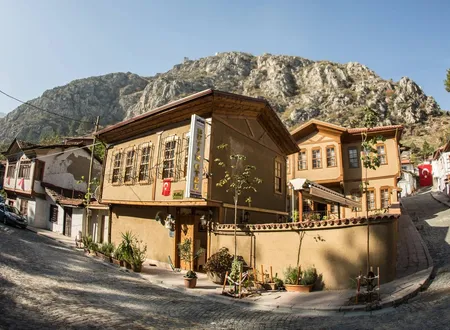
In the centre of Amasya, close to Yavuz Selim Square and opposite the Hükümet Bridge, the Gümüşlü Mosque stands on a small rise. It carries both the name and the written memory of Gümüşlü Neighbourhood. To describe the neighbourhood is, in a sense, to describe the mosque, the family that built it, and the madrasa, dervish lodge and mansions that grew up around it. For seven centuries the mosque has remained on the same spot despite earthquakes, fires and repairs, leaving with each rebuilding an endowment arrangement and an inscription or record. Hüseyin Hüsâmeddîn Yasar's Amasya Tarihi and Osman Fevzi Olcay's Amasya Hâtıraları add to these records the names of the neighbourhood's residents, its streets and its former neighbours.
Origin of the Name
Provincial and municipal records say the mosque was built in 1326 by Gümüşlüzade Taceddin Mahmut Çelebi. Selim Özcan's encyclopedia entry dates the building to 1325 and reminds us that Amasya was then under Mongol-Ilkhanid rule. Hüsameddin supplies a detail that allows both dates to be read together: according to him the mosque was built in 725 AH (1324-25) and its endowment was arranged in 727 (1326-27). The one-year difference may have arisen from this interval between construction and the endowment deed, but this is only an interpretation, and none of the sources explains the gap in this way.
Today the neighbourhood is called Gümüşlü. In older records it is Gümüşlüzâde Neighbourhood, and the mosque has also been called Taciye and the Defterdar Ahmed Bey Mosque. Hüsameddin writes that the neighbourhood entered the official registers under the name of Gümüşlüzâde Tâceddîn Mahmûd Çelebi, the emir of Amasya. The present short name, according to the official records, took hold only after the repair of 1688: once Gümüşlüzade İbrahim Bey had carried it out, the building began to be called the Gümüşlü Mosque.
The genealogy Hüsameddin gives takes the origin of the name down one more step. Hâce Emîneddîn Yûnus bin Abdullah el-Müstevfî, the "great emir Gümüşlü", was chief treasurer and finance minister of the Seljuks and is mentioned as the brother-in-law of the vizier Muîneddîn Süleyman Pervâne. His son Sirâceddîn İsmâîl Bey was Pervâne's nephew and, like his father, served as müstevfî of Rûm, the head of Anatolia's financial registers. İsmâîl Bey's son was Tâceddîn Mahmûd Çelebi. Hüsameddin states plainly that the neighbourhood and the family descend from this line. The mosque and the neighbourhood thus took their name from a family's by-name; but there is no reliable explanation of why the word "gümüş" (silver) was given to Emîneddîn Yûnus, and none has been guessed at here.
Boundaries and Location
The sources place the Gümüşlü Mosque in the city centre, around Yavuz Selim Square and opposite the Hükümet Bridge. The building stands on slightly raised ground, which lets it look down on the square a little and makes it appear more imposing than it is. Its official address is on Mehmet Paşa Street. The present surroundings of the neighbourhood are described as follows: Yavuz Selim Square to the west, a small square to the east, Atatürk Street to the south and the Yeşilırmak to the north.
In Hüsameddin's list of neighbourhoods the boundaries are drawn with older names. Gümüşlüzâde Neighbourhood lies on the eastern side of Selağzı; to its east are Yassı Kaya and the Sofîler neighbourhood, to its west and south Selağzı and the stream, and to its north the Sofîzâde neighbourhood. The northern neighbour, Sofîzâde, lies below Gümüşlüzâde and runs down to the Yeşilırmak; it takes its name from Sofî Bâyezîd Çelebizâde Mahmûd Çelebi, tutor and adviser to Çelebi Sultan Mehmed. Mahmûd Çelebi had a mosque built in this neighbourhood in 835 (1431-32), and Şahbulâ Hatun, wife of Yörgüç Paşa, added a school and a fountain beside it in 843. That the northern boundary today is the Yeşilırmak itself suggests that Sofîzâde gradually ceased to be named as a separate neighbourhood; this is an inference, not something the documents state.
The Yeşilırmak determines the orientation of every settlement in Amasya. Gümüşlü, too, is laid out on a strip squeezed between the square at the head of the bridge and the river, between the foot of the slope and the water. Hüsameddin writes that the pointed rock known as Zencirli Kaya extends from south to north into the town and reaches as far as the Çukur Bahçe locality, south of Gümüşlüzâde Neighbourhood. In this respect the neighbourhood is a narrow line between the rocky foot of the slope and the riverbank.
The Gümüşlüzade Mansion and Garden
According to Hüsameddin, the elevated locality known in Amasya as the "Palace of the Beys", "Saray Düzü" and "Pîr İlyâs" was the residence of the rulers and emirs who governed the town from the Islamic conquest onwards. A legal document of 614 (1217-18) calls the place "Mülk-i Gıyâseddîn Şâh" (the estate of Gıyâseddîn Shah). Hüsameddin takes this as proof that it had been the residence of princes since the time of the Seljuk Sultan Mesud. The family of Emîneddîn Yûnus, the first step in the neighbourhood's name, took the land into its possession around 665 (1266-67); after his death the estate passed to his children and stayed in their hands for a long time.
During the years Tâceddîn Mahmûd Çelebi was emir of Amasya, he had a lofty pavilion built here. The eastern side of the pavilion was known as the Gümüşlüzâde Mansion and the western side as the Gümüşlüzâde Garden. At the head of the garden stood a small but solid stone tomb, in which, according to Hüsameddin, his wife Döndü Hatun and his daughter Ayşe Hatun lay. When Tâceddîn Mahmûd died in Rebîülâhir 735 (November-December 1334), he was buried in the garden in front of his mansion, and his sons Abdullah, Ahmed and Kâsım Çelebi succeeded him. Pîr Kutbeddîn Muhammed Çelebi, the cousin regarded as the eldest of the same lineage, withdrew into seclusion in Gümüşlüzâde Neighbourhood.
Hüsameddin reports that when Çelebi Sultan Mehmed came to Amasya as governor at the beginning of 800 (1397-98), he bought the site of the mansion from Gümüşlüzâde Hoca Celâl Çelebi and had a large palace built there. The garden remained entirely in the hands of the Gümüşlüzâde family, and as family members were buried in it, it gradually turned into a cemetery. Hüsameddin writes that this palace served the Ottoman dynasty as its residence in Amasya for about three hundred and fifty years, that Çelebi Mehmed lived there sixteen years, Murad II twenty and Bayezid II twenty-six, and that it was the birthplace of Murad II and Selim I. Some scholars name Trabzon as Yavuz Selim's birthplace; Hüsameddin's statement should be read as his own record in that dispute.
By his account, what remained of the palace was a large harem quarter, a reception wing, two baths, two kitchens, two gardens with marble pools in their centres, and the masonry wall that enclosed them. The building was damaged by the earthquake of 1147 (1734-35), could not be repaired because the Iranian wars continued, and was destroyed completely in the earthquake of 1241 (1825-26). Hüsameddin tells how the great fire of 1311 (1893-94) also burned the Amasya secondary school (idadi), and how the governor Mahmud Kemal Bey, when a new site was being sought, approved the construction of the new school on the western side of the palace garden. A barracks, begun in 1316 and finished in 1318, rose in the middle of the palace site. The school Olcay remembered as a student at Saraydüzü is in the same quarter.
History of the Gümüşlü Mosque
The first building, with a timber roof, was built in 1325 or 1326 by Tâceddîn Mahmûd Çelebi. Hüsameddin writes that when Tâceddîn Mahmûd arranged his endowments he also endowed the Helkis Garden, and that the mosque's being called Tâciye Câmii appears in the endowment deed drawn up in 805 (1402-03).
The first great disaster to befall the mosque was an earthquake. Hüsameddin dates the tremor to 818 (1415-16), while the official records and Özcan give 1419. Hüsameddin and Özcan agree that the repair was ordered by Gümüşlüzâde Ahmed Paşa. When the mosque later burned, the man Hüsameddin calls "Ahmed Paşazâde Defterdâr Ahmed Bey ibn Abdullah Bey" rebuilt it in masonry in 890 (1485), added a minaret on its western side and arranged its endowment. On the marble slab above the door a Persian inscription recounts the completion of the building and Ahmed Bey's charity. The official records attribute the rebuilding to 1491 and to Defterdar Mahmut Bey; Özcan says that construction begun in 1481 was finished in 1485, as the inscription states. Because the inscription is a primary document, 1485 is the stronger date. The name Ahmed in Hüsameddin also agrees with Özcan; where the name Mahmut comes from cannot be determined from these sources.
The following century was one of fires. Hüsameddin records the mosque as burned in the "brigands' incident" of 1011 (1602-03) and attributes the repair to the beylerbey Şemseddin Paşa, of the line of Defterdar Ahmed Bey. This date agrees with Özcan's 1603; the 1612 given in the official records departs from both. The records show that Şemseddin Paşa did not stop at the mosque: the same pasha built a small mosque at Çukur Bahçe and endowed his properties for it in 1023 (1614). Later, in 1099 (1688), Gümüşlüzâde İbrahim Paşa repaired the mosque and extended its endowments. Hüsameddin adds that in 1100 İbrahim Paşa built a fountain at Selağzı, in front of the tomb of Gümüşlüzâde Muhyiddîn Mehmed el-Halvetî.
A fire broke out in 1133 (1720-21), and the trustee Hacı Mustafa Ağa had the mosque rebuilt in 1134. The official records date this repair to 1721 and state that Mustafa Ağa was the trustee of the endowment. In 1238 (1822-23) Rahtuvân Paşazâde Hacı Ali Bey, one of the notables, had a preaching pulpit built and endowed his shops to the mosque's pulpit sheikhship. Hüsameddin writes that in his own time these shops were still held as endowment property by the descendants of Vâzıh Efendi. In 1903 the present last-congregation porch was added to the north façade, in 1953 Hürrem Arpacıoğlu had the mosque repaired, and in 1960 the painted decoration inside was executed. The last repair, between 1985 and 1989, gave the mosque its present appearance.
Architecture
The Gümüşlü Mosque has a nearly square plan, and its walls are built of regular cut stone. On the east and west of the harim, the main prayer hall, there are two side sections, three-bayed on the lower floors and with galleries running north-south on the upper floors, which widen the prayer space laterally. The portal on the north is of stone and projects from the wall; the corners of the arched doorway have colonnettes, and there are small niches and mihrabiyes at the sides. Above the door is a four-line Persian construction inscription, which mentions Ahmed Bey's charity.
The harim is covered first by a sixteen-sided drum and, above it, by an octagonal drum with a timber framework. Each side of the octagonal drum has two small wooden windows. Özcan describes this covering as a dome and calls the mosque the only timber-domed, single-minaret mosque in central Amasya. A separate roof was built over the walls to protect the dome from the elements. On the north, the last-congregation porch, carried on six wooden posts, took its present form in 1903. The central part of this five-bayed section is higher than the sides and carries a triangular pediment. The porch, said originally to have been a five-domed arcade, today has a very shallow dome over the centre and flat roofing at the sides. In the middle of the courtyard before the porch stands an octagonal wooden ablution fountain.
The single minaret rises from a stone base with a cylindrical brick shaft. The sources differ on its position: the official records give the north-east corner, while Özcan and another publication give the north-west. Hüsameddin's statement that the 1485 rebuilding placed the minaret on the "garb", that is the west, side of the mosque is consistent with the north-west position. That position also agrees with the stair to the minaret beginning from the landing of the western door. The minaret's steps are of brick, stone as far as the shaft, with timber-clad brick above; the central pole is of wood. The interior of the mosque is plastered today, but there is stone, plaster and painted decoration. The floor of the harim is stone, the galleries are wooden, and the last-congregation porch is paved with brick.
Dervish Lodge and Madrasa
The history of the mosque does not consist of its walls alone; a dervish lodge and a madrasa developed around it. Hüsameddin writes that the empty ground east and south of the mosque was the site of the Gümüşlüoğlu Lodge. Registered under the name Taciye, this lodge was the first built in Amasya for the Halvetis and for more than two centuries served as a place of worship for the Gümüşlüzâde dynasty. In another section Hüsameddin tells of the founding of this lodge among the events of 810 (1407-08): the defterdar Hâce Celâl Çelebi had a Halveti zawiya built in Gümüşlüzâde Neighbourhood, on the site of the present Gümüşlüzâde Mosque, for his relative Pîr Şücâeddîn İlyas Çelebi.
Gümüşlüzâde Pîr İlyâs began to spread the order here, and when he died in 813 (1410-11) his daughter's husband and successor Gümüşlüzâde Pîr Abdurrahmân Çelebi took his place. Hüsameddin's chain of sheikhs runs down to 1585 with Pîr Üveysoğlu Hacı Ahmed Çelebi, then lists Hasan Efendi, Ali Çelebi, Mustafa, Mahmud and Hâfız Hüseyin Efendi. In the middle of the eighteenth century the chain takes a different direction with the death of Abdürrahîm Efendi in 1150 and the accession of the tomb-keeper İsmâîl Efendi as trustee and sheikh. Out of devotion to İsmâîl Efendi, and at his suggestion and reminder, an Amasya woman of the palace of Mahmud I, Fatma Hanım, the wife of Hindî Paşazâde Ahmed Bey, had a madrasa built in place of the lodge in 1153 (1740-41). Hüsameddin calls it the Fâtımiye Madrasa.
The madrasa was built of timber and stood on the qibla side of the mosque. The properties of Sarı Alan and Ortaköy that Fatma Hanım donated formed the endowment's income, from which shares were set aside for the trustee, the teacher, the collector, lighting and repairs. Hüsameddin writes that in 1179 the teaching post of the madrasa was separated from the tomb-keepership of Pîr İlyâs. The list of teachers runs to 1228, but because the madrasa was not looked after, it fell into ruin by about 1280 (1863-64). The records on the first teacher do not fully agree: in one place the first teacher is a scholar, the son of a hâfız from Çorum, who taught hadith and Quranic commentary at the mosque and died in 1170 (1756-57), and Sheikh İsmâîl Efendi succeeds him; in another it is written that in the year the building was completed the teaching post was given to the tomb-keeper of Pîr İlyâs, İsmâîl Efendi.
Teaching around the mosque was organised around the pulpit sheikhship and the preachership of the Gümüşlüzâde Mosque. In Hüsameddin's records this pulpit and the Fâtımiye teaching post are at times held by the same person. In 1074 (1663-64) Küçük Hızır Efendi took over the preaching allowance that Hacı Sefer and Ya'kûb Ağa had set up at the mosque, taught until his death in 1104 (1692-93), and was buried beside his teacher. Hacı Sefer Ağa is the man who repaired the Hacı Hamza Mosque and had the Sefer Ağa Fountain built beneath it. Before his death he endowed a sufficient sum to provide a salary for the pulpit sheikhship of the Gümüşlüzâde Mosque. In another record Abdülganî Efendi, preacher and pulpit sheikh of the Gümüşlüzâde Mosque, was a hâfız known for his fine voice, who died after 1048 (1638). Hüsameddin also shows that the preachership of the Pervâne Bey and Gümüşlüzâde mosques was often combined in one person.
Other Buildings in the Neighbourhood
Hüsameddin names other buildings within the neighbourhood boundaries besides the mosque. At Çukur Bahçe the mosque built by the beylerbey Şemseddin Paşa was endowed in 1023. At Selağzı, Ali Paşa built a school in 916 (1510-11); it was called the Kürd School for a time, was turned into a girls' primary school in 1306, and in 1326 its dome was removed and the building enlarged and raised. In the market area, in 1218 (1803-04), Topçuzâde Hacı Abdurrahmân Abdî Ağa had a mosque and a fountain in front of it built and endowed his shops. This mosque is known as Eğri Câmi (the Crooked Mosque).
Near Eğri Mosque, inside a blind alley, stood the Şeyhoğlu Lodge. Abdullah Vecîh Efendi, son of Sheikh Hasan Efendi of Çorum, built a lodge in 1190 (1776) at the front of a large house he had bought from the heirs of the teacher Seyyid Ahmed Efendi and held Naqshbandi rites there. His son Sheikh Ahmed Rüşdî Efendi, then Rüşdî's son Hâfız Ali Efendi, who was a Qadiri, and in 1312 the latter's son Hacı Ali Efendi became sheikh. Above the neighbourhood, north of the road to the Tomb of Pîr İlyâs, inside a small cemetery, lies the tomb of the Halveti sheikh Ya'kûb. Ya'kûb Efendi's son Mustafa Efendi, the mufti of Amasya, and his other children lie here.
The People of the Neighbourhood
The neighbourhood was one where Amasya's learned and notable families lived. In the biographical sections of Hüsameddin's volumes 9-12, the people noted as "born in Gümüşlüzâde Neighbourhood" or "of the people of the neighbourhood" show together the neighbourhood's janissary, imam, soldier and mayor. Hacı Kasımoğlu Hüseyin Ağa was the son of es-Seyyid Hasan Ağa of the neighbourhood; he became a janissary in youth, rose to be a company cook (çorbacı) of the corps, and with the support of Damat İbrahim Paşa became kethüdâyeri. According to the janissary register he died in 1143 (1730-31).
Hakkı İsmail Paşa was born in the same neighbourhood. He came from the Geyiklioğlu notable family, trained in the Enderun, rose to the rank of peşkir ağası and in 1218 was sent to the provinces as a palace gatekeeper-chief. In 1224 he went to the Russian war at the head of a volunteer force of five hundred, in 1227 to guard the fortress of Yergöğü with eight hundred men, and in 1230 he became mütesellim of İzmit. Hıfzı Abdurrahman Efendi became imam of the Gümüşlüzâde Mosque in 1216 (1801-02) on the death of his father, served as imam for more than forty years and died in 1273 (1856-57). It is said that his fine voice enlivened the mosque. One of his sons, Mustafa Efendi, also served as imam in the same mosque.
Topçuzâde Halil Efendi was the son of Hacı Salih Ağa of the neighbourhood's notables and was born in 1258 (1842-43). From a municipal membership he was elected mayor in 1301 (1883-84); in 1306 he was dismissed because of the anger of the governor Ca'fer Sâdık Paşa and the Armenian disturbances, in 1307 he became a member of the administrative council, and in 1313, with the help of the governor Çerkes Bekir Sıtkı Paşa, he was elected mayor again. The Topçuzades, whom Olcay counts among the neighbourhood's old families, bear the surname of Abdî Ağa, who built the Eğri Mosque; but the kinship between them is not stated plainly in the records.
Olcay's Amasya Hâtıraları recalls the same neighbourhood from the early twentieth century. According to him, the neighbourhood's oldest residents include the families of Mecdizâde Abdurrahman Kamil Efendi, the Topçuzades and Şirvanlı Mustafa Takiyyüddin; Anaç Hoca Efendi and Canikli Mehmet Efendi were also well-known families. From Hüsameddin's record we learn that Abdurrahman Kamil Efendi studied Quranic recitation under Canikli Hâfız Mehmed Hilmi Efendi and was born in the neighbourhood in 1263 (1846-47); Olcay adds that he received his licence from Mir Hasan Efendi, father of Mir Said Efendi. Kamil Efendi's wife Emine Hanım was the daughter of the scholar known as Anaç Hoca. Anaç Hoca (Mehmed Hafız), remembered as the teacher of Grand Vizier Mehmet Rüştü Paşa and the father of Hafız Fuat Bey, was in Olcay's words "a devout, ascetic man", and he had a son named Nalbant Abdullah Usta.
Kamil Efendi had three sons, Sabri, Ahmet Emri and Mustafa. Olcay writes that he was in the same class as Ahmet Emri Efendi at the secondary school at Saraydüzü, and that among the classmates of Sabri Efendi, who graduated a year before him, were Bektaşzâde Ahmet and Nuri Efendi, Nail, son of Saatçi Yusuf Efendi, and Hasip, son of Telgrafçı Hasan Efendi. In his own class were Mehmet Hilmi, son of Hamamcı Hakkı Efendi, and Ali Rıza, son of the mayor Musa Efendi. Hüsameddin gives Sabri Efendi's full name as Mecdizâde Sabri Mehmed Efendi and writes that he was born in the neighbourhood in 1303 (1885-86). Remembered as a scholar, poet and calligrapher, Sabri Efendi completed his education with his father after the primary and secondary schools, received his licence in 1326 and died in 1338 (1919-20).
Olcay goes on naming families. Munise Hanım, wife of Şirvanlı Mustafa Takiyyüddin, was the mother of his teacher Ahmet Nuri. Yumuk Osman-zâde Hamdi Efendi lived in a house on the corner directly across from the lecture hall; his two sons Ferruh and Mustafa worked the farm at Terziköyü and from time to time collected the tithe. The building Olcay calls the lecture hall is the Şehzâdeler Dershanesi (Princes' Lecture Hall). It stood on a corner, level with Canikli Mehmet Efendi's house. Olcay writes that it was built in 903 (1497) by İskender Çelebi. According to the account, the children of rulers studied there. It is told that Murad II sent his son Mehmed to Amasya for his education and that Molla Fenari and then Molla Gürani were his teachers. Yavuz Sultan Selim, Tâcibeyzâde Cafer, Tâcibeyzâde Sadi and Cemâlizâde Pîri Mehmed are also said to have studied there. The chronology creates a problem here, since 1497 is half a century after Mehmed the Conqueror's childhood; it is unclear which part of Olcay's account belongs to the building and which to the tradition of teaching in this quarter. Olcay adds that nothing remains of the lecture hall's site.
The Recent Period
A photograph in Olcay's book shows the Hükümet Bridge and Gümüşlü Neighbourhood together. The bridge was timber before it was rebuilt in concrete in 1940. What passers-by on the square see of the neighbourhood today are the mosque and the ablution fountain around it, the narrow streets along the same line, and the houses on the slope. The neighbourhood is noted as part of the historic fabric of the city centre, and the mosque is among the buildings promoted within the city's faith and cultural tourism. No reliable population count for the neighbourhood was found in this research, and no figure is given. A survey of the Islamic court registers and endowment records might enrich the account with new detail.
Chronology
665 (1266-67): The family of Emîneddîn Yûnus takes the Gümüşlü estate into its possession.
1325/1326: Gümüşlüzade Taceddin Mahmud Çelebi has the mosque built; its endowment is arranged in 727 (1326-27).
1334: Death of Tâceddîn Mahmûd Çelebi and his burial in the garden in front of his mansion.
1397-98: Çelebi Sultan Mehmed buys the site of the mansion and has a palace built (Hüsameddin).
1407-08: Founding of the zawiya for Pîr İlyas Çelebi.
1415-1419: Repair of the building damaged in an earthquake (the sources differ on the date).
1481-1485: Defterdar Ahmed Bey rebuilds the mosque in stone (according to the inscription; 1491 in one source).
1497: Building of the Şehzâdeler Dershanesi by İskender Çelebi (Olcay).
1602-1603/1612: Repair by Şemseddin Paşa after a fire.
1688: Repair by Gümüşlüzade İbrahim Bey; the mosque takes its present name.
1721: Repair by Mustafa Ağa after the fire of 1720-21.
1740-1745: Fatma Hanım has the Fâtımiye Madrasa built and arranges its endowment.
1803-04: Topçuzâde Abdurrahmân Abdî Ağa builds the Eğri Mosque.
1823: Building of the preaching pulpit and endowment of shops.
1903: Renewal of the last-congregation porch on the north façade.
1953, 1960, 1985-1989: Repairs and painted decoration.
Bibliography
Primary sources
- Hüseyin Hüsâmeddîn Yasar, Amasya Tarihi, vols. 1-4 and 9-12, Amasya Belediyesi, 2022 (e-book) amasya.bel.tr
- Osman Fevzi Olcay, Amasya Hâtıraları, Amasya Belediyesi Kültür Yayınları amasya.bel.tr
Official sources
- Republic of Türkiye, Amasya Governorate, "Mosques" page (amasya.gov.tr)
- Ministry of Culture and Tourism, Culture Portal, "Gümüşlü Mosque" (kulturportali.gov.tr)
- Amasya Municipality, City Guide, "Gümüşlü Mosque" (kentrehberi.amasya.bel.tr)
Other sources
- Selim Özcan, "Gümüşlü Mosque", Online Turkey Tourism Encyclopedia, 2019 (turkiyeturizmansiklopedisi.com)
- Mustafa Gürelli, "Gümüşlü Mosque / Amasya", Tarih Gezisi (tarihgezisi.com)
Online sources