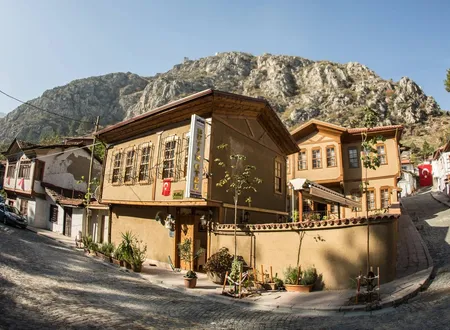
Kurşunlu Mahallesi, in the Merkez district of Amasya, is today a residential quarter of some two thousand people that lies off the usual tourist routes. Yet its name reaches back to one of the oldest layers of Amasya's history. According to Hüseyin Hüsameddin Yasar, the neighbourhood owes its name to a caravanserai built by the Danishmendid ruler Yağıbasan and later roofed in lead, and the palace of the Seljuk Sultan Mesud in Amasya stood on the same riverside strip, within this neighbourhood's bounds. The name appears in the 1840 population register as a unit of 45 households, and in nineteenth-century biographies it is often given as the birthplace of madrasa-trained scribes, Qur'an reciters and a Rumelian chief military judge. What follows gathers these scattered traces, noting where the sources agree and where they do not.
The Origin of the Name and the Yağıbasan Inn
In the section of his Amasya Tarihi that lists the neighbourhoods one by one, Hüsameddin places Kurşunlu forty-third among the neighbourhoods of İçeri Şehir, the Inner Town. By his description it lies to the west of the Upper Bath (Yukarı Hamam), with Karatay to the east, the Ahi Sa'deddin neighbourhood to the west, the Yeşilırmak to the south and the mountain to the north. Its older name was "Yağıbasaniye". Yağıbasan Gazi, one of the Danishmendid rulers, had a large inn built here, and from AH 560 (1164-1165) onward it was known as "Hân-ı Yağıbasan". Later Cemal Gazi Bey, a descendant, repaired the inn and covered it with lead, so the building came to be called "Kurşunlu Han" (the Leaded Inn); in time the word "han" dropped away and Kurşunlu remained as the name of the neighbourhood itself. Hüsameddin says he worked this out from his study of the old records, so the account rests less on local tradition than on the endowment and property documents he consulted himself.
Further details on Yağıbasan appear again in the book's chapter on the Danishmendids. Relying on the endowment deed dated 560, Hüsameddin writes that the ruler was a son of Sultan İbrahim and cannot be counted as a son of Melik Muhammed Gazi or of Gümüştigin Gazi. According to the same document, the administration in Amasya included an atabeg, a chief of emirs and a chief judge. One of Yağıbasan's emirs, Hüsameddevle Hasan, also had a mosque built near Han-ı Yağıbasan and endowed it with the farm of Emir Hasan Alanı in the Öz sub-district. This shows that the neighbourhood did not merely carry the name of an inn: a mosque and an endowment system had also grown up around it. No published counterpart of the chain Hüsameddin reports, together with the text of the deed, has been found, so the origin of the name remains the account of a strong local historian who worked from documents.
No claim that the name comes from somewhere else exists. Many neighbourhood names in Turkey derive from lead-covered buildings, and Kurşunlu in Amasya fits that general pattern of naming. What sets it apart here is that the lead roof is said to have belonged to an inn, not to the dome of a mosque.
The Palace of Sultan Mesud
Hüsameddin writes that when the Seljuk Sultan Mesud made Amasya his centre (around AH 540, 1145-1146), he repaired the Inner Citadel and had a mosque, a madrasa, a bath and a palace built. His description of the palace's location is clear: it stood on the riverbank that now forms the Kurşunlu neighbourhood and part of the Ahi Sa'deddin neighbourhood. The quay on the bank running west from the house of Saraçzade Yaşar Mehmed Efendi, above the Upper Bath, is said to have been the foundation of this palace, a belief handed down since early times. According to Hüsameddin the palace was damaged in the earthquake of AH 718 (1318-1319) and afterwards remained in the hands of the judge Ziyaeddin Mesud bin Ahmed and his descendants.
The palace's later fate sheds light on the building history of the neighbourhood. In AH 853 (1449-1450) part of the palace grounds was turned into a mosque and endowed by Alaeddin Ali el-Mesudi, while the remaining parts formed the southern face of a neighbourhood. The house held by the heirs of Saraçzade Yaşar Mehmed Efendi was counted among the outer buildings of the palace; Hüsameddin relates that its very handsome arched outer gate stood until 1271 (1854-1855), and that when the house was being renewed Yaşar Efendi's father had the gate pulled down, as he heard from Yaşar Efendi himself. The section describing the neighbourhood repeats that the Mesud palace lay within its bounds and that the palace's legacy later passed to the descendants of Mesud.
The Upper Bath at the head of the neighbourhood is placed in the same setting. Hüsameddin counts it among the works Sultan Mesud left to Amasya and adds that the bath is a queen's endowment. Since he writes that Mesud built a bath along with the palace, the two statements support each other; even so, this source does not reveal from which period the present structure of the bath dates, because Hüsameddin gives no date for the building.
Mosques, Fountains and Qur'an Schools
Hüsameddin's survey of the neighbourhood describes the first mosque as follows. Alaeddin Ali Çelebi bin Ebü'l-Kasım Ahmed bin Mesud, of the line of Mesud, had a mosque and a fountain in front of it built on the riverbank in AH 840 (1436-1437) and arranged its endowment. When the building burned in a raid by brigands, Bayram Paşa, a former grand vizier, came to Amasya in 1047 (1637-1638), revived the mosque and enlarged its endowments. Since the same page also mentions a mosque dated AH 853, the book does not make clear whether the two records describe one building or two; all that is certain is that Alaeddin Ali, named in both, belonged to Mesud's line and that a mosque stood in the riverside part of the neighbourhood.
The neighbourhood housed places of learning as well as places of worship. According to Hüsameddin's section on the dârü'l-kurrâ, the Qur'an-reading schools, Müeyyedzade Ali Çelebi, a former mufti of Amasya, had a reading school built in AH 884 (1479-1480) on the west side of the mosque in Kurşunlu and arranged its endowment. The building later fell into ruin, became a juz-recitation hall and was assigned to several well-known reciters; by Hüsameddin's time its site was no longer known. Places of teaching were not limited to this one: the judge İzzeddin Hasan Çelebi (Ahizade), before his death in 1039 (1629-1630), had a mosque and a school built in the Üçler neighbourhood and added another school in the Kurşunlu neighbourhood of İçerişehir. When the mosque in Üçler burned in AH 1011, it was rebuilt in stone in 1018 (1609-1610) by Sa'dî Çelebi, who endowed three houses in Kurşunlu for its upkeep. Kurşunlu thus appears also as a quarter that held endowed property supporting the mosques of other neighbourhoods.
Osman Fevzi Olcay's Amasya Hâtıraları draws another face of the neighbourhood. Olcay treats this quarter under the heading "Meydan Köprü Mahallesi (Kurşunlu Mahallesi)" and says that the whole area that begins right at the end of the İçeri Şehir neighbourhood, from the end of the citadel gate to where the railway runs towards the station, is this neighbourhood. At the bridgehead there was a modest wooden madrasa, but by the time Olcay wrote, nothing of it remained. He says he knew only the Madenoğlu and Kemeroğlu families among the residents. He adds that on the way to the station there were fruit orchards along the riverbank.
The fate of a cemetery that Olcay describes also illuminates the neighbourhood's recent history. Near the station, beside the road, there had once been a historic and neglected graveyard; local people used to say that scholars, men of merit and great figures raised in Amasya lay buried there. When the cemetery had fallen into abandonment, the Amasya Municipality sold the place to a man named Arabacı Şükrü Usta, who had a large building put up and founded the Şark Araba İmalathanesi, the Eastern Carriage Works. This detail from Olcay shows that the part of the neighbourhood toward the river and the station turned into small industry and workshops in the twentieth century. Because two writers describe the same name in two different ways, it cannot be assumed that Hüsameddin's Kurşunlu inside İçeri Şehir and Olcay's Meydan Köprü Mahallesi, stretching from the citadel gate to the station, have exactly the same bounds; they overlap in the area near the Meydan Gate and the riverside strip.
Scholars and Scribes from the Neighbourhood
In Hüsameddin's biographical sections Kurşunlu appears several times as a place of birth or residence. The earliest example is Sinaneddin Yusuf Efendi (Muhaşşî), born in Kurşunlu in 893 (1487-1488). His father was the Khalwati sheikh Hüsameddin Hüseyin Efendi of Sonisa. After completing his reading and memorisation of the Qur'an at the Sultan Bayezid School, Sinaneddin Yusuf studied at the Büyük Ağa Madrasa, became a pupil of Taşköprülü Musliheddin Mustafa Efendi and went to Istanbul with him in 918. The same passage notes that the place on the Bosphorus where his waterside house stood at Anadolu Hisarı came to be called the Muhaşşî Sinan Efendi neighbourhood, and that his mosque in Kurşunlu was known as the "Sheikh's Mosque" and had its own endowments. Of his sons, Hasan Efendi died while serving as judge in Aleppo, Mehmed Efendi died in 987 as a professor at the Süleymaniye, and Ali Efendi rose as far as chief military judge of Rumelia.
By the nineteenth century the neighbourhood is remembered for a tradition of scribes and calligraphers. Kâtibzade Rıfat Mustafa Efendi was born in Kurşunlu in 1229 (1813-1814), the son of Ahmed Kâmil Efendi, a calligrapher and professor at the Sultan Bayezid Madrasa; he studied under his maternal uncle and under Kabartalı Mehmed Efendi, memorised the Qur'an, took over the Sultan Bayezid professorship on his father's death in 1244 and travelled to the Hejaz the following year. On his return he stayed a year in Damascus, learned the variant readings of the Qur'an, came back to Amasya and completed his education in Istanbul under İmamzade Mehmed Es'ad Efendi; when he failed the professorial examination, he returned home and turned to teaching and to court clerkship. Another figure is Abdüllatif Efendi (Apardızade), son of the endowments clerk Hasan Efendi. Hüsameddin writes that he was born in 1278 (1861-1862) in the Kurşunlu neighbourhood of İçerişehir, studied at the preparatory school, rose from clerk of the sharia court to candidate member of the civil court, then court member and circuit teacher, and died in 1327 (1909).
Two more people from an earlier period are tied to the neighbourhood. The judge Kara Kadızade Halil Efendi is recorded in 1134 as a head of reciters living in the Kurşunlu neighbourhood, and he died in 1146 (1733-1734). Halil Efendi (Hammamîzade), son of Ahmed Ağa, the bath-keeper of the Upper Bath, is likewise "of the Kurşunlu neighbourhood of Amasya"; his father's trade shows once more how closely the neighbourhood was bound to its bath. From the political sphere comes the name Kurşunlu Ali Ağa, who appears in 1099 (1687-1688) as Amasya's steward (kethüda) in the arrangements that followed Süleyman Han's accession; Hüsameddin does not state outright that he was from the neighbourhood, but the byname strongly suggests it. The name of a Topçuzade, counted among the notables of Kurşunlu and described as a saz poet, also occurs; however, the columns on the page in question are tangled, so the identity of this person cannot be settled.
Location and Surroundings
Kurşunlu is a neighbourhood of the Merkez district of Amasya. Map sources place it at about 40.65 degrees north and 35.82 degrees east and list Gökmedrese, Hacı İlyas, Hatuniye and Hızırpaşa as neighbouring neighbourhoods. In Hüsameddin's late nineteenth-century arrangement, by contrast, Kurşunlu lies west of Hatuniye, with Karatay to its east and Ahi Sa'deddin to its west. These two orderings do not fully confirm each other, since the Karatay and Ahi Sa'deddin that Hüsameddin lists do not appear as separate units in today's administrative list; the neighbourhood boundaries have evidently been redrawn. Still, the common ground is that Kurşunlu is a narrow strip in İçeri Şehir, on the north bank of the Yeşilırmak, leaning against the foot of the Citadel. One source gives the neighbourhood's distance from the town centre as about two kilometres.
Kurşunlu in the 1840 Population Register
The earliest trace of the neighbourhood put into figures is found in Selim Özcan's article comparing the Amasya population register of AH 1256 (1840) with the revenue-survey (temettuat) registers of AH 1260-1261 (1844-1845). According to the table in the article, Kurşunlu is entered in the 1840 population register with 45 Muslim households, and no non-Muslim household appears in the neighbourhood. In the revenue survey four years later the same neighbourhood appears with 50 Muslim households. Kurşunlu is thus among the neighbourhoods inhabited only by Muslims; according to the register, of the town's 55 neighbourhoods, 32 were mixed neighbourhoods where Muslim and non-Muslim families lived together and 23 consisted only of Muslims.
Looking at the town as a whole, the 1840 register gives Amasya 3,180 households, of which 2,236 were Muslim and 944 non-Muslim. In the revenue survey the number of neighbourhoods falls to 48 and the number of households to 2,709, made up of 1,857 Muslim and 852 non-Muslim households. The author ties this decline to wars, the long military service laid on Muslim men, plague and cholera epidemics, and migration toward large cities. The fall in Muslim households is about 17 percent and in non-Muslim households about 9 percent. Against this background Kurşunlu's rise from 45 to 50 households runs counter to the town's general course; yet the author also notes that household changes at the neighbourhood level range between 1 and 21 and that part of this stems from the counting method.
The nature of the two surveys is genuinely different. The population register rests on copies prepared at the centre, whereas the revenue registers are original records kept on the spot by asking household heads about their occupation and income. The population register is said to list two muhtars in each neighbourhood as household heads, while the revenue surveys do not; this is one reason for small household differences per neighbourhood. The five-household difference in Kurşunlu should be read with this difference of method in mind. Since the names and occupations of Kurşunlu's household heads could not be extracted from the accessible text of the article, nothing documented can be said about the neighbourhood's economic structure in the 1840s; this detail could be obtained from the relevant pages of the Amasya revenue registers in the Ottoman Archive.
It is worth remembering that the 45-50 household neighbourhood in the registers falls in the same period as the generations Hüsameddin describes. Rıfat Mustafa Efendi had become professor at the Sultan Bayezid Madrasa in AH 1244 (1828-1829); in the years the 1840 register was compiled, Kurşunlu was a neighbourhood in which madrasa-trained scribes and professors lived. To what extent this shows in the occupations of the household heads is not known.
Population and Change
In a compilation based on ADNKS data, which by its own account is unofficial and for information only, the population of Kurşunlu Mahallesi between 2012 and 2019 is as follows:
- 2012: 2,331
- 2013: 2,224
- 2014: 2,121
- 2015: 2,259
- 2016: 2,235
- 2017: 2,194
- 2018: 2,181
- 2019: 2,219
The same compilation ranks the neighbourhoods of Merkez by population. Among the 40 neighbourhoods listed in the 2019 data, Kurşunlu stands 12th with 2,219 people. At the head of the list are Şeyhcui with 23,145, Hacılar Meydanı with 14,837 and Bahçeleriçi with 11,821; among the neighbouring neighbourhoods, Hızırpaşa has 5,972, Gökmedrese 1,297 and Hatuniye 126. The neighbourhood populations in the compilation add up to about 120,850, and Kurşunlu holds a share close to 2 percent of that. Within the eight-year series the highest value is in 2012 (2,331) and the lowest in 2014 (2,121); the difference is a little over a hundred people and the population has stayed relatively steady.
Another compilation gives the neighbourhood's population as 2,003 (984 men, 1,019 women) as 2025 ADNKS data. Read together, the two series show that over the last thirteen years the neighbourhood has stayed between roughly 2,000 and 2,300, with a slight decline in recent years. Because the figures come from derived sources, the TÜİK data should be taken as the official value.
Kurşunlu Today
Today the neighbourhood has a muhtar's office, its streets, and an order of its own within the surrounding new construction. In news reports the neighbourhood muhtar is seen responding to incidents such as house fires; it is also reported that a private kindergarten opened on Kırklar Sokak in 2022. No registered mosque or tomb has been attributed to this neighbourhood; well-known buildings nearby, such as the Gök Medrese (1267) in Gökmedrese, belong to the neighbouring neighbourhood. The real historical layer for the neighbourhood concerns what Hüsameddin and Olcay describe: the Yağıbasan Inn, the Mesud palace, the Upper Bath and the old mosques on the riverbank; which of these is still standing today must be settled separately by fieldwork.
Chronology
Around AH 540 (1145-1146): The Seljuk Sultan Mesud makes Amasya his centre, repairs the Inner Citadel and has a palace and a bath built on the riverbank within the neighbourhood's bounds (Hüsameddin).
AH 560 (1164-1165): The Danishmendid Yağıbasan's endowment deed; Hân-ı Yağıbasan known from this date (Hüsameddin).
AH 718 (1318-1319): The Seljuk palace is damaged in an earthquake (Hüsameddin).
AH 840 (1436-1437): Alaeddin Ali Çelebi has a mosque and a fountain built on the riverbank (Hüsameddin).
AH 853 (1449-1450): Part of the palace grounds is endowed as a mosque (Hüsameddin).
AH 884 (1479-1480): Müeyyedzade Ali Çelebi has a dârü'l-kurrâ built in Kurşunlu (Hüsameddin).
AH 893 (1487-1488): Sinaneddin Yusuf Efendi (Muhaşşî) is born in Kurşunlu (Hüsameddin).
AH 1018-1039 (1609-1630): The mosque in Üçler is renewed with an endowment of three houses in Kurşunlu; İzzeddin Hasan Çelebi has a school built in Kurşunlu (Hüsameddin).
AH 1047 (1637-1638): Bayram Paşa revives the burned mosque (Hüsameddin).
AH 1099 (1687-1688): Kurşunlu Ali Ağa is mentioned as Amasya's steward (Hüsameddin).
AH 1229 (1813-1814): Kâtibzade Rıfat Mustafa Efendi is born in Kurşunlu (Hüsameddin).
AH 1271 (1854-1855): The date by which the palace's outer gate was pulled down (Hüsameddin).
AH 1278 (1861-1862): Abdüllatif Efendi (Apardızade) is born in Kurşunlu (Hüsameddin).
1840 (AH 1256): Amasya population register; an entry named "Kurşunlu" with 45 Muslim households (Özcan, 2016).
1844-1845 (AH 1260-1261): In the revenue survey Kurşunlu is recorded with 50 Muslim households (Özcan, 2016).
2012-2019: The neighbourhood's population ranges between 2,121 and 2,331 (compilation based on ADNKS data).
2025: The population is compiled as 2,003 according to ADNKS data.
Sources
Primary sources
- Hüseyin Hüsâmeddîn Yasar, Amasya Tarihi, vols. 1-4, Amasya Municipality, 2022 edition (Kurşunlu Mahallesi entry, e-book p. 128; Mesud palace p. 93; Yağıbasan p. 330).
- Hüseyin Hüsâmeddîn Yasar, Amasya Tarihi, vols. 9-12 (biographies: Muhaşşî Sinaneddin Yusuf p. 319; Rıfat Mustafa p. 225; Hasan Çelebi p. 268; Apardızade p. 582).
- Osman Fevzi Olcay, Amasya Hâtıraları (section on Meydan Köprü Mahallesi, or Kurşunlu Mahallesi). amasya.bel.tr
Academic studies
Other sources
- Nufusu.com, "Merkez Mahalleleri Nüfusu, Amasya" (2012-2019 compilation).
- Nufusune.com, Amasya Merkez neighbourhood population (2025 ADNKS compilation). amasya.bel.tr
- TrHaritası, "Kurşunlu Mahallesi, Merkez, Amasya" (location and neighbouring neighbourhoods).
Online sources