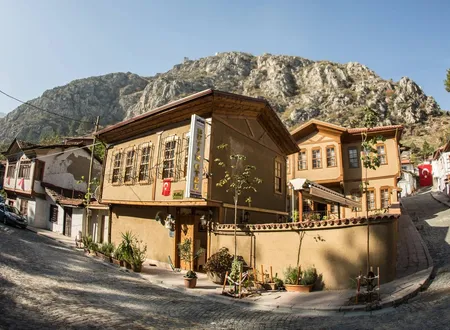
Şehirüstü is one of the neighborhoods of Amasya's central district that begin where the ground rises from the Yeşilırmak toward the slopes of Karakaya and Çakallar to the south. Its present name reads at first glance as a simple description of position, but the older records show that it grew out of an episode of wounded pride. Hüseyin Hüsameddin, the author of Amasya Tarihi, was born in this quarter in the house adjoining the Çeribaşı Mosque, and his family's burial ground is here too. Within the neighborhood stand a mosque of the fourteenth century, a woman's tomb dated to the fifteenth, the memory of a Halvetî lodge and a hill around which Prince Mustafa distributed vineyards. No monograph has been written on the neighborhood; the information is scattered through Hüsameddin's volumes, academic studies of the Halvetî order and local recollection.
Name and Location
The name Şehirüstü should be read as the present-day form of the neighborhood that Ottoman records call "Şehre Küstü". An academic article on the Halvetî lodges of Amasya places the Şehre Küstü Lodge in the "Şehir üstü neighborhood" and puts the Çeribaşı Mosque in the same neighborhood. Hüsameddin, for his part, calls it "Şehre Küsdü Mahallesi", gives its popular pronunciation as "Şâraküsdü", and notes that the old registers write it as "Şehre Küsdü, otherwise the Pîr Sinan Quarter". "Şehirüstü" therefore looks like the old name, meaning "one who sulked at the city", smoothed by use and drained of its original sense. No document has turned up that describes the name changing in this way; the inference rests on the fact that the sources refer to the same quarter by both names.
Hüsameddin's survey in volumes 1-4 lists the quarters one by one and gives their neighbors. According to him, the Çeribaşı Quarter lies on the northern skirt of Karakaya on the site once called "Sungur Mülkü" (Sungur's Estate), with the Acem Ali quarter to the east, Devehane to the west, Bozahane to the north, and the Şehre Küsdü quarter and Karakaya to the south. Şehre Küsdü he describes as a quarter above the Uzun Yol Cemetery, with cemeteries on its eastern and northern sides and the foothills of Karakaya on its western and southern sides, almost outside the city. That the Çeribaşı Mosque and the Halkalı Evliya Tomb are both reckoned today under the name Şehirüstü suggests that the two old quarters were merged or blended into one. No document is at hand to say when this happened. The rocky slope that rises behind the neighborhood is shared between Karakaya and Çakallar, and the dividing line Hüsameddin draws follows the road in front of Hoca Sultan above the Dârüsselâm Quarter: east of that line is Çakallar, west of it Karakaya.
Sungur's Estate and the Çeribaşı Quarter
Hüsameddin writes that the old name of the Çeribaşı and neighboring Bozahane quarters was "Sungur Mülkü" and ties the name to the Danishmendid ruler Sunkur. He also records that at the western end of the Çeribaşı Quarter, in a lane at the foot of a bluff, stands a sarcophagus-shaped tombstone whose head carries, in Kufic script, the words "Hâzâ kabrü'l-meliki'l-mu'azzam Sunkur" (this is the tomb of the great king Sunkur). Since the accession of Sunkur's successor, his uncle Melik Muhammed Gâzi Bey, is firmly dated to 529 AH (1134-35), Sunkur is thought to have ruled in Amasya for some nineteen years. From the old name of the quarter and the inscription Hüsameddin concludes that the ruler's palace stood in this area; he leaves the phrase "it is supposed" in his sentence and offers no excavation or document. The Danishmendid trace in the neighborhood is thus limited to a gravestone and an old estate name, and all of it depends on the reading of a single author.
The man who gave the quarter its present name was Çeribaşı Emîneddîn Mehmed Çelebi, a well-known emir of the days of Şadgeldi Pasha and, after him, Devâtdâr Ahmed Pasha. According to Hüsameddin this emir lived in the quarter and had a mescit built, and the quarter took the name "Çeribaşı" from him. The inscription of the mosque has been pulled out and its endowment deed has not been found, so its date of construction cannot be learned directly. Hüsameddin nevertheless infers from the witnesses of a deed drawn up that year that the same emir was alive in 793 AH (1390-91), and he concludes that the mosque was built around those years. In volume 4 he adds that the inscriptions of the Sarachâne and Çeribaşı mosques of Şadgeldi's time were pulled out in an attempt to erase Şadgeldi's name and traces, and that he spent years searching for them. The similarity in the construction of the two mosques is, in his view, a matter that deserves separate study.
The continuation of the Çeribaşı line in the quarter can be followed in the records Hüsameddin gathers under the heading "Sungur Sülâlesi" (the Sungur lineage). The descendants of the emir Seyfeddin Sungur, who died around 700 AH (1300), later divided into three branches called "Osman Paşazâde", "Çeribaşızâde" and "Yahşi Beyzâde"; the third branch stayed in Amasya and, under the titles "Zanbak Oğulları" and "Mütevelli Oğulları", survived in the Çeribaşı Quarter until 1300 (1882-83). Volumes 9-12 state that Hacı Mehmed Çelebi, a city steward from this circle, descended from the "Büyük Çeribaşı" line whose mosque is in Amasya, and was known as "Zanbak Dede". Volume 4 gives the nickname "Küçük Çeribaşı" to Şâdî Beyzâde Burak Bey, who served as commander-in-chief during Prince Mehmed's (the future Conqueror's) governorship of Amasya; Burak Bey lived in the Çeribaşı Quarter and was the son of the daughter of Büyük Çeribaşı Mehmed Çelebi. The name of the quarter thus carries more than the memory of a single man; it carries a family circle spanning several generations.
The Çeribaşı Mosque
As the center of life in the quarter, the Çeribaşı Mosque was managed for centuries by the descendants of its founder's line. By the measure Hüsameddin gives, the office of trustee remained with the children of this family for some four hundred years. The mufti Mütevellîzâde Hacı Ahmed Efendi set up the mosque's minbar in 1118 (1706-07) and enlarged its endowments; Mütevellîzâde Hacı Halil Ağa, one of the janissary sergeants, added a minaret on the east side of the mosque in 1197 (1782-83). Another entry in volumes 9-12 says that Çavuşzâde Halil Ağa (d. 1212) had a brick minaret built on the right side of the mosque and endowed money for the mosque's needs; the two entries may describe the same minaret, and Hüsameddin offers no explanation on the point. Most of the endowments were later lost, and nothing remained but the cash endowment.
In the nineteenth century the mosque was repaired many times. The governor of Amasya, Ziya Pasha, had it repaired in 1281 (1864-65). When the dome began to leak again, Hüsameddin's father, Abdîzâde Hacı Mehmed Ağa, had a protective mortar structure raised over the dome in 1309 (1891-92) to protect it. The corner house opposite the mosque was endowed for the imam, and the vacant plot two houses above it for the Qur'an reciter. Hüsameddin also records the water supply of the quarter: Kaya Pasha built a fountain in the lower part around 803 AH (about 1400), Mütevellîzâde Hacı Hasan Ağa another on the upper stream side around 1145 (1732-33), and Acem Ali Ağa added one beside the mosque in 873 (1468-69). The fountain also affected the window of the Çeribaşı Dârülkurrâ (Qur'an reciters' school) beneath the mosque; when Ziya Pasha leveled the road he brought the fountain in front of that window, which was thereby blocked, and the dârülkurrâ ceased to function.
The imams and preachers of the mosque belong to the chain of Amasya's learned men. İmamzâde Zihnî Mehmed Efendi became imam in 1117 (1705-06) in place of his father, Mevlâna Mustafa Efendi, left the imamate for the judiciary in 1121, and died in 1148 (1735) after being dismissed as judge of Çorum; Hüsameddin describes him as a poet with a fine hand. Sorukluzâde Râşid Ahmed Efendi took over in 1221 (1806-07), after his father, the posts of professor at the Dârülhadîs of Osman Çelebi and imam and preacher of the Çeribaşı Mosque, then moved to the deputy judgeship of Havza and died in 1243. A man nicknamed "Kuru İmâm" (the Lean Imam), who became imam of the mosque in 1231 (1815-16), lived in the house adjoining the mosque on its west side and died in 1246 (1830-31); his son's name was Hâfız Osman Efendi. Since Hüsameddin's maternal grandfather was also Hâfız Osman Efendi, whose own father was the chief of Qur'an reciters Halil Efendi, these records suggest that the Lean Imam was the author's maternal ancestor; Hüsameddin does not link the two entries explicitly.
Among the preachers is counted the Halvetî Dede Hüseyin Efendi (d. around 999, about 1591); the date of his death is written on his gravestone, and he lies at the edge of the garden where Hüsameddin's mother was buried. In volume 10 Uzun Vâizzâde Abdülmuttalib Efendi was dismissed from the preachership of the Sarachâne Mosque and became preacher of the Çeribaşı Mosque, was removed from there too after a time, and in 1192 (1778) became chair sheikh and preacher of the Sultan Bayezid Mosque. The name of Hacı Nuh Efendi, preacher of the Çeribaşı Mosque, was given to a lodge lying east of the mosque. On the site of this lodge, which Hüsameddin calls the Nuh Lodge, the mufti Mütevellîzâde Hacı Ahmed Efendi had a madrasa built in 1116 (1704); when it burned in 1143, Mütevellîzâde Hacı Ali Ağa of the same family founded a Halvetî lodge there. Hüsameddin gives the date of the lodge's burning as about 1233 (1818), while the academic article gives 1808; the difference between the two dates remains unresolved. Today the site of the lodge is guessed to be around the Atatürk Primary School.
The Author's Neighborhood
Hüseyin Hüsameddin was born as one of twin boys in the house adjoining the west side of the mosque in the Çeribaşı Quarter at dawn on the last Friday of Receb 1286 AH (November 1869). His father was Abdîzâde Hacı Mehmed Ağa. His father gave him the name Hüseyin; his mother, Zahide Hatun, added the epithet Hüsameddin out of her affection for the Halvetî saint of Kuba, Hüsameddin. On the pages where he tells his own life, Hüsameddin mentions this house and the neighborhood again and again; the quarter is where his relationship with the sources he used in compiling the history of Amasya began. The place he gives to the imams and preachers of the Çeribaşı Mosque also springs from this closeness.
The Hüseyin Dede Tomb, on the road to the southeast of the mosque and west of the garden, is the burial ground of the author's family. Here lie the well-known Halvetî preacher Şeyh Hüseyin Efendi and the professor Mustafa Efendi; to their east are buried Hüsameddin's mother, Zahide Hatun, his brother, Hâfız Halil Efendi, and his sister, Fatma Hatun. Zahide Hatun's forebear, the chief of Qur'an reciters Hacı Halil Efendi, is remembered as the sheikh of the dârülkurrâ beneath the mosque. This information shows how mosque, madrasa, lodge and graveyard were tied together in a single quarter by the hands of the same families.
The Halkalı Evliya Tomb
The best-known building in the neighborhood is the Halkalı Evliya Tomb. Hüsameddin describes it under the name "Halkalı Dede Tomb" as a structure standing alone in the Çeribaşı Quarter, in front of the Şehre Küsdü Quarter. Resting on four stone pillars, the building is covered by a conical dome; garden surrounds it on three sides, the road lies on the south, and a wall encloses it. The author reports that the tomb holds Sâru Hatun, daughter of Şâdî Bey of the line of Şadgeldi Pasha, and that this is written on the headstone and on a stone set in the qibla wall. Beneath the cenotaph there is a crypt the size of the tomb; in the middle of the crypt, in an open coffin, the body is seen lying unspoiled inside a slightly yellowed shroud. Of the two black stones north of the tomb, each carries two iron rings; the stones cover the mouth of the crypt and are lifted by the rings when necessary.
The origin of the name lies in these rings. Hüsameddin writes that the belief is firmly rooted that if the feet of children who cannot walk are fitted into these rings on three Saturdays they will walk, by God's leave, and that women therefore call Sâru Hatun "Halkalı Dede" after the rings. A modern collection of observations shows that the practice continues today; children who have reached the age for walking but cannot are brought, especially on Saturdays, their feet are passed through the ring three times to the sound of prayers, a sacrifice is brought to the tomb when the child walks, and it is sometimes eaten to the beat of drum and zurna. People who make a wish leave a pencil, an eraser or a key on the cenotaph; tea sugar is distributed at the tomb on certain days and is held to be sacred. In Çapanoğlu's recollections the shade of the tomb appears as the place where neighborhood children sat in its garden on summer days reading books; he also relates that those who came to put a child's foot through the ring later began to leave money, and that no such custom existed in his own childhood.
The identity of the person in the tomb has a double aspect in the sources. In Hüsameddin's section on tombs, Sâru Hatun is the daughter of Şâdî Bey of the line of Şadgeldi. Elsewhere, among the biographies in volume 11, the entry written for "Şâh Rûze Hatun", daughter of Burak Bey, son of Şâdî Bey, a grandson of Devâtdâr Ahmed Pasha, contains the following: the woman grew up in Amasya under her father's protection and was first married to Prince Alaeddin Bey, governor of Amasya; it is told that in 846 AH (1442-43) the prince was strangled as he slept in his bed and that his sons, Prince Gıyâseddîn and Tâceddîn Çelebi, were also drowned; after this she gave herself to worship and charity, died in 871 (1466-67) and was buried in the tomb adjoining the author's house beside the Çeribaşı Mosque. The text also says that her body was seen to be intact in its coffin. The page's column order is confused, so the details should be read with caution. Hüsameddin does not link the two entries and says "Sâru" in one place and "Şah Rûze" in another; whether Sâru and Şah Rûze are the same person, and whether her father was Şâdî Bey or his son Burak Bey, remains an open question. The Ministry of Culture and Tourism's descriptive text speaks of Şahruz Hatun, daughter of Burak Bey; an encyclopedia entry on saints and Çapanoğlu give the name Sâru Hatun, daughter of Şadi Bey. Çapanoğlu adds that Sâru means "yellow-complexioned", and that the lady may have taken the name either because her complexion was yellow or because her body turned yellow; this interpretation is a guess.
The building is of the baldachin type and is dated to the fifteenth century; neither a precise date of construction nor its founder is known. The tale of the unspoiled body in the crypt is a hagiographic detail; Hüsameddin relates it as his own observation, but it is not supported by an independent document. Whatever the dispute over identity, the tomb remains one of the places in Amasya still visited today that keep alive a devotional practice built around the health of children.
Pîr Sinan and the Şehre Küstü Lodge
The episode that gave the neighborhood its name is a story of a sermon and a dismissal that Hüsameddin tells in two separate places. Pîr Sinâneddîn Yusuf Efendi was a disciple of Seydî Alâeddîn Ali Çelebi, the deputy of Habîb-i Karamânî. In 940 AH (1533-34) he succeeded him as sheikh of the Habîb-i Karamânî Lodge and preacher of the Mehmed Pasha Mosque. In 949 (1542-43), when he admonished the governor of Amasya, Prince Mustafa, about extravagance during a sermon, the prince removed him from both the lodge and the chair; the mufti Sinan Efendi was also dismissed and investigated. The academic article describes the reason more specifically: the waste and the spending of the treasury at the circumcision feast of the prince's son, Süleyman Çelebi, had been criticized in the sermons. After this the sheikh withdrew to the edge of the city and broke his ties with the public; Hüsameddin tells that he retreated to a lodge built by his friends and disciples on empty land above the Çeribaşı Quarter, and that when houses were built around it the place took the shape of a quarter. The nickname "Şehre küstü" was attached to him for this reason, and the lodge and the quarter bore the same name.
The date of Pîr Sinan's death differs in the sources. Hüsameddin writes in volumes 1-4 that he lived in this quarter until 957 (1550); the academic article also gives his death as 957/1550. The biography in volume 10, however, says that he occupied himself with remembrance and worship in the lodge for some ten years and puts his death in Ramadan of 959 (1552). If it is taken into account that Prince Mustafa's governorship of Amasya ended with his execution in 1553, the interval between the sheikh's withdrawal and the prince's end is seen to be short. There is no other document that can reconcile the two dates.
Over time the surroundings of the lodge turned into a small cluster of buildings. Hüsameddin writes that the disciples built a mescit, a fountain and houses, whose income was endowed to the lodge, beside the lodge. The lodge stood above the fountain at the western end of the quarter. In the list in volumes 1-4, after Pîr Sinan his deputy Derviş Ali el-Halvetî and then Şeyh Ahmed Efendi sat in the seat; the lodge remained standing until 1241 (1825-26), then fell into ruin and its site became private property. Derviş Ali Efendi also preached at the Çeribaşı Mosque, and Hüsameddin places his death around 991 (about 1583); Dede Çelebizâde Hüseyin Efendi also names him among the teachers from whom he learned calligraphy and learning. The biographies in volumes 9-12 arrange the sequence somewhat differently. İmamzâde Abdülkerim Efendi, son-in-law and deputy of Pîr Sinan, was the son of Ahmed Efendi, imam of the Çeribaşı Mosque; after his father he held the imamate of the mosque and after his sheikh the sheikhdom of the lodge, preached for some forty years, died around 987 (1579) and was buried beside his sheikh. Derviş Ali and Resûl Efendi seem to have served as sheikh in the lodge after him; Hüsameddin writes that both died after 991.
The traces of building kept enriching the area with new charitable works. The judge Sa'dî Çelebi-Ahîzâde, who died in 1039 AH (1630), had a mescit built in the Şehre Küstü Quarter of Pîr Sinan adjoining the Sinâniyye Lodge. By the time Hüsameddin wrote, even the site of the lodge and the mescit had been lost and only its fountain was standing; Pîr Sinan's tomb, however, was found in 1304 (1886-87). The tomb lay on the road above the Şehre Küsdü Quarter and was known as a place of visitation. The academic article says that nothing of the tomb remains today, and that the place is known only from the older sources.
Çakallar and the Era of Prince Mustafa
The slope behind the neighborhood is, in Hüsameddin's description, a hill on the Yukarı Pazar side of Amasya, to the south, rising about two hundred meters above the surrounding flat ground, at the foot of the Pontic mountains. In length it resembles a cradle, high on both sides and level in the middle; the flat is called "Hamza Düzü". The air is good, every place is a vineyard, and in each vineyard there is a pavilion, in one or two places running water, and beside the water a meadow. Three famous springs, the Kaya Pasha, Üçler and Acem Ali waters, issue from the foot of this hill; the Çırçır water, which comes from the Karakaya side, was formerly known as the "Alişîr water". Hüsameddin states plainly that Karakaya and Çakallar form one whole and that Çakallar was in addition a hunting ground; since Karakaya had properties belonging to notables and emirs, the princes' hunting ground can only have been Çakallar. Hüsameddin also writes that Çelebi Sultan Mehmed had a lofty pavilion built on Köşk Kayası during his rule in Amasya, that the ruins of the pavilion were still seen in his own day, and that in the time of Prince Ahmed the "Köşklü Kaya Entertainments" lodged themselves on the tongues of poets.
The eastern slope of the hill, according to what Hüsameddin relates, had passed to Süleyman the Magnificent. When his son, Prince Mustafa, came to Amasya as governor, he had a summer residence built here and lived in it. Seyrek Muhyiddîn Efendi, Hayreddîn Hızır Efendi of Merzifon and Sürûrî Efendi took part in his education; around him were poets such as Hamdî, Zamânî and Edâyî, and companions such as Rüstem Beyzâde Gonca Keyvân, Lala Beyzâde Benefşe Ahmed, Gâzi Beyzâde Çiğdem Ali and Çakalzâde Gül Sinan Çelebi. The prince had granted a plot of vineyard each to the gentlemen Gonca and Çiğdem, to Çakalzâde Lâle Ali Çelebi and Gül Çelebi, and to his tutor Hamza Bey. The place now called Hamza Düzü fell to Hamza Bey, and the part east of Hamza Düzü, known as "Goncalık", to Gonca Bey; the land of Gül and Lâle Çelebi must lie to the west and south of Hamza Düzü. Hüsameddin notes that the way to win the prince's favor was to compose and present odes with the refrains violet, rosebud, rose and tulip, that many poets wrote verse in this vein, and that some of it appears in anthologies.
Hüsameddin relates the later fate of the land through records he extracted from the court registers. It is written that Prince Bayezid, during his governorship of Amasya, fell into the trap of Kara Mustafa Pasha and disappeared in 967 AH (1559-60), that the entire land, the princes' hunting ground, was then sold to emirs, notables and local worthies, and that the greater share passed to Çakalzâde Gül Sinan and Lâle Ali Çelebi. Lale Ali's share passed first to his son Lâlezâde Mehmed Çelebi and then to Sinan Çelebi; when Çakalzâde Sinan Pasha died in 1005 (1597) after being dismissed from the governorship of Sivas, the land remained with his sons Mahmud, Yusuf and Mehmed Pashas and with his daughters. When Mahmud Pasha died childless his share was sold; when Ahmed Pasha died in 1076 (1665-66) his daughters Münevvere and Fatma Hanım became his heirs; and when Mehmed Beyzâde Ahmed Bey died childless in 1091 (1680) his share passed to his daughters and others. Hüsameddin's account of the episode of the prince is a condensed summary; since the end of Bayezid is told with different details in other sources, this part should be read with caution.
The Çakalzâdes
The name of the hill comes from the Çakalzâde family. Hüsameddin writes that the descendants of Bedreddîn Mahmûd Çelebi, known as "Çakal Kadı" (Çakal the Judge), were called Çakalzâdes and that they were trustees of the endowments of the Hacı Mahmûd Çelebi Lodge in İçerişehir. The family is tied to the İmâdî branch of the Halâtî lineage; of the İmâdîs, the branches Şeyh Müeyyedzâde, Küpelizâde and Çakalzâde sprang from Amasya. As for the origin of the hill's name, Hüsameddin, relying on the court registers, explains it thus: first these vineyards were called "Çakaloğulları Bâğları" (the Vineyards of the Sons of Çakal), then the phrase was shortened to "Çakallar Bâğları", and in the end only "Çakallar" remained. He cites as parallel cases the way the Topaloğulları are called "Topallar" and the Ortakoğulları "Ortaklar". Hüsameddin also notes that the vineyards of Çakaloğlu Hacı Sinan Çelebi, who died around 998 (1590), at Çakallar were famous.
The Çakalzâdes were not merely a family of vineyard owners; they belonged to the learned and administrative cadre of Amasya. Çakal Kadızâde Şemseddin Ahmed Efendi was one of the "Şemsler" (Suns), the companions of Prince Ahmed. Sa'dullah Çelebi-Çakalzâde was exiled and sent to Tokat in 918 (1512) at the accession of Selim the Grim. Çakalzâde Sinan Pasha, like his father Hacı Mahmud Çelebi, grew up in Prince Mustafa's circle and became a divan clerk; when Mustafa was executed in 960 (1553) he went to Istanbul, entered the finance bureau and later became a beylerbey. His son, Çakalzâde Mehmed Pasha, was appointed to the sanjak of Amasya in 1017 AH (1608); Hüsameddin opens the third historical period of the Ottoman era with this appointment. The tie between the neighborhood and the family becomes concrete in the way the name has reached us from the hill.
Population and Change
According to a population table compiled from TÜİK/ADNKS data, the population of the Şehirüstü neighborhood is as follows:
- 2012: 2,183
- 2013: 2,057
- 2014: 2,082
- 2015: 2,094
- 2016: 2,045
- 2017: 1,905
- 2018: 1,880
- 2019: 1,856
Between 2012 and 2019 there is a decline of about fifteen percent. These sources do not give the reason. It may be the effect of the general emigration from the old neighborhoods of the city center, but this is a guess and not documented. Hüsameddin, for his part, writes that the city of Amasya in his own time had fifty-three quarters, some eight thousand households and some thirty-seven thousand inhabitants; he gives no figure by quarter.
Şehirüstü Today
Today Şehirüstü is a neighborhood largely outside the tourist route, where everyday life goes on. The neighborhood has the Atatürk Primary School and Halkalı Street; the Halkalı Evliya Tomb is presented within faith tourism and receives visitors. Around the Çeribaşı Mosque the Hüseyin Dede Tomb and the author's family graves stand in place, while the site of Pîr Sinan's lodge and tomb has been forgotten. The Ottoman-period boundaries of the neighborhood, the time when Çeribaşı and Şehre Küstü merged, and the inscriptionless date of construction of the Çeribaşı Mosque are matters that studies of the Islamic court registers and the tahrir defters may illuminate.
Chronology
529 AH (1134-35): Accession of Melik Muhammed Gâzi Bey, Sunkur's successor; according to Hüsameddin, Sunkur's gravestone is in the Çeribaşı Quarter.
793 AH (1390-91): Endowment deed showing Çeribaşı Emîneddîn Mehmed Çelebi alive; the mosque is dated to these years.
846 AH (1442-43): According to Hüsameddin, the killing of Prince Alaeddin, husband of Şah Rûze Hatun.
949 AH (1542-43): Pîr Sinan's criticism of Prince Mustafa, his dismissal from the preachership and his withdrawal to the Şehre Küstü lodge.
957-959 AH (1550-1552): Death of Pîr Sinan (the sources differ).
967 AH (1559-60): Sale of Çakallar after Prince Bayezid's disappearance.
1118 AH (1706-07): The mufti Mütevellîzâde Hacı Ahmed Efendi sets up the minbar of the Çeribaşı Mosque.
1241 AH (1825-26): The Şehre Küstü Lodge is recorded as standing until this date.
1281 AH (1864-65): Ziya Pasha has the Çeribaşı Mosque repaired.
1286 AH (November 1869): Birth of Hüseyin Hüsameddin in the house adjoining the Çeribaşı Mosque.
1304 AH (1886-87): Pîr Sinan's tomb is found again.
1309 AH (1891-92): Hüsameddin's father has the dome of the Çeribaşı Mosque protected with a mortar shelter.
Sources
Primary sources
- Hüseyin Hüsâmeddîn Yasar, Amasya Tarihi, vols. 1-4 (Amasya Municipality, 2022), entry on the Çeribaşı Quarter (e-book p. 115), Şehre Küsdü Quarter (p. 124), Dârülkurrâs (p. 163), description of Çakallar and Karakaya (pp. 82-85).
- Hüseyin Hüsâmeddîn Yasar, Amasya Tarihi, vols. 1-4, section on tombs: the Hüseyin Dede and Halkalı Dede tombs (e-book pp. 138-140), Şehre Küsdü Lodge (p. 152).
- Hüseyin Hüsâmeddîn Yasar, Amasya Tarihi, vols. 9-12, entries on Sinâneddîn Yusuf Efendi-Şehre Küstü and the imams and preachers of the Çeribaşı Mosque (e-book pp. 19, 142, 163, 268, 319, 375).
- Kadir Çapanoğlu, "Şehr-i Amasya'da Halkalı Evliya ve Çakallar Tepesi", Yozgat Gazetesi.
- Turkish Culture Portal (Ministry of Culture and Tourism), "Halkalı Evliya Türbesi - Amasya".
Books
- Kadir Özköse, "Amasya'da Bulunan Halvetiyye Tekkeleri", Akademiar, no. 5 (2018).
- "Amasya ve Tokat Çevrelerinde Türbe ve Yatır İnanç Pratiği", Kültür Evreni, no. 47 (2022).
Other sources
Online sources
- https://amasya.bel.tr/uploads/e-kitap/kitap/1-4/files/basic-html/page115.html
- https://amasya.bel.tr/uploads/e-kitap/kitap/1-4/files/basic-html/page140.html
- https://amasya.bel.tr/uploads/e-kitap/kitap/9-12/files/basic-html/page319.html
- https://dergipark.org.tr/tr/download/article-file/606666
- https://www.yozgatgazetesi.com/a-kadir-capanoglu/sehr-i-amasya-da-halkali-evliya-ve-cakallar-tepesi-139110.html
- https://www.kulturportali.gov.tr/turkiye/amasya/gezilecekyer/halkali-evlya-turbes