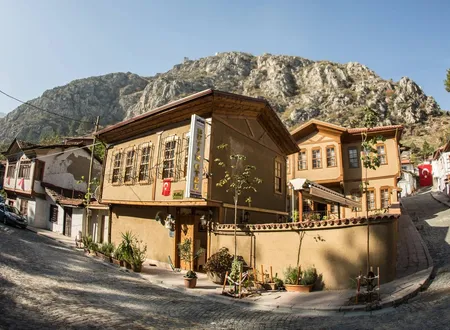
Most neighbourhood names in Amasya come from a building, a trade or a feature of the landscape; Şeyhcui takes its name directly from a person. That person is Mehmed Cui Dede, who served as sheikh of the Amasya Mevlevi lodge and then withdrew to his own village. The hillside orchard district on the western flank of the city, to the left of Harşena Castle, had been known as "Kelkis" before him; once Cui Dede had a village, a dervish lodge, a school and a tomb built there, the old name was forgotten and the sheikh's name took its place. Today the same name belongs to the most populous neighbourhood of the central district.
Origin of the Name and the Older Name
According to the Amasya historian Hüseyin Hüsameddin, Şeyhcui is the name of the orchards lying to the west, on the left side of Kal'a-i Bâlâ, the high citadel. Local people also called the place "Cığcığı". Above the orchards stood the tomb of the Mevlevi sheikh Cemaleddin Mehmed Cui Çelebi, the Mevlevi lodge he built and the village that bore his name; the water that irrigated the orchards came from the village, and the water, the village and the hamlet lands were all part of the endowment. Hüsameddin states that until Cui Dede's time the area was known as "Kelkis", and that this is written in the sheikh's endowment deed.
The same author writes that the western and northern mountains of Amasya form an arc, that the whole of this arc used to be called Kelkis, and that its middle later came to be called Şeyhcui. He adds that Arabic histories record the district as "Kalis" and the orchards as "Batn-ı Kalis". The clash in which the Umayyad commander Maslama, in the year 92 of the Hijra (about 710-711), tried to descend into Amasya from Karaman Mountain and met fierce resistance from Byzantine forces took place, according to Hüsameddin, where these orchards lie. His grounds are concrete: whenever the soil of the orchards is dug, human bones come up in clusters, and in 1313 AH (1895-96) the body of a tall, white-bearded man was found. The same book also relates that, in the early conquest narrative of Amasya, Süli Gazi's detachment was ordered to come down on the Şeyhcui orchards from behind Kelkis Mountain. These records show that long before Cui Dede the place was known under another name and was associated with wars.
The neighbouring districts called Akbilek and İltekin belong to the same slope. The places that run from the eastern foot of Karaman Mountain down to the south of the Şeyhcui locality are called Akbilek, and the orchards and rises on the upper side of Akbilek are called İltekin. Hüsameddin links the name İltekin to the Danishmendid commander İltekin Gazi and records that the ruins of the old Kelkis Castle are pointed out behind this district.
On the upper side of the İltekin district, Hüsameddin says, stands the tomb of İltekin Gazi, an old dome on four stone columns; Kadem Paşa Hatun is said to lie buried beside it. Behind the tomb, heaps of stones and old wall remains are shown as the ruins of Kelkis Castle. Above the stream north of Ferhat Rock there is a stone cavity about ten metres in diameter. Its interior descends like a road carved from a single piece of rock; according to tradition this road runs beneath the river in Ferhat Arası and comes out at Kelkis Castle. Hüsameddin reports that several people followed it by candlelight, but after about thirty metres the effect of saltpetre grew so strong that they turned back. No one seems to have reached the end of the tunnel, so the account remains a tradition.
Cui Dede and His Village
There is no detailed document on Cui Dede's life. Hüsameddin describes Cemaleddin Mehmed Cui, whose lodge stood in the village known as "Şeyhcui" near Amasya, as a man from Lâdik. According to the same author, the first Mevlevi lodge in Amasya had been built in 714 AH (1314-15) by Alaeddin Ali Pervane Bey on the bank of the Yeşilırmak, near the Hükümet Bridge. In that lodge the office of sheikh passed in the time of Şadgeldi Pasha from Cemaleddin Ahmed Dede of Zile, son of Nusret, to Cui Dede; when Cui Dede had a Mevlevi lodge built in his own village and withdrew there, Mecdeddin Küpeli Dede took the post in the city, followed in 840 AH (1436-37) by Müstencid Dede.
The date of the building work in the village appears in two forms in the sources. Local accounts and compilations say that in 1414 Cui Dede had a Mevlevi lodge, a dervish lodge, a school and a fountain built in his village and endowed the whole of the village's land. The documented record that Hüsameddin relates says that in the month of Dhu al-Hijjah of 817 AH Cemaleddin Mehmed Dede, known as "Şeyh Cui", endowed his property for the expenses of the mosque and Mevlevi lodge he had built in the village where he lived. The year 817 AH begins at the end of March 1414 and ends in March 1415; since Dhu al-Hijjah is the last month of the year, the endowment falls in February-March 1415. The difference can be explained by separating what the tradition calls "had built" from what the document calls "endowed"; even so, no document settles the point. Hüsameddin notes in a separate biographical entry that he saw the endowment deed and Cui Çelebi's certificate of succession himself, and that a scholar from Amasya appears among the witnesses of both.
An old uncertainty about the village's location can also be resolved. A local compilation places the Tomb of Cui Baba in Yuvacık Village in the central district, beside the village mosque, and writes that the village, officially named Yuvacık, is still called "Cıcui" or "Şeyhcui Village" by the people. Hüsameddin, for his part, places the Şeyhcui village above the orchards and the lodge to the northwest of the orchards, beneath the village, near a lake. The two descriptions agree: the name spread from the village on the slope down to the orchards and from there to the neighbourhood that now reaches into the city. Osman Fevzi Olcay, too, lists Şeyhcui as a district with "its village and the place called Gölbaşı", and when he enumerates the great mystics of Amasya he locates "Pir Muhammed Cuî" "at the pool head of the Great Water of the village of Şeyh Cuî". No document, however, shows how the name passed to today's administrative neighbourhood boundary.
The Sheikhs and Descendants of the Lodge
Hüsameddin lists the Şeyhcui Lodge as a separate entry among the dervish lodges of Amasya. This Mevlevi lodge's first sheikh was its founder, Mehmed Cui Dede. His successor was Pîrî Ahmed Dede, known as "Yoğurtçu Baba" (Şemseddin Ahmed Dede, who died in 842 AH / 1438-39), followed by Ömer Âhî Dede. Later sheikhs are recorded as "mesnevîhan", whose duty was to teach the Mesnevi at the lodge. For the eighteenth and nineteenth centuries Hüsameddin gives a detailed succession: İsmail Dede in 1154 AH, İbrahim Dede in 1177, İsmail Dedezade Feyzullah Dede in 1190, Seyyid Hasan Dede in 1194, then Seyyid Mustafa Dede, Ahmed Efendizade Feyzullah Efendi in 1204, Abdullah Dede in 1208, then Hacızade Hüseyin Dede with his brother Hafız Mustafa Dede, and from 1227 Seyyid Mehmed Kâmî Dedezade Mehmed Sabit Dede. The author also notes that, in his own time, "no trace remained" of the lodge.
There are also periods in which the sheikhdom and the trusteeship stayed in one family. According to the biography of Hacızade Sa'dî Efendi, when his father Ebû Sa'îd Ahmed Dede ("Hacı Dede") died in 1114 AH (1702-03), the eldest son Sa'îd İbrahim Dede became sheikh and trustee of the Şeyhcui lodge, and in 1129 (1717) his brother Sa'dî Efendi took his place. Sa'dî Efendi worked for some twenty-four years both as mesnevîhan at the Amasya Mevlevi lodge and as sheikh at Şeyhcui, and died in Shawwal 1153 (1740-41). His son Nâyî Osman Dede became trustee and mesnevîhan; when he died in 1189 (1775), his son Mustafa Dede succeeded him, and Osman Efendi in 1234 (1818-19) and Ömer Çelebi in 1274 (1857-58) continued as trustees. In the lodge records Hacı Mehmed Çelebizade Sa'îd Dede, who died in 1143, is also named among the trustees of Şeyhcui.
What Hüsameddin gives on Cui Dede's descendants draws a separate line. Şeyhcuizade Âbid Çelebi died around 868 AH (1463-64); he served as sheikh at the lodge and worked to guide the villagers, and he received the favour of Prince Bayezid, who, while governor of Amasya, visited the lodge from time to time. Among his descendants Abdî Ahmed Çelebi (died 1086 / 1675-76) became a teacher at a madrasa and the deputy judge of Amasya; Hüsameddin writes that the family were trustees of the Şeyh Cui endowment and mesnevîhan at its lodge. The grandfather of Abdî Pasha (died 1099 / 1688), who rose as far as the governorship of Tripoli, is likewise tied to the line of Âbid Çelebi. These accounts show that Şeyhcui lived not under the name of a single sheikh but through a household tradition that lasted for centuries by way of the endowment and the sheikhdom.
The weight of the village and its endowment in the city shows in other records too. Hüsameddin writes that one of the eleven soup-kitchen hostels of Amasya was the "Şeyh Cui Hostel". The sheikh of the Quran readers at the Dârü'l-kurrâ built by Mahmud Çelebi in 807 AH was "Şeyh İbrahim Efendi of Şeyhcui"; another sheikh of the readers, who died in Mecca in the second half of the eighteenth century, was Hacı İbrahim Efendi, son of Yahya, of Şeyhcui. Olcay remembers, among the rooms of the Darülfeyz Madrasa, the room of "Şükrü and Musa Mollas of Şeyh Cui", and among the greengrocers around the Sinan Bath he counts a "Çayköy Ağa of Şeyh Cui". Şeyhcui thus became an identity placed before people's names, from the madrasa corridors to the market rows.
Orchards and Outings
Among the spring outing places of the people of Amasya, Hüsameddin puts the Şeyhcui orchards first. According to him the notables and the wealthier part of the city moved here from the twentieth of April; the air is pleasant, the cherries are famous and the pavilions very elegant. The Ziyare, Kirazlıdere and Derbent orchards follow. The outing places set aside for Fridays and for women are Şirvanlı, Saraydüzü, Çanaklar and Kaşık Pınarı.
Olcay describes this life as a witness. According to him the neighbourhood is Amasya's outing place famous for its best grapes and cherries. In the season people moved into their pavilions, neighbours invited one another to eat cherries beneath the trees, and nightingales sang while lutes were played on one side. The cherry season lasted a month; as the heat set in, the regulars drifted back to the city, though most stayed in the orchards until the grape season. Every morning milk and yoghurt were brought from the village to the pavilions at the outing place. Olcay's book also has separate headings for orchards; the Meydan, Akbilek, Şeyhcui, Alp Tekin and Helvacı orchards are among them. The area west of the railway station, at the foot of Harşena Castle, which extended on one side to the Şeyhcui orchards and on the other to the Akbilek orchards, was altogether called "Karaağaç Meydanı".
The boundary Hüsameddin draws for the Hızır Paşa Neighbourhood also sheds light on this geography. The high neighbourhood, once called "Komatus Palace" and later "Kavak", is bounded on the east by the Hekim Çelebi Neighbourhood, on the west by the Şeyhcui orchards, on the south by Ok Meydanı and on the north by Kırklar Mountain. The Şeyhcui orchards thus lie on the western edge of the city, south of Kırklar Mountain.
Akbilek and the Tomb of Bahşi Halife
The Akbilek locality inside Şeyhcui's boundaries takes its name from a scholar. Hüsameddin writes that because Molla Bahşi Halife, one of the Hanafi scholars and Quran commentators, lies buried to the south of the orchards, these places began to be called Akbilek from 931 AH (1524-25). In the Cultural Inventory the structure is registered as "Ak Bilek Tomb (Saint)" in the Şeyhcui Neighbourhood, beside the mosque. It sits within a retaining wall of rubble stone, 6.80 metres long and 5.10 metres wide. The grave inside is 2.50 metres long, and the inscription on its headstone has worn away. A wooden hipped-roof reinforced-concrete structure and a wooden prayer room were later added on top, and in 1938 the Amasya Municipality had the landscaping and retaining walls rebuilt. The structure is under third-degree monumental protection.
Compilations on Bahşi Halife's life relate that he was born in Uluköy in Taşova, studied in Amasya, then went to Egypt, where he took lessons from the famous scholars of the day such as Jalal al-Din al-Suyuti, Zakariyya al-Ansari and al-Sakhawi, that he was learned in jurisprudence and Quran commentary, and that he died in Amasya in 1523-24. This date roughly coincides with the year 931 AH given by Hüsameddin. It is told that students beginning madrasa training held their first lesson at his tomb, and that they tried to solve problems they could not resolve by visiting the tomb on Friday. The tomb is still visited today; people with mental illness are said to pray two units of prayer and vow a sacrifice at the head of the sarcophagus, and to fulfil their vows once they recover. A local legend also circulates about the origin of the name: while explaining the merit of ablution in a sermon, Bahşi Halife spread his arms and the parts he had washed shone like light, and the name "Akbilek" arose from this event. Hüsameddin, for his part, ties the name to the location of the grave.
The "Pir Akbilek Bahşî Halife" whom Olcay counts among the great mystics of Amasya is likewise placed "on the road of the Akbilek orchards". Two of Şeyhcui's pirs appear in the same list: one at the head of the village's water, the other on the orchard road.
The Rain Prayer in Yuvacık
There is also a tradition living in the village of the name Şeyhcui. Every year a rain prayer is held in Yuvacık village, sacrifices are slaughtered, and bulgur pilaf and sacrificial meat are served to guests. The villagers believe that Sheikh Mehmed Cui Dede began this tradition six centuries ago. According to news reports, nearly six hundred people attended the 2019 ceremony, and the offal of the slaughtered animals was sold at auction. One villager explains that the area is rural, that little rain fell, and that the sheikh went out with the villagers to pray for rain. The name still lives on in the village's yearly calendar.
Population and Change
According to a compilation based on population registration system data, Şeyhcui is the most populous neighbourhood of Amasya. Its population of 27,428 in 2023 is roughly twice that of the second-ranked Hacılar Neighbourhood (14,998). The series compiled from TÜİK address-based population data is as follows:
- 2007: 11,798
- 2010: 15,416
- 2015: 18,172
- 2020: 22,931
- 2022: 25,391
- 2023: 27,428
- 2024: 27,609
- 2025: 26,670 (11,907 men, 14,763 women)
The neighbourhood has grown more than two and a half times in eighteen years and has shown a decrease of 939 people in the last year alone. The district that Olcay described through seasonal pavilions and orchards has become a settlement full of apartment blocks. The figures come from a compilation and should be confirmed with TÜİK for official use. The sources contain no clear assessment of the reasons for the growth.
Şeyhcui Today
The neighbourhood has the Şeyhcui Mosque on Türkistan Avenue and the Kırklar Mosque. Akşemsettin Primary School on Yıldızhan Street is one of its educational institutions. On the health side, it was announced in September 2026 that ground survey work had begun for a four-physician family health centre to be built in the neighbourhood.
The dense population also shapes everyday needs. In February 2024 Mayor Bayram Çelik announced that construction of a two-storey, air-conditioned covered market with a car park had begun in the neighbourhood, saying that the need had existed for a long time. The existing markets, held three days a week, were at that time on İstasyon Avenue and in the Bahçeleriçi Neighbourhood.
Chronology
710-711: According to Hüsameddin, the clash in which the Umayyad commander Maslama descends from Karaman Mountain takes place in the Kelkis orchards.
1314: Alaeddin Ali Pervane Bey has Amasya's first Mevlevi lodge built.
1414: According to tradition, Cui Dede has a Mevlevi lodge, a dervish lodge, a school and a fountain built in his village and endows the village lands.
1415: According to the record Hüsameddin relates (Dhu al-Hijjah 817 AH), Cui Dede endows his property for the expenses of the mosque and Mevlevi lodge in the village.
1438-39: Pir Yoğurtçu Ahmed Dede dies.
1463-64: Şeyhcuizade Âbid Çelebi dies in these years.
1523-24: Bahşi Halife dies; the district begins to be called Akbilek.
1740-41: Hacızade Sa'dî Efendi, sheikh of Şeyhcui, dies.
1938: The Amasya Municipality renews the landscaping and retaining walls of the Akbilek tomb.
2007: Start of the population series, population 11,798.
2024: The population reaches 27,609, the highest value in the series; construction of the covered market begins.
2025: Population 26,670.
Sources
Primary sources
- Hüseyin Hüsâmeddîn Yasar, Amasya Tarihi, Amasya Municipality, 2022: volumes 1-4 (Şeyhcui orchards pp. 82-85; Şeyhcui Lodge pp. 233-234; Mevlevi lodge and sheikhs pp. 247-250; the 817 AH endowment pp. 192-193; entries on soup-kitchen hostels and the dârü'l-kurrâ); volumes 9-12 (entries on Sa'dî Efendi, Âbid Çelebi, Abdî Ahmed Çelebi, Abdî Pasha) amasya.bel.tr
- Osman Fevzi Olcay, Amasya Hâtıraları, Amasya Municipality Culture Publications (sections on the Şeyhcûi Neighbourhood, the orchards and the mystics) amasya.bel.tr
- "Ak Bilek Mezarı (Evliyası)", Cultural Inventory
Other sources
- Abdulhalim Durma, "Amasya'da Mevlevilik"
- "Şeyh Cui Baba Türbesi / Amasya - Merkez - Yuvacık Köyü", Sosyo Denemeler, 2013
- "Bahşi Halife Türbesi / Amasya - Merkez - Şeyhcui Mahallesi", Sosyo Denemeler, 2013
- "Amasya'da 6 Asırlık Gelenek Sürüyor", DHA, 30 April 2019
- "Şeyhcui Mahallesi Nüfusu (Merkez, Amasya)", nufusune.com (compiled from TÜİK ADNKS data, 2007-2025)
- "Amasya'nın en Kalabalık 5 Mahallesi", 05.com.tr, 14 February 2024
- "Başkan Sözünü Tuttu: Şeyhcui Mahallesi'ne Pazar Yeri Yapılıyor", Objektif Amasya, 22 February 2024
- "Amasya'ya Yeni Sağlık Yatırımı: Şeyhcui Mahallesi'nde İlk Adım Atıldı", Merzifon Bilgi Gazetesi, 18 September 2026
Online sources
- http://sosyodenemeler.blogspot.com/2013/08/seyh-cui-baba-turbesi-amasya-merkez.html
- https://www.kulturportali.gov.tr/turkiye/amasya/kulturenvanteri/ak-bilek-mezari-evliyasi
- https://www.nufusune.com/1321-amasya-merkez-seyhcui-mahallesi-nufusu
- https://www.semazen.net/amasyada-mevlevilik-abdulhalim-durma/