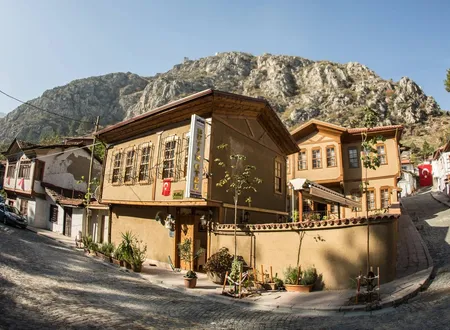
Yeşilyenice is a small settlement east of Amasya's city centre, close to the bank of the Yeşilırmak. Until 2013 it was administered as a belde, a town with its own municipality and municipal council; after that date it was merged into Amasya Municipality and became a neighbourhood. The older form of its present name is Yenice, and that name appears fairly often in Ottoman sources, including Hüseyin Hüsameddin Yasar's Amasya Tarihi. Yenice is mentioned as a village of the Akdağ nahiye of the Amasya sanjak, and its history can be pieced together around the tomb of a sheikh who lived there, the scholars it produced and a notable (a'yan) family that took part in the city's politics. Because the sources are not consistent with one another, part of this information has to be left open to dispute.
Its Name and Former Name
In Bekir Başalan's study of settlements in Amasya whose names were changed, "Yeşil Yenice" appears among the 35 renamed settlements of the Central District, with "Yenice" given as its earlier name. Başalan places the change in the group of cases where the old name was replaced by a synonym or near-synonym. In other words the name was not altered at its root: the word "Yeşil" was added in front of "Yenice". The same study lists Yeşilyenice among the villages later turned into neighbourhoods, together with Boğazköy, Fındıklı, Helvacı, Karasenir, Saraycık and Yeniköy.
It is plausible that the added "Yeşil" refers to the Yeşilırmak, but no document has been found showing when or why the name was changed. Since no other settlement called Yenice exists in the Central District, the village that Hüsameddin calls "Yenice" and today's neighbourhood can reasonably be taken as the same place, considering Başalan's table and the present location of the tomb together. Hüsameddin himself places the village in one passage to the east of Amasya and in another to the south-east; the two descriptions do not match exactly, but both point to the eastern side of the city.
Within the neighbourhood there are still place names left over from the old village layout. A study of colour-based place names in Amasya lists the Karakucak hamlet houses belonging to Yeşil Yenice Neighbourhood, and Karaağaç Street in the neighbourhood, as separate entries. The neighbourhood thus comes from a village structure that included small scattered units alongside the main settlement.
A Village of the Akdağ Nahiye
Hüsameddin divides the central district (kaza) of the Amasya sanjak into four nahiyes and lists the Akdağ nahiye first. According to him it surrounds the eastern parts of Amasya, its centre is the village of Akviran, and it takes its name from the Akdağ, a mountain stretching from east to west and rising to about twelve hundred metres, at whose foot it lies. The mountain's highland pasture is plentiful, its water abundant and its air healthy, and most of the Amasya province's sheep graze there in summer. Among the villages of the nahiye he names Baş Alan, Zana, Akviran and Yenice, and he mentions the people each produced. His sentence on Yenice runs as follows: from the village of Yenice came the Yeniceli family and the scholar Musliheddin Efendi; the village has the lodge and tomb of a Khorasani sheikh counted among the great saints, and the mosque and endowments of the treasurer (defterdar) Mahmud Efendi.
This short sentence shows that the village was by no means a dull place in Ottoman Amasya. That a village should hold a lodge, a tomb and a mosque built by a person who had held high office in the state at the same time suggests a place known for both religious and political reasons. Hüsameddin does not separately explain who Defterdar Mahmud Efendi was or when the mosque was built, and the sources available do not say whether the mosque still stands. The Yeniceli family's genealogy also includes a treasurer named Mahmud; the two names may belong to the same person, but Hüsameddin does not say so explicitly.
Sadreddin Horasani and His Lodge
The best-known figure of Yenice is the sheikh who appears in the sources as Sadreddin Muhammed (or Mehmed) Horasani. The relevant entry of the encyclopedia of saints counts him among the saints of Amasya, says it is not known in which age he lived, reports that he was the father of Seyyid İbrahim, a well-known scholar of the region, and states that his tomb lies in the village of Yenice in the Akdağ nahiye, adding that nothing survives of the lodge beside it. Hüsameddin tells the sheikh's life in far greater detail. According to his biographical entry, Sadreddin Mehmed, son of Seyyid Hüseyin bin Ali el-Horasani, studied under Seyyid Şerif Cürcani, received the Naqshbandi path from the Khwajagan line, left Khorasan weary of the wars of Timur's sons, travelled through Iraq into Anatolia and settled in Amasya in the time of Sultan Murad II. He gained the attention of Yörgüç Pasha, the governor of Amasya, served for a time as sheikh of the Darbhaneci Lodge, and showed closeness to Şehzade Alâeddin Ali, Murad II's son, when the prince came to Amasya as governor; the prince, in turn, felt great respect and devotion toward him.
Şehzade Alâeddin was killed at the hands of Kara Hızır, one of the devshirme recruits. When the news reached Edirne it provoked great anger among the Turks, and Murad II was forced, at the beginning of 847 AH (1443), to hand the throne to his son Mehmed. According to Hüsameddin, after the prince's death his entourage was scattered, his tutor Hatibzade Tacettin İbrahim Efendi was sent to İznik as a madrasa professor, and the prince's sheikh, Seyyid Sadreddin Mehmed Horasani, was sent off to the village of Yenice near Amasya. The biographical entry gives the same event this way: in 846 the sheikh left Amasya and settled in the village of Yenice, east of the city. The villagers built him a lodge, and he spent the last years of his life in seclusion there. It is written that toward the end he lost his sight, that he was past seventy, and that he was a learned, pious man believed to work wonders. He was buried in the garden of his lodge. Hüsameddin ties his death to two different dates in two different places: the beginning of 862 AH (1457-58) in the section on events, and 867 (1462-63) in the biographical entry. The difference is not explained in the source, and both dates are only information passed on by the same author.
Whether the sheikh was banished to Yenice or withdrew of his own will is unclear; Hüsameddin says he was sent, while the biographical entry implies that he went of his own accord. Local literature on tombs likewise reports that after the prince's death he withdrew to the village of Yenice with his son, founded a lodge there and carried on his work until his death. The same sources say the sheikh came from Khorasan in 1413 and became a sheikh at the Bedreddin Mahmud Çelebi Lodge in 1414. These dates do not agree with Hüsameddin's account, which points to the reign of Murad II, since 1413 falls in the reign of Çelebi Mehmed. No document exists that would settle which date is correct.
The name, too, varies from source to source. In the passage describing the nahiye Hüsameddin calls the sheikh "Sa'deddin Mahmud Horasani"; in the biographical entries he writes "Sadreddin Mehmed bin Hüseyin bin Ali el-Horasani" with the father's name, and also calls him Sadreddin Mehmed Baba. The encyclopedia of saints uses the name Sadreddin Muhammed. Since all of them point to the lodge and tomb in the same village, they evidently refer to the same person. In his biographical entries Hüsameddin names Hüseyin, Abdullah and İbrahim Efendi among the sheikh's sons and writes that all three served as madrasa professors in Amasya; this list is consistent with the encyclopedia of saints counting Seyyid İbrahim as his son.
The Sheikh's Son, Abdullah Efendi
The best described of the professors to come out of the village of Yenice is the sheikh's son Abdullah Efendi. Hüsameddin presents him as a man who studied under the scholars of Amasya, received the licence to teach publicly and became professor of the Atabeg Madrasa. He then taught at the Sultan Mehmed Madrasa in Merzifon and tutored Şehzade Bayezid when the latter was governor of Amasya in 883 AH (1478-79). When Bayezid became sultan in 886, Abdullah was made professor of the Sultan Murad Madrasa in Bursa, and he died in 890 (1485). Hüsameddin describes him as a learned, accomplished, devout and noble sayyid; his son Emîrî Mahmud Efendi became head of the sayyids (nakîbüleşraf). The heading of the entry specifically notes that his father lies buried in the village of Yenice, in the cell of his lodge. The same work shows that the descendants of the sheikh buried at Yenice were known in Amasya as "Emîr Sadrîzâde" or "Sadreddinzâde".
The Yeniceli Family
Among the notable (a'yan) families Hüsameddin lists, one that came out of the village of Yenice has a place of its own. In his account the "Yeniceli Family" is the name given to the descendants of Yeniceli Ahmed Paşa, a notable of Amasya in 1200 AH (1785-86), from the village of Yenice near Amasya. The children of Ahmed Paşa's brother, the treasurer Mahmud, and of the scholar Ali Efendi are also called "Yenicelizâde", and from Ahmed Paşa's line came two viziers, named Mehmed Paşa and Hüseyin Paşa. Hüsameddin also counts an earlier treasurer among the people this family produced: Yenicelizâde İskender Çelebi, who was executed in 941 AH (1535) and is listed among the high treasurers Amasya produced. That both names are tied to the same village of Yenice can be seen from Hüsameddin's list of families; but the family connection between İskender Çelebi and the Ahmed Paşa of 1785 is not explained in the source, and it remains uncertain whether the two generations were directly related.
The family's place in Amasya's city government becomes clear in the events of the last quarter of the twelfth century AH. According to Hüsameddin, in 1182 (1768-69) Yenicelioğlu Hacı Mehmed Ağa became the mütesellim of Amasya. At the beginning of 1198 AH (1783), Yenicelioğlu Hacı Ahmed Ağa, one of the capıcıbaşıs, was made chief notable of Amasya. In 1203 (1788-89) Yenicelizâde Hacı Ahmed Ağa became hacıbaşı, and during the events that began in 1204 (1789-90) the Amasya notable Yenicelizâde Hacı Ahmed Ağa was appointed warden of Tutrakan with the rank of mîr-i mîrân. Amasyalı Yenicelizâde Ahmed Paşa, for his part, became governor of Adana with the rank of vizier; Hüsameddin tells this by saying that his learning and ability stirred the scholars of Amasya into action. Another detail showing the family's standing in Amasya is the office of inspector of the arsenal (tophane): Amasyalı Yenicelizâde Hafız Ahmed Efendi held this post and died in 1210 AH (1795-96); his son Hüseyin Paşa was taken into the Enderun at a young age.
Hüsameddin also records the religious and scholarly branch of the family separately. Yeniceli Hafız Mehmed Efendi was one of the muezzins of the Sultan Bayezid Mosque; he took up his post as muezzin there around 1101 AH (1689-90). Hüsameddin writes that his high, plaintive voice made Amasya weep and moan. It is related that the gatherings in which the chief muezzin Yeniceli Hafız Ahmed Efendi sat with Neyzenbaşı Mustafa Efendi were never tiresome, and that, because the Neyzenbaşı, who died in 1149 (1736-37), had a beautiful voice and a cheerful disposition, such gatherings were sought after. The muezzin Şerif Ahmed Efendi is also called Yenicelizâde and counted among the head muezzins of the Sultan Bayezid Mosque. Those who came from the village of Yenice thus took part both in the city's government and in Amasya's music and mosque service.
The Yeniceli People in Olcay's Account
In Osman Fevzi Olcay's Amasya Hâtıraları, people from the place called the village of Yenice appear in the daily life of the city. Describing his madrasa days, Olcay lists, among the regular students of the two-storey wooden Mehmet Bey Madrasa overlooking the Yeşilırmak, Molla Kerim, Molla Mahmud and Molla Yusuf from the village of Eraslan, Molla Şerif of Ladik and, together with them, Molla Sabri from the village of Yenice. This short list shows that the village was still sending students to Amasya's madrasas in Olcay's student years. In another section of Olcay's book, the house of "Yenice Köylü Ekmekçi İbrahim Ağa" (İbrahim Ağa the baker, from the village of Yenice), who worked as a baker in the Selağzı quarter of Gümüşlü Neighbourhood, is mentioned among the houses in the rows facing the Gümüşlü Mosque. A villager from Yenice owning a house and a bakery in the city is a good example of the everyday link between village and town. Olcay does not state outright that his village of Yenice is the same place as today's Yeşilyenice; this identification is made on the basis of the records of Hüsameddin and Başalan.
The Tomb and the Recreation Area
According to local sources, the sheikh of the village of Yenice is today called Hacı Dede among the people, and his tomb is in Yeşilyenice. The Hacı Dede Tomb was rebuilt by the municipality in 2005; the sarcophagus belonging to Hacı Dede inside is arranged so that prayers can be performed beside it. The surroundings of the tomb have been laid out like a large picnic area, with a place for slaughtering votive animals, cooking areas and a large pool. Some of the visitors come from neighbouring Samsun; those whose wishes are granted slaughter their votive offerings here and distribute the meat. A local guidebook, Abdülhalim Durma's Evliyalar Şehri Amasya (2003), is cited as the basis for this information.
Another public space of the neighbourhood is the social facility at the Gölbaşı locality. Amasya Municipality renovated the Yeşil Yenice Gölbaşı Social Facilities between 2021 and 2023. In autumn 2021 the work was at the stage of levelling and the automatic irrigation system. On an area of about 10,500 square metres the fragmented green spaces were rearranged, the shape of the existing pool was changed and the restaurant was rebuilt; a café, a children's playground, pavilions, a small mosque, toilets, walking paths and barbecue areas were added to the facility. The facility was mentioned in summer 2022 among the structures being prepared for opening, and in May 2023 Mayor Bayram Çelik announced that it was ready to open. The facility's address is Aşıklar Street, and it serves the people of Amasya as a recreation area.
From Town to Neighbourhood
The clearest turning point in Yeşilyenice's administrative history is the year 2013. According to a written statement by the Amasya Municipality, the Municipal Council's decision that Yeşilyenice Municipality be attached to the centre as a neighbourhood was approved by the Ministry of the Interior's General Directorate of Local Administrations in a decision dated 5 August 2013, and the municipality was attached to Amasya Municipality under Law No. 6360. The same statement announced that the villages of Fındıklı and Sarılar, which were attached to the centre, had also become independent neighbourhoods under Article 8 of Municipal Law No. 5393. Notification letters were sent to the Amasya Governorship, the General Directorate of Provincial Administration, the Directorate of Population and Citizenship Affairs, the Ministry of Environment and Urbanisation, the General Command of Mapping and the Turkish Statistical Institute.
The decision's entry into force was tied to the first local elections to be held, and it was stated that Yeşilyenice Municipality's legal personality would continue until then. The date of the municipality's founding and its first mayors could not be found in the sources available.
Population
The neighbourhood's population can be followed through the address-based population registration system data published every year since the year it became a neighbourhood. The population, 1,179 in 2013, fell to 1,100 in 2014 and 1,033 in 2015; it was recorded as 988 in 2016 and 944 in 2017. Rising to 988 in 2018, it fell to 922 in 2019 and 907 in 2020. From 866 in 2021 and 797 in 2022 the figure rose to 913 in 2023, then dropped to 871 in 2024 and 833 in 2025. The 2025 figures show 429 men and 404 women. Over the twelve-year period the population has fallen by about three hundred and fifty people, roughly 29 per cent. Closeness to the city centre has not, by itself, been enough to hold the population of a small settlement. The reason for the sharp rise and fall between 2022 and 2023 is not explained in the sources.
Yeşilırmak Floods
Yeşilyenice's position affects the neighbourhood when the Yeşilırmak overflows. In May 2026 the river flooded; more than 4,500 decares of farmland went under water in the villages of Aksalur, Büyük Kızılca, İpekköy, Karaköprü, Kayrak, Ovasaray, Sarıkız and Yeşildere, and in Yeşilyenice neighbourhood and Ziyaret town. The report stated that there had been no loss of life.
Yeşilyenice Today
The neighbourhood has the Yeşil Yenice Primary School and a mosque called Yeni Cami; there is no reliable information about the mosque's date, founder or architecture. The settlement is today described as a quiet, small-scale neighbourhood. User assessments on one compilation platform describe it as away from the crowded city centre, relatively inexpensive and peaceful, while noting that green space, health services and secondary education facilities are limited. These assessments are impressions.
Chronology
846-847 AH (1442-43): After the death of Şehzade Alâeddin Ali, his sheikh Sadreddin Mehmed Horasani leaves Amasya and is sent to the village of Yenice.
862 or 867 AH (1457-58 or 1462-63): According to the dates Hüsameddin gives in two different places, Sadreddin Mehmed Horasani dies in the village of Yenice and is buried in the garden of his lodge.
883-890 AH (1478-1485): The sheikh's son Abdullah Efendi tutors Şehzade Bayezid and dies in 890.
941 AH (1535): The treasurer İskender Çelebi, counted within the Yenicelizâde family, is executed.
1182 AH (1768-69): Yenicelioğlu Hacı Mehmed Ağa becomes mütesellim of Amasya.
1198 AH (1783): Yenicelioğlu Hacı Ahmed Ağa becomes chief notable of Amasya.
2005: The Hacı Dede Tomb is rebuilt by the municipality.
5 August 2013: By decision of the Ministry of the Interior, Yeşilyenice Municipality is annexed to Amasya Municipality under Law No. 6360; Yeşilyenice takes neighbourhood status.
May 2026: The Yeşilırmak flood submerges the neighbourhood's farmland.
Sources
Primary sources
- Hüseyin Hüsameddin Yasar, Amasya Tarihi, volumes 1-4, Amasya Municipality 2022 (Akdağ nahiye, p. 187; Yeniceli family, p. 183; period of Şehzade Alâeddin, pp. 474-478)
- Hüseyin Hüsameddin Yasar, Amasya Tarihi, volumes 9-12 (Emîr Sadreddinzâde Abdullah Efendi, p. 558; biographies of Yeniceli and Yenicelizâde)
- "Sadreddîn Muhammed Horasânî", Evliyalar Ansiklopedisi, vol. 10
Academic studies
Other sources
- "Yeşilyenice Beldesi Amasya'ya Mahalle Oldu", Haberler.com (AA, August 2013)
- "Yeşilyenice Mahallesi Nüfusu", TÜİK/ADNKS compilation 2013-2025
Online sources
- https://amasya.bel.tr/uploads/e-kitap/kitap/1-4/files/basic-html/page187.html
- https://amasya.bel.tr/uploads/e-kitap/kitap/9-12/files/basic-html/page558.html
- https://dergipark.org.tr/tr/download/article-file/4249891
- http://www.islamilimleri.com/Ktphn/Kitablar/19/Html/10Cild/2/05.htm
- https://www.haberler.com/yerel/yesilyenice-beldesi-amasya-ya-mahalle-oldu-4915934-haberi/
- https://www.nufusune.com/140891-amasya-merkez-yesilyenice-mahallesi-nufusu